eBook - ePub
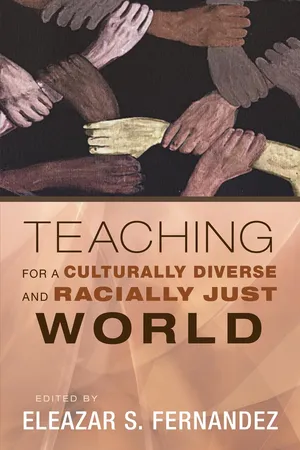
Teaching for a Culturally Diverse and Racially Just World
- 280 pages
- English
- ePUB (mobile friendly)
- Available on iOS & Android
eBook - ePub
Teaching for a Culturally Diverse and Racially Just World
About this book
Cultural and ethnic diversity is the reality of our world, and much more so in this age of heightened globalization. Yet, do our ways of doing theological education match with our current reality and hopes for a colorful and just tomorrow? How shall we do theological formation so it helps give birth to a culturally diverse, racially just, and hospitable world? This edited volume gathers the voices of minoritized scholars and their white allies in the profession in response to the above questions. More particularly, this volume gathers the responses of these scholars to the questions: What is the plight of theological education? Who are the teachers? Who are our students? What shall we teach? How shall we teach? How shall we form and lead theological institutions?
It is the hope of this volume to contribute to the making of theological education that is hospitably just to difference/s and welcoming of our diverse population, which is our only viable future. When we embody this vision in our daily educational practices, particularly in the training of our future religious leaders, we may help usher in a new, colorful, and just world.
Information
Topic
Theology & ReligionSubtopic
Christian Church1
Theological Education of Not Yet
Thesis: A large swath of theological schools in North America has failed to address race as a critical challenge facing theological education. This failure is due primarily to their refusal to acknowledge the deep pain of racism borne by people of color and the consequent lack of institutional commitment to make race one of the major challenges facing theological education and the preparation of leaders in churches.
Introduction: The Establishment of the Theological Bill of Rights
The thesis of this article is clear enough to those of us, teachers and scholars of color, who have languished in North American theological education for the past century: A large swath of theological schools in North America has failed to address race as a critical challenge facing theological education. This failure is due primarily to the deep pain of racism borne by people of color and the consequent lack of institutional commitment to make race one of the major challenges facing theological education and the preparation of leaders in churches. The reason for the failure was stated in the ATS Seminar for Racial/Ethnic Faculty Members at Predominantly White ATS Institutions that was held in October, 2001: “The values that we embrace are not perceived as valuable by tenure evaluators. Our difference is valued as a presence but not affirmed as a professional contribution to theological education.”7 In other words, the effective exclusion of teachers and scholars of color in shaping theological education for the past century is the primary culprit of the failure. This failure mirrors the failure to address the matter of race in a wider North American society. The failure is so fundamental to the nature and definition of theological education that any attempt to reform it cannot accomplish its intended purpose of “the increase among men [sic] of the love of God and neighbor,” as H. Richard Niebuhr stated.8 Furthermore, the words of Benjamin E. Mays about race in the U.S. some time ago capture the fundamental problem of race facing theological education as well:
I would submit that a nation cannot restore what it has not established. The nation exempted blacks and, to a large degree, Native Americans from the dialectics of freedom. It has not succeeded to this day in including them. Whether blacks and other minorities will wait for the “quiet processes” to “confirm the obsolescence of our present commitments” is not yet assured. The multiplied consequences of white racism have created a malignancy that will not wait for such gradual and self-interested therapy.9
The real critical issue facing race in North American theological education then is not a reform, because the foundation on which theological education is built is corrupt. Rather, the primary issue is a new establishment of a fair and equal representation of all voices—racial, gender, sexual orientation—in defining what theological education is. To put this issue in a question form, North American theological educators need to address the questions: “What is ‘academic’ and who defines it?” “Whose knowledge is valued? Can we value communal knowledge alongside the cognitive bodies of knowledge that are in tension?” How do we as an institution of theological education begin to recognize that community and institutional loyalties are in tension?”10 Theological education should have been one of the most fertile areas of North American life where the moral integrity of the society is to be established by embodying freedom and dignity to the captives it held. But North America chose a meaner path where the insistent rhetoric about liberty, freedom, justice, and love rang hollow against the pitiful cries of the men and women whose freedom never reached the agenda of serious deliberation. Just as the civil rights movement and its leaders, such as Martin Luther King, Jr., lent an aura of credibility, however fleeting, to our most cherished presumption that we are a nation under God, Christian faith in the era of religious diversity and theological education where Christian leaders are nurtured and educated is indeed given an opportunity to be a fountain of redemption and reconciliation for all people. As the society anticipates the time in the near future when the current racial ethnic minorities are about to become a numerical majority, Christian communities and their leaders are given an opportunity for a higher way, a way in consonance with our professions of love and kinship in a just and humane society. This is to say that the task facing North American theological education today and in the future is no less than an establishment of the theological Bill of Rights, first within our own institutions that can become a beacon of freedom and equality for the whole society. This theological Bill of Rights serves as the revelatory paradigm of the very faith we affirm as it is incarnated in our societal life. The price for not acknowledging this critical task is very high, running the risk of the irrelevance of theological education and the total erosion of its credibility in our society.
The Historical Landscape of Race in Theological Education
And yet, this task cannot be carried out on a blank slate. The pain and sufferings long endured by the theological educators of color, the lessons learned by us, and the question of inter-racial reconciliation that is the theological expression of truth and reconciliation, constitute the initial step in addressing the establishment of the theological Bill of Rights.
The establishment of the Constitutional Bill of Rights in the U.S. was deeply rooted in the Enlightenment values. No wonder its rhetoric—life, liberty, and the pursuit of happiness—and the racial reality of life in the U.S. history display such a painful gap. The Bill of Rights was crafted by those who were of a single racial group and was then applied to the whole nation. No matter how lofty and noble the Constitutional Bill of Rights sounds, its fundamental flow is the absence of equal representations of all diverse groups of people. North American theological education is no less dependent on this historically shaped set of values. The establishment of the theological Bill of Rights must be rooted in another set of values and a totally new paradigm, that is, the reality of multiplicity and not of singularity. In the place of e pluribus unum, the starting point of the theological Bill of Rights is that reality of life is multiple! Unless this basic life orientation is affirmed, no attempt to reform theological education can be successful. Theological institutions cannot restore what they have not established, to paraphrase Mays.
But the affirmation of this multiple reality has not marked the history of theological education in North America. Daniel Aleshire, the executive director of ATS, acknowledges, “For all practical purposes, ATS schools and the Association were white institutions in the 1960s.”11 ATS began gathering data about racial/ethnic representations among student in its member schools only in 1977.12 The dearth of racial/ethnic representations in both faculty and students meant the dismissal and devaluation of what people of color consider significant literature and resources by the White institution. To add an insult to this pain of injury, people of color repeatedly observed those members of the majority race who were rewarded for research divorced from the crucial issues facing the community.
In the subsequent decades of the 1970s through the present, the paradigm of theological education in North America has been that of inclusion, with the exception of a few institutions that are racially and ethnically formed. The often unstated purpose of theological institutions regarding race has been “to redress the institutional patterns and prejudices that had excluded primarily African Americans from enrollment and employment in many ATS schools,” according to Aleshire.13 Granted, some progress has been made over the last three decades in “redressing” the racial exclusivity of theological education, but the paradigm shift in addressing racial justice and representation has not taken place. The old wineskin continues to remain the pattern and culture of North American theological institutions. ATS is keenly aware of this problem, as Aleshire has stated, “Over the past forty years, the ATS focus has changed from inclusion to institutional capacity.”14 This shift is behind the current ATS project called “Preparing for 2040: Enhancing Capacity to Educate and Minister in a Multiracial World.” The implications of this shift are very significant because the focus of theological institutions on “institutional capacity” points to the paradigmatic shift to the establishment of the racial Bill of Rights, the equal representation of all people, and the affirmation of “life, liberty, and the pursuit of happiness” for all people of faith, and not just for Christians. The question is whether the institutions participating in ATS’s 2040 project as well as other theological schools are indeed aware of this paradigm shift as they struggle toward the future of theological education in North America. “The future of the North American church and theological schools is dependent, in part, on our getting race and ethnicity right,” says Aleshire.15
Race in Theological Education: The Microcosm of the Societal Health of North A...
Table of contents
- Title Page
- Essay Contributors
- Acknowledgments
- Introduction: Birthing Culturally Diverse and Racially Just Educational Institutions
- Chapter 1: Theological Education of Not Yet
- Chapter 2: When Subjects Matter
- Chapter 3: From Foreign Bodies in Teacher Space to Embodied Spirit in Personas Educadas
- Chapter 4: Racial/Ethnic Diversity and Student Formation
- Chapter 5: You Cannot Teach What You Do Not Know
- Chapter 6: What Shall We Teach?
- Chapter 7: Thoughts on Curriculum as Formational Praxis for Faculty, Students, and their Communities
- Chapter 8: Teaching Disruptively
- Chapter 9: A Pedagogy of the Unmasked
- Chapter 10: The Vocational Cycle to Support Institutional Justice
- Chapter 11: Institutional Life and Governance
- Chapter 12: Angle of Vision from a Companion/Ally in Teaching for a Culturally Diverse and Racially Just World
- Chapter 13: Faculty Colleagues as Allies in Resisting Racism
- Bibliography
Trusted by 375,005 students
Access to over 1.5 million titles for a fair monthly price.
Study more efficiently using our study tools.
Frequently asked questions
Yes, you can cancel anytime from the Subscription tab in your account settings on the Perlego website. Your subscription will stay active until the end of your current billing period. Learn how to cancel your subscription
No, books cannot be downloaded as external files, such as PDFs, for use outside of Perlego. However, you can download books within the Perlego app for offline reading on mobile or tablet. Learn how to download books offline
We are an online textbook subscription service, where you can get access to an entire online library for less than the price of a single book per month. With over 1.5 million books across 990+ topics, we’ve got you covered! Learn about our mission
Look out for the read-aloud symbol on your next book to see if you can listen to it. The read-aloud tool reads text aloud for you, highlighting the text as it is being read. You can pause it, speed it up and slow it down. Learn more about Read Aloud
Yes! You can use the Perlego app on both iOS and Android devices to read anytime, anywhere — even offline. Perfect for commutes or when you’re on the go.
Please note we cannot support devices running on iOS 13 and Android 7 or earlier. Learn more about using the app
Please note we cannot support devices running on iOS 13 and Android 7 or earlier. Learn more about using the app
Yes, you can access Teaching for a Culturally Diverse and Racially Just World by Eleazar S. Fernandez, Fernandez in PDF and/or ePUB format, as well as other popular books in Theology & Religion & Christian Church. We have over 1.5 million books available in our catalogue for you to explore.