eBook - ePub
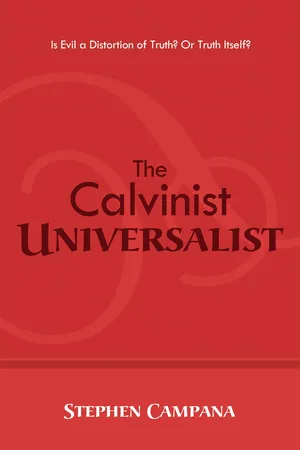
The Calvinist Universalist
Is Evil a Distortion of Truth? Or Truth Itself?
- 198 pages
- English
- ePUB (mobile friendly)
- Available on iOS & Android
eBook - ePub
About this book
-From eternity past God intended that the most vivid and profound demonstration of his glory would come in the form of His work of salvation on the cross of Christ.
-God then made man to punish him.
-He made him perfect and thus unlikely to ever need punishing, or, for that matter, a Savior.
-By a happy coincidence, and against all the odds, this perfect man sinned, thus allowing God to fulfill His purposes for both the man and Christ.
-When he sinned, God, who is suddenly confronted with the prospect of being able to fulfill all of His original plans, becomes furious.
What you have just read is not a joke. I wish that it were. Rather, I have simply enumerated the points that comprise the Calvinist theological system, or, as I call it: the Happy Coincidence model of sin and salvation. It reflects what can only be described as an Alice-in-Wonderland reality, in which the only sense is nonsense, and logic is the enemy. This book will seek to explore some of its many logical inconsistencies and, in the process, propose a perfectly viable--and biblical--alternative.
Information
Topic
Theology & ReligionSubtopic
Christian ChurchPart 1
Is God the Universal Father?
1
A Calvinist’s Journey From Eternal Torment to Annihilationism
I did not gain the impression that the theologians who mounted this evasive defense were being willfully dishonest. I think they were sincere. Nevertheless, I was irresistibly reminded of Peter Medawar’s comment on Father Teihard de Chardin’s The Phenomenon of Man, in the course of what is probably the greatest negative review of all time: “its author can be exused of dishonesty only on the grounds that before deceiving others he has taken great pains to deceive himself.”
—Richard Dawkins
If the name Harold Camping rings a bell, there’s a good reason. He made headlines a while back when he set an exact date for the Rapture. May 21, 2011.1 That was the day that the Rapture would occur. Absolutely guaranteed. Throngs of his loyal followers devoted themselves to spreading the word. You might recall the billboards proclaiming the news.
Not to spoil the ending, but he was wrong. By how much time will tell. But that’s not what’s of interest to me here. What’s interesting to me is the fact that as Camping’s eschatological understanding shifted, so did his understanding of the fate of the wicked. During that time frame he converted from an avid belief in eternal torment to an equally avid belief in Annihilationism. What caused the shift? Simple. He came to understand that the verses depicting the torment of the damned in hell were actually depicting the torment of being left behind during the Rapture. The verses had absolutely nothing to do with God torturing people forever in a place called hell. A good God, he now declared, would never do such a thing.
Now, here’s the interesting part: he did not come to his new position through years of anguished wrestling with the moral implications and logical problems posed by the idea of eternal torment. At least he never said anything to indicate that this was the case. Moreover, anyone familiar with his hermeneutic understood that it did not allow for man to apply his sin-tainted reason and conscience to the scriptures. And by all accounts he retained this hermeneutic during and after his conversion. The fact is that no actual thought went into the conversion at all. He simply came to see that the eternal torment passages could just as easily be describing temporal torment, and on the basis of this discovery, he changed his views. And upon changing his view on what God would do to the unsaved, he also changed his views about what God should do to the unsaved. Suddenly he realized that eternal torment was a doctrine unworthy of a good God. In fact, it made him “cruel.”2
But here’s the point I want to emphasize: What did this change of heart indicate if not that this is precisely what he had believed all along? I’m not talking about the change in his belief as to the fate of the wicked. I’m talking about the change in his beliefs as to the fairness of that fate. Camping used to defend the fairness of hell:
“The answer to the question of man’s accountability to God after the fall is found in the reason for his hopeless condition of slavery to sin and Satan. This frightful condition did not result from a whim or caprice of fate; it did not result from God lashing out in irrational anger for his disobedience. The condition is altogether the result of man’s own actions.”3
But Annihilationist Camping writes: “The traditional view discloses the inherent cruelty and lack of mercy that is part of the nature of unsaved mankind.”4
Upon discovering that God would not subject people to eternal torment, he also discovered that doing so would be wrong, even after spending decades professing that it was right. Again, this could only mean he had never believed it was right in the first place.
God Hides the Truth
The question, then, is this: What was causing him to profess what he knew deep down was wrong all along? Was there a culprit? Indeed there was, according to Camping. It was God Himself. He had written the bible in such a way that we could not come to truth except in these end times. God had linked “time and judgment” (Ecclesiastes 8:5–6) in such a way that we could not understand the latter without an adequate understanding of the former.
“Throughout the church age, God has hidden this time information, and an understanding of God’s judgment plan, from all mankind, including the churches . . . Because the time information is linked tightly to God’s judgment plan, God’s judgment plan was also altogether wrongly understood throughout the 1,955 years of the church age . . .”5
But is that the real reason Camping could not see that eternal torment was both unbiblical and immoral? It seems to me that Camping’s newfound eschatological perspective simply gave him a newfound appreciation of laws that were there all along, with or without a Rapture. He writes:
“The horrible man-made traditional idea of God’s judgment process is a terrible denial of the law of God. The idea was designed with little or no understanding that the entire Bible, which is the Word of God, is therefore, the law of God. Effectively, statements like “the wages of sin is death,” and “in the day that thou eatest therefore thou shalt surely die,” are looked upon as instructions from the mouth of God, rather than the very law of God”.
Here Camping describes the traditional doctrine as a “terrible denial of the law of God,” whereas elsewhere, he states:
Throughout the church age, God has hidden this time information, and an understanding of God’s judgment plan, from all mankind, including the churches . . . Because the time information is tightly linked to God’s judgment plan, God’s judgment plan was also altogether wrongly understood throughout the 1,955 years of the church age . . .
So, which is it? Does the doctrine of eternal torment reflect a denial of God’s laws? Or merely the best understanding God Himself made available? Did God really write the bible in such a way that would make us deny His laws and slander His character? Because of time issues? What if Camping came to the bible insisting on a good God? A loving Father? Is not his failure to do so at least as much to blame for the “terrible” conclusions he reached as the idea that God hid His judgment plan in His “time” plan? To this his own words testify.
The way each person thinks and believes is a product of the ideas he has accepted to be true and trustworthy . . . As additional ideas are presented, they will be filtered and tested in light of the ideas that he has already accepted to be true and trustworthy . . . Once we have learned certain religious ideas, and have accepted them as truth, it seems impossible to accept any ideas that are not in agreement with the ideas that we have already accepted as truth.
Doesn’t Camping read his own words? Clearly the fault was with his hermeneutic, not the timeline factor. And what exactly is his hermeneutic?
The solution to this problem is: we must go to the bible with no prejudices and no presuppositions whatsoever. If we are to find truth, the presuppositions have to be examined and critiqued as vigorously as any doctrine that we claim to have received from the Bible. We must let the Bible alone guide us into truth. We must recognize that we are human beings with feet of clay; we have sin-tainted minds. Our minds are finite and not like the infinite mind of God. We must hold the position, “let God be true, but every man a liar (Romans 3:4).6
But is it really possible to come to the bible with no presuppositions? David Burnfield writes:
Before starting it is helpful to remind ourselves that how one interprets Scripture has very little to do with one’s commitment to the Lord or reverence for His word and everything to do with the theological presuppositions or model one holds to. If one accepts that God will punish people eternally in hell, passages are interpreted one way; if it is believed God will eventually annihilate the wicked, passages are interpreted another way; and if one holds that all will eventually be saved, there is yet a third possibility.
Years before I considered Patristic Universalism, I would think about the difference between exegesis and eisegesis. Exegesis meant you obtained the meaning from the text (a good thing) while eisegesis meant you read the meaning into the text (a bad thing). But for these words (exegesis and eisegesis) to have any meaning, there would have to exist some official, single and authoritative interpretation of each passage of Scripture by...
Table of contents
- Title Page
- Preface
- Part 1: Is God the Universal Father?
- Chapter 1: A Calvinist’s Journey From Eternal Torment to Annihilationism
- Chapter 2: The Hater Creator
- Chapter 3: God’s Hidden Will
- Chapter 4: A Matter of Principle
- Chapter 5: Reality: What a Concept!
- Part 2: Two Gods: Two Sets of Doctrines
- Chapter 6: Adam and Eve
- Chapter 7: Sin: Transfused or Imputed?
- Chapter 8: The Penalty for Sin
- Part 3: God’s Mercy Will Extend to All
- Chapter 9: We Hold These Truths to Be Self Evident
- Chapter 10: The Judgment Verses
- Part 4: Closing Thoughts on Calvinism and Arminianism
- Chapter 11: Calvinist Conundrums
- Chapter 12: Arminianism
- Chapter 13: The Danger of Relying on Mystery
- Bibliography
Trusted by 375,005 students
Access to over 1.5 million titles for a fair monthly price.
Study more efficiently using our study tools.
Frequently asked questions
Yes, you can cancel anytime from the Subscription tab in your account settings on the Perlego website. Your subscription will stay active until the end of your current billing period. Learn how to cancel your subscription
No, books cannot be downloaded as external files, such as PDFs, for use outside of Perlego. However, you can download books within the Perlego app for offline reading on mobile or tablet. Learn how to download books offline
We are an online textbook subscription service, where you can get access to an entire online library for less than the price of a single book per month. With over 1.5 million books across 990+ topics, we’ve got you covered! Learn about our mission
Look out for the read-aloud symbol on your next book to see if you can listen to it. The read-aloud tool reads text aloud for you, highlighting the text as it is being read. You can pause it, speed it up and slow it down. Learn more about Read Aloud
Yes! You can use the Perlego app on both iOS and Android devices to read anytime, anywhere — even offline. Perfect for commutes or when you’re on the go.
Please note we cannot support devices running on iOS 13 and Android 7 or earlier. Learn more about using the app
Please note we cannot support devices running on iOS 13 and Android 7 or earlier. Learn more about using the app
Yes, you can access The Calvinist Universalist by Stephen Campana in PDF and/or ePUB format, as well as other popular books in Theology & Religion & Christian Church. We have over 1.5 million books available in our catalogue for you to explore.