eBook - ePub
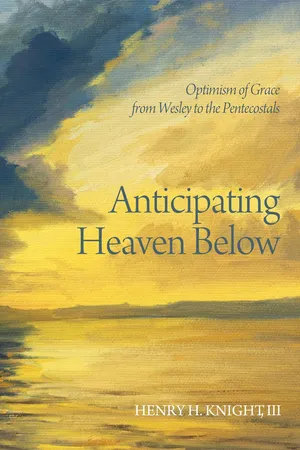
Anticipating Heaven Below
Optimism of Grace from Wesley to the Pentecostals
- 276 pages
- English
- ePUB (mobile friendly)
- Available on iOS & Android
eBook - ePub
About this book
Wesleyanism is a movement of hope. Wesleyans and their Holiness and Pentecostal offspring pray and work with the expectancy that the love and power of God will transform hearts and lives, renew the church, and bring compassion, healing, and justice to a suffering world. In a variety of ways, from holiness of heart and life to bodily healing to the abolition of slavery, they anticipated the life of the coming kingdom of heaven to already be breaking into the present through the power of the Holy Spirit.
Anticipating Heaven Below explores their optimism of grace, examining its pitfalls as well as its promise. Henry H. Knight seeks to enable and inspire present generations within Wesleyan, Holiness, and Pentecostal movements to proclaim with confidence the promise of heaven below, and to do so with passion and integrity.
Information
Topic
Theology & ReligionSubtopic
Christian TheologyPart One
The Beginning of Heaven
Chapter 1
Wesleyan Identity
Love Divine, all loves excelling Joy of heaven, to earth come down . . .
—Charles Wesley1
Traditions are complex. If Alasdair MacIntyre is correct in describing a living tradition as “an historically extended, socially embodied argument” focused on “the goods which constitute that tradition,”2 then a tradition cannot continue to exist without a diversity of voices in conversation. Yet as MacIntyre also shows, traditions have goals and concerns that give them their distinctive shape. Their identity comes from the goal or central good that those in the tradition seek, a communal narrative that both identifies and describes the goal, and a common set of practices that enable persons to cultivate the virtues necessary to attain the goal while avoiding being drawn away by temptations or distraction.
Christianity is itself a complex tradition that exhibits these characteristics. It is shaped by the gospel narrative (here understood as the story of God’s creative and redemptive activity culminating in Jesus Christ and the coming of the Holy Spirit), focused on salvation and mission, and embodied in a wide range of communities and practices that shape the lives of participants. There is over two thousand years of ongoing argument over the nature of God, salvation, church and mission, which at its best has given the tradition theological vibrancy (and at its sometimes violent worst, betrayed in practice the very gospel it professed).
Wesleyanism is a distinctive tradition within Christianity. It has its own way of telling the gospel story, specifying the nature and goal of salvation, and providing communities and practices to aid persons in attaining that goal. But attempting to identify just what it is that makes this tradition “Wesleyan” in its theology and practice has itself produced a vigorous and insightful conversation from the mid-twentieth century to the present.
This book is a contribution to that discussion. My intent is not to challenge the work that has gone before; indeed I will presuppose it and build upon it. What I hope to do is to make explicit a way of thinking—a kind of theological vision—that permeates John Wesley’s theology and is an essential component of its “Wesleyan” identity. Moreover, I want to show that this way of thinking, which I’ve labeled (drawing on Charles Wesley) “anticipating heaven below,” continues to shape the theological vision of early Methodism, the Holiness movement, and the Pentecostal tradition.
As preparation for that argument, let us first identify some of the key insights already advanced concerning Wesleyan identity which are foundational for my own proposal.
A Theology of Love and Grace
Most broad descriptions of John Wesley’s theology quickly center on two terms which are at its core: love and grace. Mildred Bangs Wynkoop emphasized the first. “To be Wesleyan,” she wrote, “is to be committed to a theology of love.”3
The centrality of love in Wesley’s theology can hardly be understated. It governs both the character of God and the content of salvation. While many of Wesley’s Calvinist contemporaries made sovereignty central to the divine nature, Wesley instead insisted that “God is often styled holy, righteous, wise but not holiness, righteousness, or wisdom in the abstract, as He is said to be love: intimating that this is . . . His reigning attribute, the attribute that sheds an amiable glory on all His other perfections.”4 For Charles Wesley, “Love Divine” was a frequent synonym for God in his hymns.
Because humanity was created in the image of this God, and for the Wesleys the goal of salvation is to restore us to the image in which we were created, love is the content and goal of salvation. They emphatically opposed reducing salvation to a kind of simplified version of justification, where the point was to be forgiven through Christ in order to attain a happy afterlife. Salvation “is a present thing”5 John Wesley insisted; justification is the doorway to sanctification wherein the Christian receives and grows in a new life marked by fruit of the Spirit and governed by love.
Sanctification, then, is the goal of salvation, and Christian perfection is the goal of sanctification. Christian perfection (or entire sanctification), said Wesley, “is neither more nor less than pure love—love expelling sin and governing both the heart and life of a child of God.”6
The Wesleys understood salvation to be by grace alone. Hence Thomas A. Langford could argue that “the grace of God, as the redeeming activity of divine love, is the center of Wesley’s theology.”7 Here Langford coordinates the two terms, understanding the graciousness of God as itself an expression of God’s love.
Grace indeed permeates the theology of both Wesleys, and does so in the most thoroughgoing Protestant fashion. Their disagreement with Luther and Calvin was not over the priority and necessity of grace, but over the extent of grace and the manner in which it works.
Randy L. Maddox has described in some detail the nature of grace in John Wesley’s theology. He argues that Wesley has a “practical theology” governed by an “orienting concern” for “responsible grace.” Maddox understands a “practical theology” to be centered on shaping the worldview of Christians in order to further spiritual growth and faithful discipleship. (This is a more precise way of stating what Wesley himself means when he describes his theology as a “practical divinity.”) The “orienting concern” is a central perspective that gives guidance in theologically addressing diverse contexts and changing situations. “Responsible grace,” as the orienting concern, refers to both grace enabling us to respond to God (and without which we could not due to sin) and, having been so enabled, our responsibility to do so.8 (My own language for this is that “grace both enables and invites us to participate in an ongoing personal relationship with God.”9)
What sets Wesley at odds with the great Protestant reformers was his insistence on this relational understanding of grace plus the universality of grace. No one is without a measure of prevenient (or preventing) grace, thus everyone has a divinely-given capacity to respond to God, according to the revelation they have. This universality of...
Table of contents
- Title Page
- Acknowledgments
- Introduction
- Part One: The Beginning of Heaven
- Part Two: Heaven in the Heart
- Part Three: On Earth as It Is in Heaven
- Bibliography
Trusted by 375,005 students
Access to over 1.5 million titles for a fair monthly price.
Study more efficiently using our study tools.
Frequently asked questions
Yes, you can cancel anytime from the Subscription tab in your account settings on the Perlego website. Your subscription will stay active until the end of your current billing period. Learn how to cancel your subscription
No, books cannot be downloaded as external files, such as PDFs, for use outside of Perlego. However, you can download books within the Perlego app for offline reading on mobile or tablet. Learn how to download books offline
Perlego offers two plans: Essential and Complete
- Essential is ideal for learners and professionals who enjoy exploring a wide range of subjects. Access the Essential Library with 800,000+ trusted titles and best-sellers across business, personal growth, and the humanities. Includes unlimited reading time and Standard Read Aloud voice.
- Complete: Perfect for advanced learners and researchers needing full, unrestricted access. Unlock 1.5M+ books across hundreds of subjects, including academic and specialized titles. The Complete Plan also includes advanced features like Premium Read Aloud and Research Assistant.
We are an online textbook subscription service, where you can get access to an entire online library for less than the price of a single book per month. With over 1.5 million books across 990+ topics, we’ve got you covered! Learn about our mission
Look out for the read-aloud symbol on your next book to see if you can listen to it. The read-aloud tool reads text aloud for you, highlighting the text as it is being read. You can pause it, speed it up and slow it down. Learn more about Read Aloud
Yes! You can use the Perlego app on both iOS and Android devices to read anytime, anywhere — even offline. Perfect for commutes or when you’re on the go.
Please note we cannot support devices running on iOS 13 and Android 7 or earlier. Learn more about using the app
Please note we cannot support devices running on iOS 13 and Android 7 or earlier. Learn more about using the app
Yes, you can access Anticipating Heaven Below by Henry H. Knight III in PDF and/or ePUB format, as well as other popular books in Theology & Religion & Christian Theology. We have over 1.5 million books available in our catalogue for you to explore.