eBook - ePub
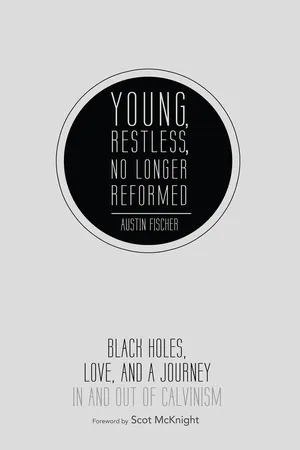
Young, Restless, No Longer Reformed
Black Holes, Love, and a Journey In and Out of Calvinism
- 130 pages
- English
- ePUB (mobile friendly)
- Available on iOS & Android
eBook - ePub
Young, Restless, No Longer Reformed
Black Holes, Love, and a Journey In and Out of Calvinism
About this book
Does it really matter?
Does it matter if we have free will? Does it matter if Calvinism is true? And does what you think about it matter? No and yes.
No, it doesn't matter because God is who he is and does what he does regardless of what we think of him, just as the solar system keeps spinning around the sun even if we're convinced it spins around the earth. Our opinions about God will not change God, but they can change us. And so yes, it does matter because the conversations about free will and Calvinism confront us with perhaps the only question that really matters: who is God?
This is a book about that question--a book about the Bible, black holes, love, sovereignty, hell, Romans 9, Jonathan Edwards, John Piper, C. S. Lewis, Karl Barth, and a little girl in a red coat. You've heard arguments, but here's a story--Austin Fischer's story, and his journey in and out of Calvinism on a trip to the center of the universe.
Information
Topic
Theology & ReligionSubtopic
Social Science Biographies1
A Blind Date with Calvinism
Why No One Starts Out a Calvinist
You have free will and you know it. You can order sweet tea or Coke, you can hit sand wedge or driver, you can open this book or close it. Like I said, you’re free and you know it . . . only you don’t know it.
When it comes down to it, you can never know whether you really have free will (just try to prove it to yourself). Maybe you couldn’t have ordered a Coke, hit the driver, or closed the book. Maybe it’s all determined. Maybe everything—love and hate, birth and death, joys and sorrows, sinners and saints, heaven and hell—unfolds according to some predetermined, eternal blueprint in the mind of God. There’s no way to know for sure.
But we certainly experience ourselves as free if nothing else, which is why no one starts out a Calvinist. It just doesn’t seem to make much sense at first glance, and for many this is enough to dismiss Calvinism and never bother giving it a second look. And yet those with the courage to gaze a bit deeper quickly discover it will not be tossed aside so easily. It has a magnetism, a defiant pull. Its gravity is irresistible.
Young and Restless
I was introduced to Calvinism on a blind date with John Piper—I should probably explain.
I was in high school and had the “more” itch, and if you’re reading this book you probably know the one I’m talking about. I wanted more out of faith, more out of life, more out of God and had the sense God wanted more out of me. I was young and restless, so my youth pastor recommended I read Desiring God, by John Piper, and offered to discuss it with me.
I walked away with more questions than epiphanies, but what I did understand struck a chord: he was scratching the “more” itch. God doesn’t care whether or not I have the American Dream, upward mobility, a cushy vacation home in the Hamptons, or a fat pension to lounge on when I retire. And while we’re at it, God isn’t my personal self-esteem coach whose only goal in life is to put powder on my bottom and tell me how special I am. My comfort and self-esteem are not God’s priorities. God cares about God and wants me to care about God.
All of this is summed up by a short phrase that is the animating impulse of Neo-Calvinism1: It’s all about God’s glory. All as in everything. As the adage goes, “The chief end of God is to glorify God and enjoy displaying and magnifying his glory forever.”2 And if we don’t like it, if we think that sounds egotistical or self-centered, then we would do well to remember that when you’re God, it’s OK for you to be a narcissistic black hole. In fact, it’s not only OK, but it’s good and gracious because what humans need most is more God, not more self-esteem or navel-gazing. Thus, Piper asks the pointed question: “Do you feel most loved by God because he makes much of you, or because he frees you to enjoy making much of him forever?”3 That stings a little, but in a good way, and it gets better.
Piper also teaches “Christian hedonism.” Humans were made for pleasure and what brings us supreme pleasure is the worship and adoration of the one thing in all existence of infinite value: God. In other words, God’s self-exaltation and our joy are not opposing pursuits but dovetail together in perfect symmetry: God is most glorified in us when we are most satisfied in him.4 Living a life for the glory of God is the most joyful, exciting, and compelling thing you can do with the fleeting existence you’re given on earth.
And did I mention that the Bible talks about God’s self-glorification a lot?5
God Dies
So when I reached the end of my blind date with Calvinism, everything I knew had been called into question—my faith, my theology, my way of life. And while I had hated it, I had loved it.
Anyone who has been through theological deconstruction knows the feeling. Your deepest and most cherished (or perhaps most assumed) views of God and self have been poked and prodded and as you desperately seek to plug all the holes there is the nagging sense that maybe this view just needs to die. Maybe this god needs six feet of dirt shoveled over him so that something closer to the real God can come walking out of the tomb.
I knew my god needed to die. I knew I was awash in Christianity that had little to do with Jesus and a lot to do with me—my comfort, my security, my stuff, my appeased conscience, my mansion in heaven. I knew I needed a new God and was confident John Piper was introducing me to him. But I also knew there were a few bullets that needed biting before I could sign off on the dotted line of Calvinism.
Biting Bullets and Counting Sheep
“So you’re telling me . . . ”
If you’ve ever tried to explain Calvinism to someone for the first time, this will be the first phrase out of her mouth. It speaks to the initial shock and skepticism people feel when it is suggested that God is the all-determining reality: that is, that every single thing that happens has been rendered certain (ordained) by God because there is nothing God does not either directly or indirectly cause. It is a bedrock belief of Calvinism, but comes with some obvious baggage.
“So you’re telling me that God has already determined everyone who will be in heaven and hell?” This big, ugly question is what anyone who wrestles with Calvinism must square off with sooner or later, and it was a tough question for me to get a handle on. How was that fair? How was it fair for God to choose to save some and then send everyone else to hell? I should have seen the answer coming: you don’t want fair. Fair would mean we all get what we deserve and what we all deserve is hell. Fair = hell. Well that’s fair enough, I suppose.
But of course the rabbit hole goes a bit deeper than that. Because maybe we don’t want fair so much as we want love. In other words, perhaps our problem with the idea that God has unconditionally predetermined who to save and who to condemn is that it doesn’t seem loving, and the Bible certainly tells us God is loving.6 Furthermore, if God has determined everything, hasn’t God also determined the sins that he is going to send people to hell forever for? Hasn’t God made sure that people will commit the sins he will then judge them for? If so, how is that just? And then there’s the question that pulls together these issues of love and justice: how is God good? If—before the creation of a single human being—God chose to send people to hell for sins he ordained they would commit, how is he good? If that question doesn’t make you count out a crowded flock of sheep on a sleepless night, I’m not sure what will.
Mystery and Transcendence
In searching for answers, I became acquainted with two terms that became a staple of my theological thought and vocabulary: mystery and transcendence. You know the verse: “‘For My thoughts are not your thoughts, nor are your ways My ways,’ declares the Lord. ‘For as the heavens are higher than the earth, so are My ways higher than your ways and My thoughts than your thoughts.’”7
The problem with theology is that it’s humans doing it. Finite, fragile, fallen creatures are trying to make sense of their Creator. Mistakes and hilarity are bound to ensue. As Frederick Buechner says, “Theology is the study of God and his ways. For all we know, dung beetles may study us and our ways and call it humanology. If so, we would probably be more touched and amused than irritated. One hopes that God feels likewise.”8
All of this to say, God is above and beyond us. In theological terms, God is transcendent. God is not just Superman minus the cape and red underwear—a being like us only way stronger and nicer. No, God exists on a completely different plane, shrouded in the veil of divine mystery. God is not like us. And this means that we cannot simply project onto God all the virtues we find desirable as humans. We cannot assume that God’s love, justice, and goodness match up perfectly with our notions of love, justice, and goodness. To do so is to make a “category mistake,” to treat God like a super-creature instead of the Creator. We might find it difficult to understand how it’s just for God to send people to hell for sins he ordained they commit, but who are we to question God’s justice? Who are we to put God in a box, telling him what he can and cannot do, who he can and cannot be? Or as Paul says, “Who are you, O man, to answer back to God?”9
Bottom
When you come to bottom of the rabbit hole, this is the mystery waiting for you. How is God loving, just, or good when he sends people to hell for sins he ordained they commit? While there are countless attempts to explain this dilemma, the most responsible answers eventually capitulate to the mystery. We cannot know exactly how God is loving, just, or good in light of his electing some and not electing others. But we can know that God is completely sovereign over his creation, is the all-determining reality, holds us accountable for our sins, and does everything for his own glory.10
And this is what it all comes down to: are you willing to live with this mystery?
Will you accept the idea that you and I and everyone who has ever lived will be sent to eternal bliss or damnation based on an inscrutable, unconditional decision of God? Will you affirm that God will send people to hell for sins he made certain they would commit? Will you worship a God who might have created you in order to damn you?
Like many others who have traveled this road, I struggled and complained and went kicking and screaming, but eventually I bit the bullet and did so for the same reason that most every thoughtful Calvinist I know has: I didn’t feel as though the Bible left me any option.
The Bible Tells Me So
As a Christian—and a Protestant evangelical at that—I care about the Bible. If the Bible teaches it, I want to believe it because I believe God speaks through scripture. And while the “battle for the Bible” is a complex and nuanced issue with those on the left accusing those on the right of bibliolatry (treating the Bible as a fourth member of the Trinity) and those on the right accusing those on the left of undermining biblical authority, I would think we could agree that if the Bible teaches it, we should ...
Table of contents
- Title Page
- Foreword
- Acknowledgements
- Introduction
- Chapter 1: A Blind Date with Calvinism
- Chapter 2: Roots of Certainty, Seeds of Doubt
- Chapter 3: One Hell of a Problem (The Girl in the Red Jacket)
- Chapter 4: God Made Impossible
- Chapter 5: The Crucified God
- Chapter 6: The Glory of God (Is) the Glory of Love
- Chapter 7: Free Will, Kenosis, and a Peculiar Kind of Sovereignty
- Chapter 8: Monsters in the Basement
- Chapter 9: Walking With a Limp
- Chapter 10: Young, Restless, and . . .
- Chapter 11: Taming the Tiger (A.K.A. Romans 9)
- Epilogue
- Endnotes
Trusted by 375,005 students
Access to over 1.5 million titles for a fair monthly price.
Study more efficiently using our study tools.
Frequently asked questions
Yes, you can cancel anytime from the Subscription tab in your account settings on the Perlego website. Your subscription will stay active until the end of your current billing period. Learn how to cancel your subscription
No, books cannot be downloaded as external files, such as PDFs, for use outside of Perlego. However, you can download books within the Perlego app for offline reading on mobile or tablet. Learn how to download books offline
We are an online textbook subscription service, where you can get access to an entire online library for less than the price of a single book per month. With over 1.5 million books across 990+ topics, we’ve got you covered! Learn about our mission
Look out for the read-aloud symbol on your next book to see if you can listen to it. The read-aloud tool reads text aloud for you, highlighting the text as it is being read. You can pause it, speed it up and slow it down. Learn more about Read Aloud
Yes! You can use the Perlego app on both iOS and Android devices to read anytime, anywhere — even offline. Perfect for commutes or when you’re on the go.
Please note we cannot support devices running on iOS 13 and Android 7 or earlier. Learn more about using the app
Please note we cannot support devices running on iOS 13 and Android 7 or earlier. Learn more about using the app
Yes, you can access Young, Restless, No Longer Reformed by Austin Fischer in PDF and/or ePUB format, as well as other popular books in Theology & Religion & Social Science Biographies. We have over 1.5 million books available in our catalogue for you to explore.