- 228 pages
- English
- ePUB (mobile friendly)
- Available on iOS & Android
eBook - ePub
About this book
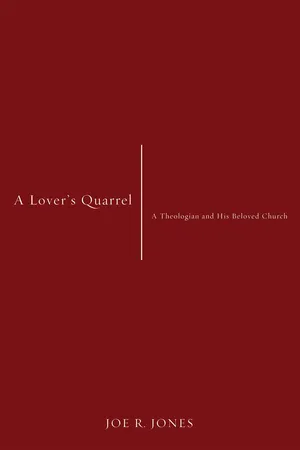
Joe Jones, a retired and well-known systematic theologian, confesses he has a lover's quarrel with the church. In wide-ranging writings mostly dating since 2006, he forthrightly argues for a theologically sound understanding of the church. And he pursues a multi-faceted critique of the feckless ways in which actual churches--ministers and laity--balk and betray their rightful calling to witness in word and deed to God. He is especially critical of the practical ways in which congregations become no more than mirror images of their sociopolitical milieu, whether to the right or to the left. Hence the quarrel, trenchantly pursued in major essays, blogs, and spiritual reflections on his own past. But it remains crystal clear to Jones in his learned and profound confession that it is his beloved church with which he quarrels and about which he still has extravagant hopes. A Lover's Quarrel is a book appropriate for ministers and laity, students and professors, and learned skeptics.
Information
Part One
Ecumenical Theologizing with Ecclesial Friends
1
The Shape and Contours of the Christian Life
A version of this essay first appeared as six articles written for the The Indiana Christian in 1997–98. This sort of careful thinking through how we talk about the Christian life I also refer to as examining the grammar of Christian discourses. The proposal herein is to explore the shape of the Christian life as Life in the Church, Life in the Spirit, Life in Faith, Life in the Works and Passions of Love, and Life in Hope.
Life In The Church
It is not uncommon that we so accentuate our American individualism that we fall into the trap of thinking the Christian life is simply an individual endeavor and can be quite easily pursued in utter independence of the life of the church. But this is not the way the New Testament talks about the faithful life: faith requires the support of the community of the faithful, rather than the lonely and isolated journey of the singular individual. We need other persons to teach us, to mentor us, to worship with us, to pray with us, to converse with us, to practice with us, to love with us, if we are to grow in faithfulness.
While the church is always at least a group of folk who have some institutional relations, the church is primarily a community of persons called into life by the Gospel of Jesus Christ. The New Testament refers to this community as a koinonia of persons in liberative and redemptive fellowship with each other and with God. We need to keep our focus on the church as a distinctive sort of community with a distinctive way of life and mission in the world.
In contemporary Christian theological reflection we are developing a new way of describing the nature and mission of the church. The emphasis is on the church as a community constituted by its distinctive discourses and practices. Under the word “discourses” we include the wide array of linguistic expressions of the faith in the life of the church: we pray, we sing, we read scripture, we preach and hear sermons and lessons, we confess our sins, and much more. It is in these discourses, when they are functioning well and truthfully, that we identify who God is, characterize the human situation before God, and characterize the way Christians are called to live in the world. Persons come to faith by encountering these discourses, and it is in the use of these Christian concepts, images, and stories that faith comes to have content and character. And when these discourses, in given communities of the church, are in disarray or confusion or said emptily, then it becomes difficult for the Christian life to take decisive shape in the hearts of the people.
Under the word “practices” we are simply pointing out that the discourses, as actions of speaking, are themselves practices of faith, and that such speaking shapes the practices of worshiping and living that are essential to Christian life. We learn in the church how to speak the language of faith, how to practice faithful speech, and how to put faithful speech into action in our relations with others, with God, and with the world. The Christian life is something definite and authentic only in its concrete practices.
Hence, Christian living requires that the individual be in the community of faithful discourses and practices that aim at forming her life in relation to herself, in relation to others in the church and in the world, and in relation to God. None of us can teach that to ourselves by ourselves: we require the church as the community of distinctive discourses and practices in which we can learn how to be faithful.
It is in the church that we learn how to be grateful for God’s grace in Jesus Christ, learn the depth and content of that grace, learn how to become lovers of Christ who are empowered to love the world in a new way, and learn how to become witnesses to the triune God for the benefit of the world. Persons do not become Christians by accident of birth or ethnicity or nationality.
They become Christians through their own authentic appropriation of the discourses and practices of the church of Jesus Christ.
Life In The Spirit
Consider the Christian life as life in the Spirit. It is everywhere evident in the New Testament that the disciples of Jesus Christ—those who say “yes” to his life, death, and resurrection as God’s gracious good news of new life—are empowered to say “yes” by the Holy Spirit. Indeed we can say that it is the Holy Spirit that is the foundational dynamism of the Christian life.
The Holy Spirit is variously named “the Spirit of your Father” (Matt 10:20), “the Spirit of his Son” (Gal 4:6), “the Spirit of Jesus” (Acts 16:7), “the Spirit of Christ” (Rom 8:9; Phil 1:19; 1 Pet 1:11), “the Spirit of life” (Rom 8:2), “the Spirit of grace” (Heb 10:29), and “Spirit of truth” (John 14:17) and many times simply the “Holy Spirit.” To live in Christ is to live in and by the Spirit of Christ, which is none other than the Spirit of the Father who is the God of Israel and the Creator of all things.
It is the Spirit that comes upon, descends upon, is poured out on persons and the church; that speaks to and through persons, teaches and reveals to persons in witness to Christ and the Father; that dwells within persons; that sanctifies persons; that intercedes in prayer; that gives wondrous gifts. Among these gifts of the Spirit are new life (John 6:63; Rom 7:6; 8:11; 1 Cor 3:6), freedom from sin (Rom 8:2; 2 Cor 3:17), living, speaking, and doing the truth (John 4:24; 14:17), the creating, building up and giving unity to the church (Acts 2; 1 Cor 12:1–13; 14:12; 2 Cor 13:13; Eph 4:3–4; 1 Pet 3:8), and the bestowing of the wonderful fruit of Christian living (Gal 5:22: “love, joy, peace, patience, kindness, generosity, faithfulness”).
There is no aspect of the life of the individual Christian and the church that does not seem to be empowered and shaped by the Holy Spirit. Hence, we can say that the Spirit is that power graciously given to persons that works within their lives to shape and form them in conformity to God’s triune life as the One who creates and governs all things, as the One who became incarnate in Jesus of Nazareth, and as the One who moves within creatures to bring new life.
It is because we say these words so meaningfully and responsibly that the church has from its foundations been set on a trinitarian trajectory. We acknowledge the Spirit as the Spirit of the Creator and the Reconciler when we confess God’s trinitarian life with us and for us. This confession also reminds us that the Holy Spirit is never the possession of individual persons or the church but is the One who freely and lovingly possesses persons and the church.
Hence, there is never any opposition between life in the Spirit and life in Christ. Life in the Spirit is tested by its having the “mind of Christ” (1 Cor 2:14–16). To live in Christ and become his disciple in witness to God’s love for the world is precisely to live in and by the Spirit.
Persons who live in the Spirit pray for God’s continuing guidance and are bold to believe that the Spirit will be their counselor through the trials and joys of life. But living in the Spirit is living in the community of church where the discourses about and in the Spirit are uttered and learned and where the practices of worship, of education, of love, and of outreach to the world are cultivated regularly. The Spirit promises to empower and to dwell within those discourses and practices when they are faithfully performed and lived. Come Holy Spirit, come!
Life In Faith
The Christian life can also be understood as life-in-faith. We should not expect to arrive a simple definition of the term faith. In the New Testament the term pistis and its derivatives are variously translated “faith,” “belief,” “believing,” and “having faith.” To capture these biblical senses, some theologians have invented the word “faithing,” comparable to “believing.” But we can save ourselves some confusions about meanings if we admit up front that “faith” [and pistis] is a term that has a family of uses that are interconnected but not reducible to a simple definition. In general we can say that “faith” can refer both to the whole of the Christian life and to some particular aspects of that life.
First, let us consider “faith” as used to refer to the whole of the Christian life as an orientation to God: the life of saying “yes” to what God has done in Jesus Christ for the salvation of the world. In this sense, faith is a whole way of life or form of life that is given its shape by God’s self-revealing life. It is the orientation of the whole person’s heart, mind, and will on God’s saving life.
As such, faith involves distinctive beliefs, actions, and passions. Faith is the comprehensive how of the person’s life: how one lives before God’s abundant grace and under the summons of God’s command to witness and to love. In this connection, faith is a matter of being faithful to God and to the life God has summoned us to live.
Second, faith, both as the basic orientation of the Christian and as particular aspects of that orientation, is always to be thought of as a gift of the Holy Spirit (1 Cor 12:9; Eph 2:8). God’s gift evokes gratitude to God and worshipful praise for God’s loving grace in Jesus Christ. Therefore, faith is never to be thought of as a human achievement about which boasting might be appropriate. With this combination of thankfulness and worship, we can say that faith is doxological gratitude to God.
Third, faith obviously involves some aspects of what we ordinarily call belief. Faith involves believing something about God, believing that God is characterized in some definite ways. In particular it focuses on God’s being characterized by the life of Jesus Christ. So, faith is always at least belief that God is characterized as the Almighty Creator of all things, as the Reconciling Lover in Jesus Christ, and as the Redeeming Spirit. Indeed there are many distinctive Christian beliefs about God, about humanity, and about the world.
But, fourth, faith is not belief in any easy or superficial sense. This is clear when we consider that it is impossible to have Christian faith, in the sense of believing a statement about God to be true, in any neutral or merely detached fashion. When we believe that God is the One we know in Jesus Christ, we are also having faith in God. We are trusting in God; we are staking our life on God. This personal trust in God keeps faith from ever being understood as mere belief that some statement is true of God.
Thus, we can see how faith as belief that and faith as trust in are mutually interrelated and never to be separated or opposed. We cannot...
Table of contents
- Title Page
- Part One: Ecumenical Theologizing with Ecclesial Friends
- Part Two: On Being Mugged by Politics but Lifted by Gospel Hope
- Part Three: Fragments from Times Past and Emerging Hopes
- Part Four: Sermons Ventured on Behalf of the Witness of the Beloved Church
Trusted by 375,005 students
Access to over 1.5 million titles for a fair monthly price.
Study more efficiently using our study tools.
Frequently asked questions
Yes, you can cancel anytime from the Subscription tab in your account settings on the Perlego website. Your subscription will stay active until the end of your current billing period. Learn how to cancel your subscription
No, books cannot be downloaded as external files, such as PDFs, for use outside of Perlego. However, you can download books within the Perlego app for offline reading on mobile or tablet. Learn how to download books offline
Perlego offers two plans: Essential and Complete
- Essential is ideal for learners and professionals who enjoy exploring a wide range of subjects. Access the Essential Library with 800,000+ trusted titles and best-sellers across business, personal growth, and the humanities. Includes unlimited reading time and Standard Read Aloud voice.
- Complete: Perfect for advanced learners and researchers needing full, unrestricted access. Unlock 1.5M+ books across hundreds of subjects, including academic and specialized titles. The Complete Plan also includes advanced features like Premium Read Aloud and Research Assistant.
We are an online textbook subscription service, where you can get access to an entire online library for less than the price of a single book per month. With over 1.5 million books across 990+ topics, we’ve got you covered! Learn about our mission
Look out for the read-aloud symbol on your next book to see if you can listen to it. The read-aloud tool reads text aloud for you, highlighting the text as it is being read. You can pause it, speed it up and slow it down. Learn more about Read Aloud
Yes! You can use the Perlego app on both iOS and Android devices to read anytime, anywhere — even offline. Perfect for commutes or when you’re on the go.
Please note we cannot support devices running on iOS 13 and Android 7 or earlier. Learn more about using the app
Please note we cannot support devices running on iOS 13 and Android 7 or earlier. Learn more about using the app
Yes, you can access A Lover’s Quarrel by Joe R. Jones in PDF and/or ePUB format, as well as other popular books in Social Sciences & Social Science Biographies. We have over 1.5 million books available in our catalogue for you to explore.