- 248 pages
- English
- ePUB (mobile friendly)
- Available on iOS & Android
eBook - ePub
About this book
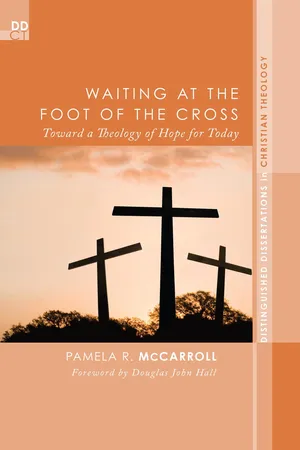
How do we hope in the face of modernity's failure and postmodernity's absence of foundations? How do we hope when the future seems fearful and no clear way forward appears? How do we hope when despair, indifference, and cynicism dominate the psychic landscape of English-speaking North America? In dialogue with theologians of the cross George Grant and Douglas John Hall, this book unmasks the failure of hope in our time and the vacuum of meaning that remains. As an exercise in the theology of the cross, Waiting at the Foot of the Cross explores the North American context as one in which true hope is discovered only when life's negations are engaged from a posture of waiting trust. Such hope is not passive or blind. Rather, it is attentive, active, open, and spiritually grounded in the One who meets us when all hope is spent. The final chapter proposes a way toward hope for today that inspires subversive resilience in the face of the ambiguities and vicissitudes of life. Readers interested in the theology of the cross, in thinking theologically in our time and place, and those interested in the character of Christian hope will find this book compelling.
Information
Topic
Teologia e religioneSubtopic
Chiesa cristiana1
Hope at the End of Hope?
The Crisis of Hope, North American Style
North America faces many crises. We need only turn on the daily news to glimpse the layers of global crisis in which our continent is embedded. There is no way to enumerate these crises exhaustively for they pile upon each other and our very existing with a weight that smothers. What is central, however, is that the extremity of contemporary crises has brought us to a place that is truly novel in the history of humanity, and indeed, in the history of the planet. Never before has the destruction of much of creation been as possible as it is now, with our high-tech weapons of mass destruction, with our dependence upon ecologically devastating practices, and with the global-scale systemic injustice of which we are all a part.
Unlike any previous generation, the generations of English-speaking North Americans raised in the sixties and after have never known a time when nuclear annihilation was not a possibility on any given day.1 Nor have they known a time when the effects of ecological devastation were not experienced, with disease in the very air they breathe, food they eat, and water they drink. These generations have never known a time when the staggering effects of systemic injustice—of starvation, genocide, poverty, disease, torture, and refugee camps—were not a part of their daily consciousness. They have been raised with a shadowy awareness of the malevolence of which humanity is capable (particularly the white middle class educated parts of humanity), for which the poignant names of Auschwitz and Dachau, Hiroshima and Nagasaki are but shorthand. Perceptions of humanity’s inhumanity have only been reinforced in these generations by the wars in Vietnam and Iraq and by the clandestine participation of the American Empire in the torture chambers and army camps of Central and South America, Africa, Asia, and the Middle East. Indeed, as never before in the history of the planet, these generations have been raised on daily injections of the destructive end to which human beings seem bound as we brazenly leap toward the nihil through the threat of nuclear annihilation, ecological devastation, and global-scale systemic injustice. More than anything else, what sets these generations apart from previous generations is that they have no memory of life before the possibility of massive scale destruction at any moment, on any day.
Even worse, as these generations have become increasingly conscious of the massive layers of global crisis, they have also recognized the extent to which they are on the one hand implicated in the mechanisms of global crisis and on the other powerless to do anything meaningful about it. Even the many who opt to repress, escape, or plead indifference to the realities of contemporary life cannot escape the sense of dread about the reality of things as they are in the world.2 There is an overwhelming sense of powerlessness in the face of the massive scale of the global crises.3 Sadly, the once-effective rallying cries to “change the world” ring hollow; they no longer inspire action. The scale of the crises and sense of powerlessness in the public realm are some of the dynamics that have pressed in upon the horizon of meaning for these generations.
These are generations that have been raised in the dominant North American way, wherein meaning and purpose are derived from one’s ability to make a difference in the world, to change the world, to make one’s mark on the world. In this context, to be confronted with one’s own powerlessness to make a difference in the world for good is to be confronted with meaninglessness. Given recent protest movements regarding economics and democracy,4 it remains to be seen how these actions will have an impact. While these protests stand as signs of hope, meaning, and investment in public life, the general trend over the last several decades has been a withdrawal from participation and lack of investment in public life. Paradoxically, over recent decades we have seen that meaninglessness has itself become a horizon of meaning.
In the public realms of civic and church life in North America, this nihilistic horizon of meaning has manifested itself in a cynicism toward both church and polis, as well as to the very idea that human institutions might serve the good. These generations have been raised within a “once-mainline church” that seems (at best) inconsequential to life or (at worst) malignant toward life.5 Is it a surprise that they rarely darken the entrance to any sanctuary? In the civic realm, too, they are increasingly opting out of the electoral process.6 They are beginning to die of inactivity7 as they sit in their cars and bow interminably before the thrones of their computer and TV screens—their self-enclosed lenses into the world.
Indeed, this all sounds rather dire and to some this appeal to experience will sound lopsided. However, what I am seeking to get at is the fact that over the last fifty years massive shifts have taken place in the public realms of civic and church life of North America, and these shifts reflect a deeper spiritual crisis of meaning and purpose—a crisis about what it means to be human. In public and religious life, the pervasive cynicism and despair over human purpose and meaning are manifested as a crisis of hope. The institutions of civil society and the church no longer earn our loyalty, nor can they any longer carry the burden of our hope.
The experience of despair that now marks North American life is manifest variously in cynicism, hopelessness, and indifference. Etymologically, despair (Latin desperare, from de- + sperare, “to hope”) means “without hope”: “No way out into the future appears.”8 It is expressed in a retreat from the public into the private sphere that involves a numbness to and disengagement from organized institutional public life. Given the particular quality of North American history and culture, despair as a pervasive experience in the North American context is truly novel.9
Like no other place on earth, North America came into being as the embodiment of the modern liberal dream. The public life of North America was built with the very materials of modernity—with foundations of freedom, walls of progressivism, and windows of optimism. In this modern experiment, the human was imaged as one who in freedom creates her own reality and who works with purpose to bring forth a better future based on freedom, equality, and justice for all. It is precisely this modern liberal image of the human as free and self-creating potentiality, innately directed toward the good, that, except in superficial terms, has been darkened in our current context. Its meaning and truth have been distorted beyond recognition. Where we once placed our hope in the potential of human will, reason, imagination, and ability as that which would actualize a future society with justice and freedom for all, now we are cynical about the potentialities of the human. Our North American understanding of hope as a collective vision for the future towards which we must move has become increasingly emptied as daily crises fragment our imaginations with uncertainty and fear. We have glimpsed the heart of the liberal modern dream and have found illusion. Images of future potentiality that used to kindle our hope and draw us together in worship and action now only rarely call us beyond the walls of our private lives. The collective horizon of meaning for the North American church and civic life, based as it was in modern liberalism, is fragmenting, and there seems to be nothing to replace it but the relentlessness of its negation, the nihil. It is no wonder that hopelessness abounds.
We live in or on the periphery of what continues to be the most powerful Empire in history. Cynicism and indifference in the public realm are frightful at the best of times. However, to find such a numbing dynamic in the very heart of the American Empire is frightful beyond measure. Indeed, the power of the Empire in the world is increasingly detached from any sense of accountability beyond its own fearful self-protection. Furthermore, since the destruction of the Twin Towers, the American Empire has been thrust deeper into its reactive fear.10 While the Empire has fearfully attacked the enemy “out there” who lurks everywhere, we who live within and on its fringes increasingly express our hopelessness and fear by retreating away from the public realm into the safety of our own self-made security, which now is even less secure than it used to be.
Hopelessness abounds and so it must, for in the public realms of church and state, it is a fearful and overwhelming time. To pretend that it is otherwise is to live in denial or to lie: it is to call “evil good and good evil.”11 However, the fact that we experience the hopelessness of life today in North America paradoxically reflects the possibility for authentic hope. Our hopelessness reflects the cracking of the foundations of the modern project as it has been gloriously manifested in North America. Our despair in the modern liberal image of the human and our cynicism toward civic and church life based on such an image marks the destruction of a false reality. This is a good thing. Such destruction of falsity contains within it a possibility—a possibility that might just open our hearts and minds to see anew the truth of things. Today only a hope that emerges from the midst of the hopelessness of the North American dream and dares to face our contemporary meaninglessness and fear head-on, only this kind of hope holds within it the possibility for a renewal of spirit and thought about our life together as church, continent, and globe.
A Theological Response to the Crisis of Hope
The extremity of the global and spiritual crises of these times demands response, evokes contemplation, and calls for a re-thinking of who we are, where we have come from, and where we are going. This is the most urgent task for theology in North America for the living of these days. By contemplating the character of authentic Christian hope through the work of George Grant and Douglas John Hall, this book engages the crises of these times through the most compelling and challenging of all traditions in Christianity—theologia crucis, the theology of the cross. The theology of the cross, over and against the theology of glory, provides both Grant and Hall with a Christian foundation for recognizing the particularities of our context, for naming the temptations toward which we are drawn, and for beginning to point to the character of authentic hope. This book examines Grant’s and Hall’s distinctive and complementary understanding of the theology of glory and the theology of the cross in the traditions of Athens (Grant) and Jerusalem (Hall), which enables each of them to engage the North American context critically. It shows how both the methods and content of their work embody a posture of hope as waiting at the foot of the cross. These theologians of the cross12 have faced, known, and named the origins and manifestations of North American hopelessness with depth and insight through incisive analyses of this context. As we shall see, their work, when considered together, provides a solid basis for further development of a theology of hope in the North American context. Finally, through contextual theological reflection on hope as “waiting at the foot of the cross,” this project builds constructively upon their work so as to further outline a theology of hope for our time and place.
Why a Theology of the Cross?
I concur with many others13 that the theology of the cross, rooted in the writings of the apostle Paul and most elementally expressed in Martin Luther’s Heidelberg Disputation,14 is one of the most prophetic and provocative critiques of power throughout the Christian tradition. We Christians who live within and on the fringe of the most powerful Empire ever to have existed in history are challenged to wrestle with the ethos of power of which we are a part and with the way in which this ethos impacts our spirits and our experience of hope. We cannot rest easily and uncritically in our context. The theology of the cross enables a Christian critique of power as it has been manifested in North American public religious and civic life through an incisive undercutting of the image of the human as master that lies at the root of the modern experiment. This theology continually st...
Table of contents
- Waiting at the Foot of the Cross
- Chapter 1: Hope at the End of Hope?
- Part 1: The Method of the Cross as Waiting
- Part 2: Deconstructing Modern Mastery
- Part 3: Waiting at the Foot of the Cross
Trusted by 375,005 students
Access to over 1.5 million titles for a fair monthly price.
Study more efficiently using our study tools.
Frequently asked questions
Yes, you can cancel anytime from the Subscription tab in your account settings on the Perlego website. Your subscription will stay active until the end of your current billing period. Learn how to cancel your subscription
No, books cannot be downloaded as external files, such as PDFs, for use outside of Perlego. However, you can download books within the Perlego app for offline reading on mobile or tablet. Learn how to download books offline
We are an online textbook subscription service, where you can get access to an entire online library for less than the price of a single book per month. With over 1.5 million books across 990+ topics, we’ve got you covered! Learn about our mission
Look out for the read-aloud symbol on your next book to see if you can listen to it. The read-aloud tool reads text aloud for you, highlighting the text as it is being read. You can pause it, speed it up and slow it down. Learn more about Read Aloud
Yes! You can use the Perlego app on both iOS and Android devices to read anytime, anywhere — even offline. Perfect for commutes or when you’re on the go.
Please note we cannot support devices running on iOS 13 and Android 7 or earlier. Learn more about using the app
Please note we cannot support devices running on iOS 13 and Android 7 or earlier. Learn more about using the app
Yes, you can access Waiting at the Foot of the Cross by Pamela R. McCarroll in PDF and/or ePUB format, as well as other popular books in Teologia e religione & Chiesa cristiana. We have over 1.5 million books available in our catalogue for you to explore.