- 146 pages
- English
- ePUB (mobile friendly)
- Available on iOS & Android
eBook - ePub
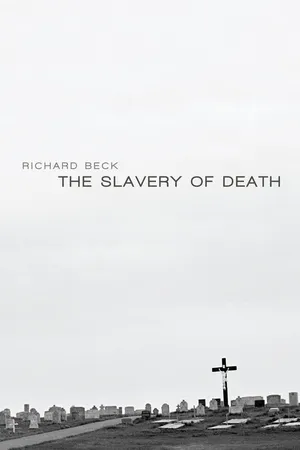
The Slavery of Death
About this book
According to Hebrews, the Son of God appeared to "break the power of him who holds the power of death--that is, the devil--and free those who all their lives were held in slavery by their fear of death." What does it mean to be enslaved, all our lives, to the fear of death? And why is this fear described as "the power of the devil"? And most importantly, how are we--as individuals and as faith communities--to be set free from this slavery to death?
In another creative interdisciplinary fusion, Richard Beck blends Eastern Orthodox perspectives, biblical text, existential psychology, and contemporary theology to describe our slavery to the fear of death, a slavery rooted in the basic anxieties of self-preservation and the neurotic anxieties at the root of our self-esteem. Driven by anxiety--enslaved to the fear of death--we are revealed to be morally and spiritually vulnerable as "the sting of death is sin." Beck argues that in the face of this predicament, resurrection is experienced as liberation from the slavery of death in the martyrological, eccentric, cruciform, and communal capacity to overcome fear in living fully and sacrificially for others.
Information
Topic
Theology & ReligionSubtopic
Christian TheologyPart 1
“The Last Enemy”
Chapter 1
Ancestral Sin
1.
The central contention of this book is that death, not sin, is the primary predicament of the human condition. Death is the cause of sin. More properly, the fear of death produces most of the sin in our lives.
The most obvious objection to this line of argument is an appeal to the sequence recounted in Genesis 3, a sequence Paul later echoes in Romans 5:12. As the Genesis text describes, Adam and Eve’s original disobedience effected a separation from the Tree of Life, and that first sin is what introduced both death and mortality into the world. Clearly, then, sin brings about death and not the other way around. And doesn’t Paul affirm that “the wages of sin is death”?
No doubt that in the Genesis story a primal disobedience precedes the introduction of death into the world. In that account, sin comes first and results in death—this much seems clear. But the issue we must consider as we go forward is this: how much of our current situation can be modeled on the story of the primal sin? To cut to the chase, we’re not in Eden anymore. Unlike Adam and Eve, we are born into a mortal state, subject to death from the moment of conception. Before our moral lives begin—before we sin—we are born into a death-saturated existence. Unlike Adam and Eve, death predates us. We live in a very different sort of world than the one described in Genesis 1–2.
In short, the issue going forward, from a biblical perspective, is less about what happened at the start of the story than about the world created by that story. In Genesis sin might have predated death for Adam and Eve. But in our experience death predates our sin or, at the very least, any moral choices we make. And if death predates our sin, might death be implicated in causing our sin? Might sin be the sting—the poisonous outcome—of death?
2.
We might, then, want to pause and reconsider what exactly we inherited from Adam and Eve in the Genesis story and how that inheritance affects us—morally, spiritually, psychologically, socially, physically, and ecologically. Our particular focus will be on how this inheritance helps us understand the relationship between sin and death.
In Western Christianity this inheritance has generally been understood to be what is called “original sin.” Adam and Eve passed on moral brokenness and incapacity, and thus humanity, in this view, is intrinsically sinful. Those who hold to this belief view sin as a congenital moral and spiritual defect that is passed down to us from Adam and Eve, affecting and infecting every living person.1 In many ways the doctrine of original sin preserves and recapitulates the primal ordering of sin and death in the biography of every person. Since each of us is “born in sin,” sin remains the primary predicament, the prime mover and original cause, just as it was with Adam and Eve. And just like Adam and Eve this sinful nature leads us to sin, which then introduces death—both spiritual and physical—into each of our personal biographies. We retrace the story of Genesis 3—sin is our central problem, the causal agent that brings death into our worlds.
3.
The doctrine of original sin is well known, but that’s not to say that it is uncontested in Western Christianity. Still, for our purposes even those whose traditions reject the doctrine retain the basic sin/death sequence. That is, they believe that even if infants are born innocent they will eventually reach an “age of accountability” and experience the inevitable first sin and fall from grace, which produces spiritual and physical death. Sin might not be intrinsic but it’s inevitable. And death always follows as the consequence.
Yet, despite its ubiquity in the West, we need not take original sin as the authoritative view on what exactly we have inherited from Adam and Eve. Specifically, the Eastern Orthodox tradition does not endorse the Western notion of original sin, but rather espouses a view called ancestral sin. Where original sin sees sin as producing death, ancestral sin tends to flip this sequence and place most of the emphasis upon the power of death.
4.
Why is there death if a perfect and loving God created the world? According to the Orthodox, the real issue at the heart of Genesis 3—the biblical story of “the Fall”—is not focused on establishing a causal model regarding the sin/death relationship and how we inherit a moral stain from our ancestors, but is mostly concerned about the etiology of death and who is to blame for introducing death into the world. In other words, the Eastern Orthodox tradition understands Genesis 3 to be more about theodicy (a story about where death came from) than soteriology (a story about where sin came from).
The answer given in Genesis 3 regarding the origins of death is that death wasn’t a part of God’s divine plan. Death wasn’t created by God. Consider the bald assertion in the deuterocanonical book of Wisdom: “God did not make death” (Wis 1:13 NRSV). If that’s the case then how did death get here? Wisdom points to two different causes. The first is the devil:
For God created us for incorruption, and made us in the image of his own eternity, but through the devil’s envy death entered the world. . . . (Wisdom 2:23–24a NRSV)
This explanation jibes well with Genesis 3. In the garden the serpent predates death and human sin and is there at the start, tempting Eve into eating the apple, which ultimately leads to the introduction of death into the world.
And yet, the devil needed willing participants. Thus, Wisdom also puts blame upon humanity:
Do not invite death by the error of your life,
or bring on destruction by the works of your hands;
because God did not make death,
and does not delight in the death of the living.
For he created all things so that they might exist;
the generative forces of the world are wholesome,
and there is no destructive poison in them,
and the dominion of Hades is not on earth.
For righteousness is immortal.
But the ungodly by their words and deeds summoned death;
considering him a friend, they pined away and made a covenant with him . . . (Wis 1:12–16a, NRSV)
In addition to the “envy of the devil” introducing death into the world, the words and deeds of the ungodly “summoned” death. We can understand this as being both a historical account and an ongoing reality: Adam and Eve summoned death and we, in word and deed, recapitulate their sin and thus continue to summon death. We live life controlled by a “covenant with death.” In the language of Hebrews 2:15, we are “slaves to the fear of death.”
We should note that Wisdom, as a deuterocanonical book, informs the imaginations of the Orthodox and Catholic traditions but is relatively unknown to many Protestants. And what we find in Wisdom, returning to Genesis 3, is less a description of a “fall from moral perfection” than a story about the etiology of death. To be sure, human disobedience is a part of this story. But the main impulse of the story, given how the Orthodox follow the framing given in texts like those in Wisdom, is less about how the world became infected by sin than how it became infected by death. And looking at the Genesis 3 narrative, we see that the root cause of death isn’t sin, as the devil/serpent actually predates sin. It’s the “envy of the devil” that introduces sin and death into the world.
These understandings go a fair way in providing context for many New Testament texts, illuminating why Jesus came to “undo the works of the devil” (1 John 3:8) and to “break the power of him who holds the power of death—that is, the devil” (Heb 2:14). These texts explain why death is the “last enemy” of Christ, as well as why the book of Revelation is keen to show the resurrected Jesus as holding the keys of death.
In all this, we see how the Eastern Orthodox tradition offers a different understanding regarding the events in Genesis 3. Specifically, we see that the primary purpose of Genesis 3 might be to provide a story about the origins of death rather than the origins of sin. Phrased another way, Genesis 3 might be less interested in explaining why humans are “depraved” than it is in explaining why we die. We do inherit a predicament from the Primal Couple, but what we inherit isn’t a moral stain. Rather, we inherit the world they have left us. We are exiles from Eden. The worl...
Table of contents
- Title Page
- Prelude: “The Sting of Death”
- Part 1: “The Last Enemy”
- Chapter 1: Ancestral Sin
- Chapter 2: Christus Victor
- Part 2: “Held in Slavery by Their Fear of Death”
- Chapter 3: The Denial of Death
- Chapter 4: The Principalities and Powers
- Part 3: “There Is No Fear in Love”
- Chapter 5: An Eccentric Identity
- Chapter 6: The Sign of the Cross
- Interlude: Timor Mortis
- Chapter 7: Practicing Resurrection
- Chapter 8: The Freedom of God
- Epilogue: The Harrowing of Hell
- Acknowledgments
- Bibliography
Trusted by 375,005 students
Access to over 1.5 million titles for a fair monthly price.
Study more efficiently using our study tools.
Frequently asked questions
Yes, you can cancel anytime from the Subscription tab in your account settings on the Perlego website. Your subscription will stay active until the end of your current billing period. Learn how to cancel your subscription
No, books cannot be downloaded as external files, such as PDFs, for use outside of Perlego. However, you can download books within the Perlego app for offline reading on mobile or tablet. Learn how to download books offline
Perlego offers two plans: Essential and Complete
- Essential is ideal for learners and professionals who enjoy exploring a wide range of subjects. Access the Essential Library with 800,000+ trusted titles and best-sellers across business, personal growth, and the humanities. Includes unlimited reading time and Standard Read Aloud voice.
- Complete: Perfect for advanced learners and researchers needing full, unrestricted access. Unlock 1.5M+ books across hundreds of subjects, including academic and specialized titles. The Complete Plan also includes advanced features like Premium Read Aloud and Research Assistant.
We are an online textbook subscription service, where you can get access to an entire online library for less than the price of a single book per month. With over 1.5 million books across 990+ topics, we’ve got you covered! Learn about our mission
Look out for the read-aloud symbol on your next book to see if you can listen to it. The read-aloud tool reads text aloud for you, highlighting the text as it is being read. You can pause it, speed it up and slow it down. Learn more about Read Aloud
Yes! You can use the Perlego app on both iOS and Android devices to read anytime, anywhere — even offline. Perfect for commutes or when you’re on the go.
Please note we cannot support devices running on iOS 13 and Android 7 or earlier. Learn more about using the app
Please note we cannot support devices running on iOS 13 and Android 7 or earlier. Learn more about using the app
Yes, you can access The Slavery of Death by Richard Beck in PDF and/or ePUB format, as well as other popular books in Theology & Religion & Christian Theology. We have over 1.5 million books available in our catalogue for you to explore.