- 248 pages
- English
- ePUB (mobile friendly)
- Available on iOS & Android
eBook - ePub
About this book
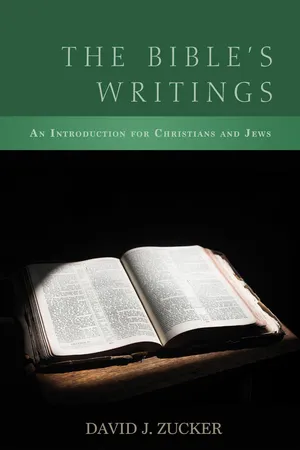
The Bible's Writings: An Introduction for Christians and Jews introduces the reader to the world of Psalms, Proverbs, Job, The Song of Songs, Ruth, Lamentations, Ecclesiastes, Esther, Daniel, Ezra, Nehemiah, and 1 and 2 Chronicles.
These books form the third section of the Hebrew Bible--the Writings/Ketuvim.
Features: Introduction to the Bible; Introduction to the Writings; Women's Voices Today; Women's Voices Then; and Women's Voices: A Cautionary Note.
Each chapter covers one particular biblical book.
Chapter divisions:
1, 2Introduction with chapter-by-chapter analyses or section-by-section analyses / geo-political and historical background / significant events / personalities / concepts and divisions.
3. The biblical book and the Christian Scriptures.
4. The biblical book in rabbinic literature. How did the rabbis utilize quotations from the Writings to teach their values? Extensive quotations.
5. Text study.
An excellent source for Christian, Jewish, or Interfaith Study of the Bible's Writings.
Information
1
Introduction to the Writings/Ketuvim
This volume is the third and final work in a series that is an introduction to the Bible, written specifically for Christians and Jews. It offers a comprehensive, section-by-section and often a chapter-by-chapter overview to the world’s most widely read book: the (Hebrew) Bible. This volume is unique in that a major feature offers examples of how the Christian Scriptures utilized the Hebrew Bible to further the ideas and ideals of Christianity; as well as offering examples where the ancient rabbis from a roughly parallel time period utilized the Hebrew Bible to further the ideas and ideals of Judaism.
The Bible is read by millions of people year by year. It is a sacred document, one that links Christians and Jews. Yet even the term “Bible” means one thing to Jews and something else to Christians. For Christians the Bible divides into two sections, the “Old Testament” followed by the “New Testament.”
When Jews refer to a Bible, they mean a different—although in some ways very similar—set of books. For Jews the “Bible” is synonymous with the TANAKH, the threefold sacred scripture made up of the Torah (i.e., Teaching, Instruction, Law), the Neviim (Prophets), and finally the Ketuvim (Writings.) The books that make up those three sections are the same books that Christians would find in their version of the Old Testament. Yet, in many cases, the books in the Christian Scriptures are set out in a different order than that found in the Hebrew Bible (TANAKH). These differences between the order of the books are explained in a later section of this Introduction.
The third section of the Hebrew Bible, the Writings/Ketuvim, is composed of thirteen books, in this particular order: Psalms, Proverbs, Job, Song of Songs, Ruth, Lamentations, Ecclesiastes, Esther, Daniel, Ezra, Nehemiah, 1 and 2 Chronicles.
The Overall Structure of This Book
This volume, while it stands on its own, is also the final section of a three-part set. The previous works in the series are The Torah: An Introduction for Christians and Jews (Paulist, 2005) and The Bible’s PROPHETS: An Introduction for Christians and Jews (Wipf and Stock, 2013). This volume is an introduction to the set of books in the Hebrew Bible that directly follow the Torah (i.e., the Pentateuch, the first five books of the Hebrew Bible) and the Prophets/Neviim.
Each chapter in this volume deals with one particular biblical book, and divides into five sections:
- An Introduction, and then various matters including geopolitical background, significant events, personalities, and concepts and divisions found in that particular book;
- The particular book in the Christian Scriptures;
- The book in rabbinic literature (see section below on “Rabbinic Literature”);
- Text study.
On occasion an asterisk (*) follows certain words. This indicates that the word appears in the glossary at the close of this work.
Translations used for this book (unless specifically otherwise noted) come from the New Revised Standard Version (NRSV*).1 This is a modern translation with inclusive, gender-neutral language. Occasionally there are differences in the verse numbers in the Hebrew Bible* (TANAKH) and a Christian Bible. Verse numbers were added to the biblical text during the Middle Ages. No one knows with certainty why there are occasional discrepancies between the two versions. When there are variations in a particular verse quoted, the NRSV translation will be followed by the Hebrew* tradition, set apart in parentheses and marked with an “H.” Real examples that will be found in this volume include Psalm 47:1–2, 8 (47:2–3, 9 H) and Song of Songs 7:2 (7:3 H).
I try to use gender-neutral language in terms for God. God cannot be described in terms of gender. God is neither a he nor a she. Yet the Hebrew language, like romance languages (French, Spanish, etc.), does not have a neutral case, only masculine and feminine nouns and pronouns. Unlike English and German, there is no “it.” The default pronouns in the NRSV, as in this volume, when referring to God are “he,” “him,” and “his.” While in the Bible God is most often described with masculine pronouns, feminine imagery is also used in the Bible. Isaiah explains that God says, “As a mother comforts her child, so I will comfort you” (Isa 66:13; cf. Isa 42:14; 49:15; 66:9). Since the word “Lord” has masculine overtones in most cases, unless quoting directly from a text this book uses the neutral term “God.”
The last quarter of the twentieth century saw a flowering of woman-authored scholarship that continues to flourish in the twenty-first century. All people, women and men alike, are indebted to their contributions, many examples of which also have influenced and are included in this volume.
The Order of the Books of the Bible
As mentioned above, another term for the Jewish Bible is the TANAKH*. TANAKH (sometimes TANAK) is an acronym; the letters T, N, and KH (or K) each refer to a word. These three words are Torah* (Teaching), Neviim* (Prophets), and Ketuvim* (Writings). They refer to the three sections of the Jewish Bible. This is the order of the books of the Hebrew Bible* (Hebrew Scriptures*, Jewish Scriptures*, Jewish Bible*, TANAKH).
- The Teaching/Torah contains Genesis, Exodus, Leviticus, Numbers, and Deuteronomy.
- The Prophets/Neviim has two sections, the Former Prophets and the Latter Prophets. In order they are: (Former Prophets) Joshua, Judges, 1 and 2 Samuel, and 1 and 2 Kings; (Latter Prophets) Isaiah, Jeremiah, Ezekiel, Hosea, Joel, Amos, Obadiah, Jonah, Micah, Nahum, Habakkuk, Zephaniah, Haggai, Zechariah, and Malachi.
- The Writings/Ketuvim consist of the Psalms, Proverbs, Job, Song of Songs, Ruth, Lamentations, Ecclesiastes, Esther, Daniel, Ezra, Nehemiah, and 1 and 2 Chronicles.
The Protestant Bible reflects the divisions of the Jewish Bible, but rearranges the order of the books in the second and third sections. Broadly speaking, the Torah (Pentateuch*) is followed by the “historical books,” Joshua, Judges, Ruth, 1 and 2 Samuel, 1 and 2 Kings, 1 and 2 Chronicles, Ezra, Nehemiah, and Esther. Next come the “poetical books,” or “Writings,” made up of Job, Psalms, Proverbs, Ecclesiastes, and Song of Songs. This set concludes with the “prophetical books,” Isaiah, Jeremiah, Lamentations, Ezekiel, Daniel, Hosea, Joel, Amos, Obadiah, Jonah, Micah, Nahum, Habakkuk, Zephaniah, Haggai, Zechariah, and Malachi.
The most striking difference is that in the Protestant Bible the Prophets (with the additions of Daniel and Lamentations) appear just prior to the Gospel* of Matthew.
The Roman Catholic Bible, in such versions as the Jerusalem Bible, New Jerusalem Bible, and New American Bible, follows a different order: Genesis, Exodus, Leviticus, Numbers, and Deuteronomy; then Joshua, Judges, Ruth, 1 and 2 Samuel, 1 and 2 Kings, 1 and 2 Chronicles, Ezra, Nehemiah, Tobit, Judith, Esther, 1 and 2 Maccabees, Job, Psalms, Proverbs, Ecclesiastes, Song of Songs, Wisdom of Solomon, Ecclesiasticus (Sirach), Isaiah, Jeremiah, Lamentations, Baruch, Ezekiel, Daniel, Hosea, Joel, Amos, Obadiah, Jonah, Micah, Nahum, Habakkuk, Zephaniah, Haggai, Zechariah, and Malachi. In the Catholic Bible, what is termed in the Protestant Bible as the Apocrypha appears as part of the Deuterocanonicals. The Roman Catholic Church shares this tradition with the Greek and Russian Orthodox Churches.
Terms of Reference
BCE and CE
“Before the Common Era” (BCE)* and “Common Era” (CE)* refer to exactly the same periods as “Before Christ” (BC) and “Anno Domini” (“In the year of our Lord,” AD). Thus, 200 BCE is the same year as 200 BC, and 500 CE is the...
Table of contents
- Title Page
- Foreword
- Chapter 1: Introduction to the Writings/Ketuvim
- Chapter 2: Psalms
- Chapter 3: Proverbs
- Chapter 4: Job
- Chapter 5: Song of Songs
- Chapter 6: Ruth
- Chapter 7: Lamentations
- Chapter 8: Ecclesiastes
- Chapter 9: Esther
- Chapter 10: Daniel
- Chapter 11: Ezra
- Chapter 12: Nehemiah
- Chapter 13: Chronicles (1 and 2)
- Glossary
- Bibliography
Trusted by 375,005 students
Access to over 1.5 million titles for a fair monthly price.
Study more efficiently using our study tools.
Frequently asked questions
Yes, you can cancel anytime from the Subscription tab in your account settings on the Perlego website. Your subscription will stay active until the end of your current billing period. Learn how to cancel your subscription
No, books cannot be downloaded as external files, such as PDFs, for use outside of Perlego. However, you can download books within the Perlego app for offline reading on mobile or tablet. Learn how to download books offline
We are an online textbook subscription service, where you can get access to an entire online library for less than the price of a single book per month. With over 1.5 million books across 990+ topics, we’ve got you covered! Learn about our mission
Look out for the read-aloud symbol on your next book to see if you can listen to it. The read-aloud tool reads text aloud for you, highlighting the text as it is being read. You can pause it, speed it up and slow it down. Learn more about Read Aloud
Yes! You can use the Perlego app on both iOS and Android devices to read anytime, anywhere — even offline. Perfect for commutes or when you’re on the go.
Please note we cannot support devices running on iOS 13 and Android 7 or earlier. Learn more about using the app
Please note we cannot support devices running on iOS 13 and Android 7 or earlier. Learn more about using the app
Yes, you can access The Bible's Writings by David J. Zucker in PDF and/or ePUB format, as well as other popular books in Théologie et religion & Critique et interprétation bibliques. We have over 1.5 million books available in our catalogue for you to explore.