eBook - ePub
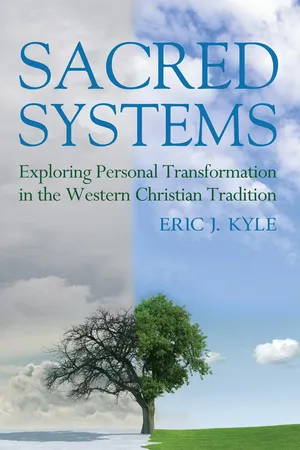
Sacred Systems
Exploring Personal Transformation in the Western Christian Tradition
- 330 pages
- English
- ePUB (mobile friendly)
- Available on iOS & Android
eBook - ePub
About this book
From early Jewish-Christian texts such as the Didache, which present well-defined catechetical programs, to contemporary authors such as Dallas Willard, who offer in-depth insights into the transformations of one's heart and soul, systematic texts on spiritual formation in the Western Christian tradition abound. These texts can offer ministers, researchers, and laypersons much clarity and guidance for their craft. However, the spiritual formation systems that we use are also always contextually influenced; such contextual factors may make them difficult to adapt to one's local work. Rather than turning to only a single text or community, then, it can be helpful for practitioners and theorists to look to a broader set of systematic presentations of spiritual formation. By turning to a group of specific individuals and communities in each era of Western Christian history, this book will help those working in this field to better understand how personal spiritual formation has been conceptualized and embodied. Such an exploration will help us not only to compile a more complete history of spiritual formation at the level of the individual but also to glean a better understanding of personal transformation so that we might engage this craft in more informed and systematic ways.
Information
Topic
Theology & ReligionSubtopic
Biblical Studiespart one
Early Non-Christian Influences
There were two primary contextual influences that helped to shape the early Christian church. The first obvious influence was Judaism.15 Jesus was a Jew as were his closest disciples. The primary scriptures and liturgies from which the early Christians drew were adopted from the Jewish religious tradition. Indeed, authors of Christian spirituality acknowledge that it is difficult, if not impossible, to understand the early church apart from this influence.
The second major influence of this early era that helped to shape Christian spiritual formation was the larger Greco-Roman culture of which both Christians and Jews were a part of.16 The Roman Empire was a vast and powerful presence in this part of the world. As we shall see with Philo of Alexandria, the Empire had a system of Hellenization wherein its citizens were educated into Roman culture. Not only was the Empire prolific in the spread of its laws and religious practices, but also its philosophies as well, for which Platonism and its variations were central.17 In addition, more and more converts to Christianity were “Gentiles,” or non-Jews. This meant that the early church not only needed to address these new converts and speak to them in symbols, philosophies, and practices that they could understand but also that the beliefs and practices of Christianity would increasingly be formulated by them. For instance, Origen formulated his stages of the spiritual life in neoplatonic terms.18 The influence of Greco-Roman culture on early Christian spiritual formation can therefore not be overlooked.
Given these wider influences, it will therefore be helpful to better understand how personal transformation was understood by parts of these alternative traditions. While there are a few forms of personal transformation that we might look at, such as moral formation in Roman culture,19 we have chosen two to focus on. For better insights into a Jewish view of personal spiritual formation, we turn to Philo of Alexandria and two of his short works: “Every Good Man Is Free” and “On the Contemplative Life or Supplicants.” While, as we shall see, Philo might not be considered by some to be classically Jewish in a traditional sense because he was a Hellenized Jew, his works did go on to influence many early Christian thinkers such as Clement and Origen of Alexandria.20
A second text that we will be turning to is The Mysteries of the Egyptians, Chaldeans, and Assyrians by Iamblichus. This piece is very characteristic of some of the neoplatonic views of this era, many of which influenced early Christianity, particularly early monasticism as we shall see in the next part of this book. Not only, then, will Iamblichus’ work provide us with insights into these worldviews, but it will also represent a very different systematic approach to personal transformation. It is therefore to these two sets of writings that we will now turn to in order to help us better understand the cultural contexts in which early Christian personal spiritual formation developed within.
15. Burridge, “Jesus and the Origins of Christianity,” 12; Sheldrake, Brief History of Spirituality, 13; Woods, Christian Spirituality, 4.
16. McGuckin, “The Early Church Fathers (1st to 6th Centuries),” 44–45; Sheldrake, Brief History of Spirituality, 27; Woods, Christian Spirituality, 48.
17. Chidester, Christianity, 5; Sheldrake, Brief History of Spirituality, 27, 31.
18. Sheldrake, Brief History of Spirituality, 35.
19. For instance, see Malherbe, Moral Exhortation; Fitzgerald, Passions and Moral Progress in Greco-Roman Thought.
20. Jones et al., The Study of Spirituality, 95.
Table of contents
- Title Page
- Part One: Early Non-Christian Influences
- Part Two: Early Christian Diversity
- Part Three: Early Monastic Formation
- Part Four: Medieval & Renaissance
- Part Five: Protestant Reformation
- Part Six: Contemporary Movements
- Part Seven: Synthesizing & Summarizing
- Bibliography
Trusted by 375,005 students
Access to over 1.5 million titles for a fair monthly price.
Study more efficiently using our study tools.
Frequently asked questions
Yes, you can cancel anytime from the Subscription tab in your account settings on the Perlego website. Your subscription will stay active until the end of your current billing period. Learn how to cancel your subscription
No, books cannot be downloaded as external files, such as PDFs, for use outside of Perlego. However, you can download books within the Perlego app for offline reading on mobile or tablet. Learn how to download books offline
Perlego offers two plans: Essential and Complete
- Essential is ideal for learners and professionals who enjoy exploring a wide range of subjects. Access the Essential Library with 800,000+ trusted titles and best-sellers across business, personal growth, and the humanities. Includes unlimited reading time and Standard Read Aloud voice.
- Complete: Perfect for advanced learners and researchers needing full, unrestricted access. Unlock 1.5M+ books across hundreds of subjects, including academic and specialized titles. The Complete Plan also includes advanced features like Premium Read Aloud and Research Assistant.
We are an online textbook subscription service, where you can get access to an entire online library for less than the price of a single book per month. With over 1.5 million books across 990+ topics, we’ve got you covered! Learn about our mission
Look out for the read-aloud symbol on your next book to see if you can listen to it. The read-aloud tool reads text aloud for you, highlighting the text as it is being read. You can pause it, speed it up and slow it down. Learn more about Read Aloud
Yes! You can use the Perlego app on both iOS and Android devices to read anytime, anywhere — even offline. Perfect for commutes or when you’re on the go.
Please note we cannot support devices running on iOS 13 and Android 7 or earlier. Learn more about using the app
Please note we cannot support devices running on iOS 13 and Android 7 or earlier. Learn more about using the app
Yes, you can access Sacred Systems by Eric J. Kyle in PDF and/or ePUB format, as well as other popular books in Theology & Religion & Biblical Studies. We have over 1.5 million books available in our catalogue for you to explore.