eBook - ePub
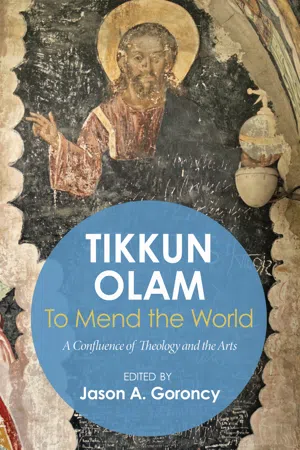
'Tikkun Olam' —To Mend the World
A Confluence of Theology and the Arts
- 232 pages
- English
- ePUB (mobile friendly)
- Available on iOS & Android
eBook - ePub
About this book
"Tikkun Olam"--To Mend the World is premised on the conviction that artists and theologians have things to learn from one another, things about the complex interrelationality of life and about a coherence of things given and sustained by God. The ten essays compiled in this volume seek to attend to the lives, burdens, and hopes that characterize human life in a world broken but unforgotten, in travail but moving towards the freedom promised by a faithful Creator. They reflect on whether the world--wounded as it is by war, by hatred, by exploitation, by neglect, by reason, and by human imagination itself--can be healed. Can there be repair? And can art and theology tell the truth of the world's woundedness and still speak of its hope?
Information
Topic
Theology & ReligionSubtopic
Christian Church1
“Prophesy to these Dry Bones”
The Artist’s Role in Healing the Earth
Introduction
This has been quite a time to be alive: earthquakes, tsunamis, the Arab Spring, and nuclear meltdown, all played out against the background of long term climate change and increasing food shortages—mending the world appears more of a challenge than ever before. One might be tempted to think that art is the last thing we need to encourage. This is not the time to brew some coffee and write a poem; it’s time for us to roll up our sleeves and get to work. I happen to think, however, that the theme chosen for this volume, long before all the tragedies of recent years, was providential and timely, and I think the theme provides ample leverage to fight off this defensive posture, and that is what I will try to do in this essay.
When our children were little there was one book that was a favorite: It was about Frederick, a mouse who loved colors and shapes. The other mice tolerated Frederick with condescending smiles, as he mussed about in colors and shapes while they were busy planting harvesting and preparing for winter. What good was he, they wondered? But Frederick was not discouraged; he found plenty to occupy his attention, he was busy with his colors and the textures he loved. All the other mice smiled: poor little Frederick. Perhaps you know the story, it is a good place for us to start.
What Really Matters?
This story raises for me a central question: What is it that really matters to people? To get at this let me turn to a more serious guide: Dante, the famous medieval theologian and poet. In his journey through the Inferno, Dante often encounters people he knows from Florence, right alongside mythical figures he has read about in classical poetry. There they are side by side in hell—my students and I have often puzzled over this. In climbing down to the seventh circle in the Inferno Canto XII, for example, Dante finds centaurs firing arrows at those who seek to escape their punishment. One of them, the mythical Nessus, who carried Deianira across a river and was shot by Heracles’s poisoned arrow, calls Dante and Virgil’s attention to Guy de Montfort, who avenged his father Simon’s death by murdering Henry, son of the Earl of Cornwall, in church. Dante describes these centaurs running around as “in the world above, they used to hunt” (Inferno 12.57), though he knows as well as anybody they never did run around in the world above.
Guy’s murderous deed, however, was, as we say, historical, and it earned him his place in hell. Yet, with a touch of irony, Dante has the centaur point out Guy to Dante and Virgil—the fictional fingers the historical.
What is going on here? How can myth occupy the same space as history, let alone illumine the historical? One source of this endorsement of fiction over history is Aristotle’s famous treatment of poetry. There the Philosopher differentiates between the poet and the historian in this way: “The one [historian] relates what has happened, the other [poet] what may happen. Poetry, therefore, is more philosophical and a higher thing than history: for poetry tends to express the universal, history the particular.”40
You see: the poet describes what is universal, while the historian merely describes contingent events. If you put it this way, which one is superior?
We moderns are put off by this apparent confusion over truth and history—as if, during our journey through the afterlife, Raskolnikov appeared and pointed out Osama bin Laden to us! But what if, in fact, Raskolnikov might illumine bin Laden? You see what is implied: the universal truths, what I call poetic truth, might illumine our particular history. Dante and his contemporaries understood intuitively that a universal story, that is a narrative that encompasses the whole of humanity and its history, should guide our reading of the events of history. And for Dante there was no question that the story of God’s actions in Israel and Christ, especially as these were mediated through the liturgical life of the Church, was the controlling universal story. But they were also convinced that other smaller stories could also embody universal truths; they could help fill in the details of God’s universal saga. The incorporation of ancient mythology, Dante believed, could contribute to his spiritual aim, which was “to remove those living in this life from a state of misery, and to bring them to a state of happiness.”41 Along with the frequent citations of Scripture, and interpreted by that Scripture, this cultural wisdom, for Dante, could play a role in the pilgrim’s journey to God.
But what I want us to notice is what has happened to us: for the modern reader, especially the Protestant Christian reader, this order has been exactly reversed—the historical has supplanted the poetic. I won’t belabor all the steps in this process, nor suggest it is entirely mistaken. But what I want us to see is what has been lost in this development. The story has been lost—we struggle to fit all the facts, what we call data, into a meaningful narrative. My argument here is that we must retrieve the impulse behind Dante’s construal of things: that the story, or what I prefer to call the poetics of life, is essential not only to bring the historical and literal to life, but also to arouse people to live that life. But why fiction? Why Poetry? Because art carries us in a way that history, by itself, cannot. The story, poetics, is what matters to people. As Paul Ricœur says, the world for him “is a set of references opened by every set of descriptive or poetic text I have ever read, interpreted or loved.”42 I still remember, for example, my first encounter with a great piece of literature. Someone recommended I read Jude the Obscure by Thomas Hardy. The next weekend was spent immersed in this story, and I cried as Jude lay dying while the graduation celebration that he had tried to become part of passed outside his house. I was shaped by the poetic.
This means that we cannot only look to the scientists to help us heal the earth, but also, and perhaps primarily, to artists. Indeed scientists themselves are increasingly recognizing the role of metaphor in their understanding. In a recent article on the interaction of genetic and environmental factors, Richard Lewontin, Professor of Zoology and Biology at Harvard University, noted how in the last twenty-five years, scientists “have considered how language, models and metaphors have had a determinative role in the construction of scientific explanation in biology.”43 So even the scientists have come to understand Aristotle’s point: the ability of metaphor to illumine fact.
Enter the Artist
Here is where the role of the artist comes in. Artists deal with poetics—with language, models and metaphors; they dress the literal in colors, shapes and sounds so that it becomes attractive, engrossing. Let me develop a bit what I am calling “poetics.” Another major source for Dante was St. Augustine who insisted that people are defined not by what they know or accomplish—things that promote pride—but by what (and who) they love. In his handbook for helping young monks interpret Scripture, On Christian Teaching, Augustine describes our life as a journey of the affections that is meant to bring us to our true homeland, found only in God. He argued that Scripture is full of signs that move us along in our journey. Then he expanded on this and argued that any sign that attracts our affections and moves us forward in our journey may be loved. But only for the sake of God—as he says all things are to be loved in God and God is to be loved in all things. So that we love signs (or what we call today “symbols”) for how they move us. As he put it: “We love the means of transport only because of our destination.”44
Artists traffic in signs—things that people love—and these can provide the means of transport of peoples’ journey. Poetics describe all the parts of life that people love—the walks on the beach, the loving gesture of a friend, a Bach sonata, the thing...
Table of contents
- Title Page
- Contributors
- Illustrations
- Foreword
- Preface
- Introduction
- Chapter 1: “Prophesy to these Dry Bones”
- Chapter 2: Cosmos, Kenosis, and Creativity
- Chapter 3: Re-forming Beauty
- Chapter 4: Questioning the Extravagance of Beauty in a World of Poverty
- Chapter 5: Living Close to the Wound
- Chapter 6: The Sudden Imperative and Not the Male Gaze
- Chapter 7: Building from the Rubble
- Chapter 8: The Interesting Case of Heaney, the Critic, and the Incarnation
- Chapter 9: New Media Art Practice
- Chapter 10: Silence, Song, and the Sounding-Together of Creation
Trusted by 375,005 students
Access to over 1.5 million titles for a fair monthly price.
Study more efficiently using our study tools.
Frequently asked questions
Yes, you can cancel anytime from the Subscription tab in your account settings on the Perlego website. Your subscription will stay active until the end of your current billing period. Learn how to cancel your subscription
No, books cannot be downloaded as external files, such as PDFs, for use outside of Perlego. However, you can download books within the Perlego app for offline reading on mobile or tablet. Learn how to download books offline
Perlego offers two plans: Essential and Complete
- Essential is ideal for learners and professionals who enjoy exploring a wide range of subjects. Access the Essential Library with 800,000+ trusted titles and best-sellers across business, personal growth, and the humanities. Includes unlimited reading time and Standard Read Aloud voice.
- Complete: Perfect for advanced learners and researchers needing full, unrestricted access. Unlock 1.5M+ books across hundreds of subjects, including academic and specialized titles. The Complete Plan also includes advanced features like Premium Read Aloud and Research Assistant.
We are an online textbook subscription service, where you can get access to an entire online library for less than the price of a single book per month. With over 1.5 million books across 990+ topics, we’ve got you covered! Learn about our mission
Look out for the read-aloud symbol on your next book to see if you can listen to it. The read-aloud tool reads text aloud for you, highlighting the text as it is being read. You can pause it, speed it up and slow it down. Learn more about Read Aloud
Yes! You can use the Perlego app on both iOS and Android devices to read anytime, anywhere — even offline. Perfect for commutes or when you’re on the go.
Please note we cannot support devices running on iOS 13 and Android 7 or earlier. Learn more about using the app
Please note we cannot support devices running on iOS 13 and Android 7 or earlier. Learn more about using the app
Yes, you can access 'Tikkun Olam' —To Mend the World by Jason Goroncy, Goroncy in PDF and/or ePUB format, as well as other popular books in Theology & Religion & Christian Church. We have over 1.5 million books available in our catalogue for you to explore.