eBook - ePub
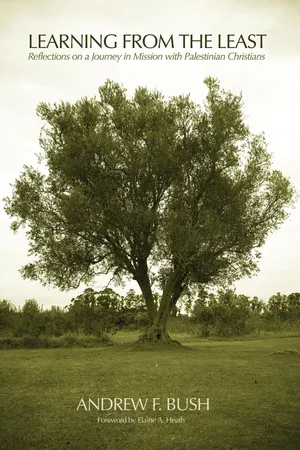
Learning from the Least
Reflections on a Journey in Mission with Palestinian Christians
- 210 pages
- English
- ePUB (mobile friendly)
- Available on iOS & Android
eBook - ePub
Learning from the Least
Reflections on a Journey in Mission with Palestinian Christians
About this book
With the majority of the world's Christians now living in the non-Western world, Christian mission has become a global movement. The mission of Western Christianity now faces the challenge of laying aside the preeminence and privilege it has long enjoyed in global Christian mission, and embracing a new role of servanthood in weakness alongside its sisters and brothers from Asia, South America, and Africa. Such a transformation in historic patterns in mission requires not just new strategies and techniques, but a renewal of its spirituality. How can the spirituality of Western mission be renewed? By learning from those non-Western Christians whose lives on the margins reveal anew the One who emptied himself of the prerogatives of glory on the cross to serve humanity out of utter weakness. Learning from the Least invites you to a journey among Palestinian Christians to meet radical peacemakers who are making courageous decisions to reconcile with those who are customarily reckoned as enemies. Their radical servanthood out of weakness is a prophetic challenge to Western Christians, a call to lay aside the prerogatives of power and wealth, to question triumphal theologies, and to discover again the vulnerability of the way of the cross.
Information
Subtopic
Ministère chrétien1
The Challenge and Hope of Renewal in Western Mission
He has done mighty deeds with His arm;He has scattered those who were proud in the thoughts of their heart.He has brought down rulers from their thrones,And has exalted those who were humble.
Luke 1:51–52, The Song of Mary
Indeed the Christian faith which once “conquered the world” must also learn to conquer its own forms when they have become worldly. It can do so only when it breaks down the idols of the Christian West, and in a reforming and revolutionary way remembers the “crucified God.”9
Jürgen Moltmann, The Crucified God
A Quiet Prophet
Twice a week Subha, a young Palestinian woman, makes the wearying journey on public transportation from Bir Zeit, a village in the hill country north of Ramallah, to Jericho. Her trip takes her along winding West Bank roads and then down the highway that descends sharply from Jerusalem. Dun-colored barren hills rise on either side of the desert highway. Faint trails worn by foraging sheep and goats crisscross the hillsides, forming an intricate web. As Subha travels on this day, she passes Bedouin camps with their black tents, basic corrals, and portable water tanks. To the south, the hulking outlines of Israeli settlements sprawl like medieval walled cities misplaced in time. As the highway falls below sea level, the temperature rises.
The descent easing, the road emerges into the Jordan River valley. Just to the north is Jericho, the oldest inhabited city in the world. An Israeli military checkpoint stops traffic going into Jericho. Since the Palestinian uprising, or Intifada, that began in 2000 and finally exhausted itself in 2005, Jericho has had the feel of a boomtown gone bust. Tourists who once flocked to the city’s sites—the excavations of the ancient city, the tree where legend has it that Zaacheus climbed to see Jesus, and to the purported cliff where Christ withstood the wiles of Satan—have been reduced to a trickle.
During the summer’s cloudless skies the heat in the ancient city of Jericho is suffocating, zay narr—like fire—as Palestinians say in Arabic. The intensity of the desert sun empties the streets at midday. Dusty donkeys stand listlessly in what shade they can find, their tails swatting tormenting flies.
In this desert inferno Subha continues her journey on foot, a friend from Jericho with her. In spite of the summer’s swelter, she is dressed as a typical Palestinian Muslim woman with a long-sleeved tunic and trousers. Since she is careful to observe her family’s standards, a scarf, or hijab, is bound tightly around her head. Subha’s appearance, though, is misleading; she is a follower of Jesus. Raised in a happy family in the bustling city of Nablus, she worked hard in high school and graduated from university. The normality of her life was overturned by an encounter with the gospel of Jesus.
For several days Subha had dreamt of climbing a ladder. With each higher rung she heard a voice that said she was going to meet new people who would teach her new things. Through a mutual friend she began an Internet chat with someone who began to converse with her about Jesus. Intrigued by the references to Jesus in the Qur’an, she wanted to know more. Her new friend encouraged her spiritual search, and in the months that followed, she began to radically reorient her life toward Jesus. She was moved by examples of Jesus’s forgiveness in the Gospels. Her Palestinian government issued identity card, which can never be altered, classifies her as a Muslim. This social identity will always characterize her public life, but she is walking a different road.
When she arrives at a small home, a Palestinian mother with her kids tugging at her side opens the door and warmly welcomes Subha. The purpose of the visit is to encourage the mother and to listen to her concerns: her husband, who waited tables in a tourist restaurant, is out of work; they don’t know how they will make it. Before Subha leaves, she prays for the mother.
New followers of Jesus often experience intense resistance from their families and villages in the Middle East. Subha’s spiritual journey has been especially difficult. Four years ago she was traveling from Ramallah to Nablus in a Palestinian-marked public taxi. Sitting in the front seat of the vehicle, she was cradling her infant son in her arms when the windshield was suddenly shattered by a rock. Glass shards flew into her face, piercing her left eyelid and cheek. A militant Israeli settler had thrown the rock that would cause years of pain. Settlers are Israelis who reside in fortified housing colonies in West Bank territory that Palestinians claim as part of their future state.
As fiercely as Palestinians claim the land on which they have lived for centuries, many Israelis and their international sympathizers assert that the land is theirs by biblical mandate. While many of the several hundred thousand settlers who now live in the settlements on the West Bank are not fiercely political, there is a strain of militant settlers who intentionally attack Palestinian civilians (who have little recourse to Israeli authorities) in an effort to drive them from the land. As I write, a Palestinian family is recovering from having a fire bomb thrown into their taxi by settler youth.10
After two surgeries Subha still experiences pain from the glass splinters that cannot be removed and from permanent damage to the nerves around her eye. Specialists from London, whom she met in Amman, Jordan, warned her that further surgeries would risk the loss of her eye. All they could offer was a prescription for pain medication and the instruction that she must adjust to the pain.
In a land in which hatred of the Other—be it Israeli or Palestinian—scorches the soul as intensely as the Jericho heat, bitterness and vengeful intentions are the reflexive response to such attacks. Forgiveness and reconciliation, in their scarcity, are like strange fruit from a strange land. Yet, for those who find it, forgiveness is a refuge, providing shelter from the destruction of the enmity of hate.
By the grace of God, Subha was able to hide herself in mercy’s shelter, and finding that refuge, she is pointing others toward it. During a retreat in Bethlehem, she was able to meet with several Israelis. She told them about her injury. Saddened, they asked for forgiveness on behalf of their nation. Subha responded simply, yet profoundly, “We are all humans. We have all sinned. We all need forgiveness. So you do not need to ask for forgiveness. But since you have asked, be assured of my forgiveness.”
This is the heart of the message and work of Jesus: reaching across chasms of misunderstanding and pain to bring reconciliation and forgiveness. It is this hope—that the wounds of old enmities between peoples may be healed, and that there is the possibility of peace in the midst of the brutality of conflict—that motivates Subha’s journeys, through unpredictable military checkpoints and the suffocating heat in packed public transport, to encourage women in Jericho. She is a quiet prophet, a living witness of Jesus in the Holy Land.
Upending Empire: The Witness of Radical Servanthood in the Early Church
As an agent of the grace and life that is in Jesus, Subha is walking the path first blazed by followers of Jesus from the first century, who sought to take the transforming message of Jesus throughout the Roman Empire. Beginning with a handful of disciples in Jerusalem after the ascension of Christ, it is estimated that by the year 300 C.E., Christians comprised as much as 10 percent of the Roman Empire, or about five million people.11 Members of the Christian community were found in all strata of society, including the aristocrats, the official court, the army, and among women, although those among the humbler people—slaves, laborers, and tradespeople—predominated.12
What characterized this phenomenal advancement was the extraordinary witness of the lives of ordinary disciples who, generally without power or prestige, moved the hearts of the citizens of the Roman Empire. The historian of Christian mission, Stephen Neill, states that the mission of these early Christians was characterized by radical acts of charitable service: the opening of their homes to travelers; the rescuing of unwanted infants from the public garbage heaps where they were left to die; the care of orphans, widows, and prisoners; and the forming of burial clubs to provide an honorable grave for the impoverished. When the bubonic plague broke out in cities, most citizens would flee to the countryside to escape the pestilence. Christians, on the other hand, traveled into the suffering cities to care for the infected and to die by their side.13
The strongest acknowledgement of the profound effect of this sacrificial concern for others may be the rather pathetic complaint of the Emperor Julian (332–63 C.E.), who stated:
Atheism [i.e., Christian faith] has been especially advanced through the loving service rendered to strangers, and through their care for the burial of the dead. It is a scandal that there is not a single Jew who is a beggar and that the godless Galileans care not only for their own poor but for ours as well; while those who belong to us look in vain for the help that we should render them.14
Now this is a criticism of which the church could be proud—that it cared for people so much it put an emperor to shame!
The first three centuries were also marked by faithfulness to Christ in the face of persecution. Citizens of the Roman Empire were required ...
Table of contents
- Title Page
- Illustrations
- Foreword
- Preface
- Acknowledgments
- Abbreviations
- Introduction
- Chapter 1: The Challenge and Hope of Renewal in Western Mission
- Chapter 2: Surprised by Palestine
- Chapter 3: The Way of Weakness in a Context of Violence
- Chapter 4: Partnering with the Enemy
- Chapter 5: Transforming Nationalism
- Chapter 6: Where Are the Peacemakers?
- Chapter 7: Crucified with the Crucified
- Chapter 8: Someone Else Will Lead You
- Epilogue: A Postcard from Ramallah
- Bibliography
Trusted by 375,005 students
Access to over 1.5 million titles for a fair monthly price.
Study more efficiently using our study tools.
Frequently asked questions
Yes, you can cancel anytime from the Subscription tab in your account settings on the Perlego website. Your subscription will stay active until the end of your current billing period. Learn how to cancel your subscription
No, books cannot be downloaded as external files, such as PDFs, for use outside of Perlego. However, you can download books within the Perlego app for offline reading on mobile or tablet. Learn how to download books offline
Perlego offers two plans: Essential and Complete
- Essential is ideal for learners and professionals who enjoy exploring a wide range of subjects. Access the Essential Library with 800,000+ trusted titles and best-sellers across business, personal growth, and the humanities. Includes unlimited reading time and Standard Read Aloud voice.
- Complete: Perfect for advanced learners and researchers needing full, unrestricted access. Unlock 1.5M+ books across hundreds of subjects, including academic and specialized titles. The Complete Plan also includes advanced features like Premium Read Aloud and Research Assistant.
We are an online textbook subscription service, where you can get access to an entire online library for less than the price of a single book per month. With over 1.5 million books across 990+ topics, we’ve got you covered! Learn about our mission
Look out for the read-aloud symbol on your next book to see if you can listen to it. The read-aloud tool reads text aloud for you, highlighting the text as it is being read. You can pause it, speed it up and slow it down. Learn more about Read Aloud
Yes! You can use the Perlego app on both iOS and Android devices to read anytime, anywhere — even offline. Perfect for commutes or when you’re on the go.
Please note we cannot support devices running on iOS 13 and Android 7 or earlier. Learn more about using the app
Please note we cannot support devices running on iOS 13 and Android 7 or earlier. Learn more about using the app
Yes, you can access Learning from the Least by Andrew F. Bush in PDF and/or ePUB format, as well as other popular books in Théologie et religion & Ministère chrétien. We have over 1.5 million books available in our catalogue for you to explore.