- 92 pages
- English
- ePUB (mobile friendly)
- Available on iOS & Android
eBook - ePub
About this book
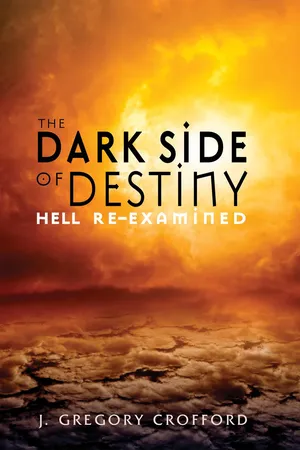
Discussion of Hell is hotter than ever. Yet for all the attention the topic has drawn, few are the resources that provide an overview of the major points in dispute without bogging down in detail.
The Dark Side of Destiny: Hell Re-examined is an excellent primer, yet goes beyond a mere description of options. Dr. Crofford weighs various views of Hell in the light of Scripture and finds them wanting. In the end, he champions a neglected view of last things that both responds better to the preponderance of biblical evidence and safeguards the character of God as equitable, holy, and loving.
With probing discussion questions at the end of short chapters, The Dark Side of Destiny is ideal for Bible studies, Sunday school classes, or small groups.
Information
Subtopic
Église chrétienne1
The God of Fair Play
The infliction of cruelty with a good conscience is a delight to moralists. That is why they invented Hell.
—Bertrand Russell
Do you like reading comment threads on news websites? It’s one of my favorite things to do. I’ve noticed that when one of the “hot button” topics is in the news, a nasty argument can ensue. Inevitably, a Christian will write: “That’s a sin, and if they don’t repent, they’ll go to Hell.” Often, others respond that they could “never believe in a God that would allow someone to be tormented forever in Hell.”
If this last response was rare, I might discount it. But it’s there, over and over again. Because I’ve been raised in the community of faith, I find it difficult to look at Christianity through the eyes of a person on the “outside.” Yet there they are, not just an isolated few, but many who are saying: “Look, if that’s what God is like, who needs God?”
What is going on here? God has placed in the human heart a notion of fair play. When children sense that they or their friends are being mistreated, they often protest: “That’s not fair!” We grow up and learn that life isn’t always fair because people aren’t always fair, but we still expect more from the God of the Bible.
Abraham asked the Lord as he pleaded for him to spare two towns: “Will not the Judge of all the earth do right?” (Gen 18:25). Yes, God will, and not only will God do what is right, God expects us to do the same. That is the basis of the lex talionis, the law of retaliation. This is the famous “eye for an eye” precept in Exodus 21:24. Kevin Vanhoozer notes that this law “limits revenge and takes the first step toward leaving revenge to God and ultimately to forgiving one’s enemies.”1 But by Jesus’ time, his fellow Jews had totally missed this lesson of proportionate response, of having the “punishment fit the crime,” so Christ modified the precept, telling the offended to swear off retaliation of any sort, to instead “turn the other cheek” (Matt 5:38–39). In short, even-handed retribution is so important that it would be better not to retaliate at all than to respond disproportionately to an offense.
So here we have a snapshot of one aspect of God’s character. While God punishes sin (Rom 6:23), the “Judge of all the earth” does so in an equitable manner, modeling the principle of lex talionis, of proportionate judgment. For God to refuse to follow God’s own law would be like the parent who says to her child: “Do what I say, and not what I do.” If a child would not respect such a double standard in a parent, why should a worshiper overlook it in the divine-human relationship?
Yet many envision Hell as a place where individuals are punished forever. They are awake and aware of their torment, and will be for all eternity. Hell as unending, conscious torment is precisely where objections arise. How so? The human lifespan averages from fifty years (in African countries) to more than seventy years in the Western world. Let’s consider the most despicable person possible, perhaps Pol Pot, the Cambodian butcher, or Josef Stalin, the Russian dictator responsible for the deaths of millions of Russians. For such heinous crimes, the concept of unending torment may be acceptable, but let’s face it: Most cases are not so clear. The vast majority of those who have lived on this earth have never murdered another person, though Paul correctly notes that all have sinned (Rom 3:23). When pressed, many would admit to other offenses, such as shoplifting, cheating on a test at school, or perhaps having been unfaithful in marriage. No, these are not to be brushed off lightly, but who is willing to argue that these reach the same level as dictators who presided over genocide? Yet the traditional doctrine of Hell consigns one and all to the same dark destiny. If the lex talionis means proportionate punishment, then for most, the punishment is infinitely greater than the crime. For one lifetime rejecting God, as regrettable as that is, God consigns an individual to a hellish existence that never ends. And so those curious about the Christian faith look on and conclude: “That’s not fair. If that’s how God is, count me out.”
Suppose that you are distracted behind the wheel of your car. You know you shouldn’t, but you do it anyways: You send that text message, then looking up too late, you slam into the car in front of you. Thankfully, no one is injured, but your car and theirs are seriously damaged and must be towed away. The police arrive on the scene and ticket you. “Don’t you know that it’s illegal to text while driving?” the officer asks. “Your court date is August 10. Be there at 9 a.m.”
Meanwhile, in the same city, a rapist breaks into a home, violates the female homeowner, then slashes her throat. She is the fifteenth victim of this serial killer, a brutal psychopath who has struck terror in the hearts of the population. Later that evening, a patrolman stops a car because its taillight is out. When he approaches the driver, he recognizes the killer and calls for back up. Ten minutes later, the monster is in custody. His sentencing is set for August 10 at 9 a.m.
August 10 comes. Both you and the serial killer arrive in the courtroom. You, the careless texter, are smarter this time and leave your cell phone at home, driving to the courthouse in your repaired vehicle. As for the murderer, he is closely guarded and wears orange prison clothes and ankle chains. His trial has already happened, a jury having found him guilty on all counts. The judge orders him to stand, then dramatically reads the sentence: “I sentence you to life in prison, with no chance of parole.”
Now it is your turn. You rise, and the judge asks you: “How do you plead?” Embarrassed, you reply: “Guilty.” The judge looks down at you, then pronounces judgment: “I sentence you to life in prison, with no chance of parole.”
“That could never happen!” you say. “That would be a total miscarriage of justice,” yet that is exactly what the traditional view of Hell claims. It is endless separation from God, unending, conscious punishment for all who reject God during their lifetime, no matter the nature of their offenses. Is that what the Christian God is like?
There are some who will object: “The idea of ‘fairness’ cannot exist apart from God. If God does it, by definition, it is fair.” Yet is this not merely projecting onto heaven the morally bankrupt notion of “might makes right”? We look at the old legends of the Greek gods and their lack of holiness, their capricious cavorting and their frequent disrespect of any notion of decency, and we say: “They’re no better than humans!” It was precisely because of the ancient gods’ moral failings that Christianity with its rigorous ethical standards appealed so strongly to those living in the first centuries AD. We must be very careful not to borrow unworthy character traits from the pagan gods and overlay them onto the portrait of our loving and holy God.
Divine judgment is a biblical doctrine, but the question remains: Does the traditional concept of Hell compute with what we know about the character of God? Or could it be that we have placed in front of non-believers a huge stumbling block to faith, a needless obstacle incompatible with the God of the lex talionis or the Jesus of Matthew 5:38–39? To this issue and others we turn in the next chapter.
For discussion
1. When someone uses the word “Hell,” what comes to mind for you? What are some of the popular ways in which Hell has been conceived? How does routinely using the words “hell” and “damn” as filler words in our vocabulary affect the conversation about Hell?
2. The author cites instances where non-believers—in light of Hell—question the nature of God. Have you had similar conversations with others? If so, share them with the group. Do you agree that Hell as traditionally taught can be an obstacle to faith? Why or why not?
3. Debate whether it is legitimate to cite the Old Testament principle of lex talionis in the discussion regarding the concept of Hell as unending, conscious torment. How would you respond to someone who says that using this argument is dangerous since it allows us as mere humans to judge God?
4. Review what you’ve read of Greek and Roman mythology, then make a list of the divine characteristics of the gods. (If you know about other deities, such as ones worshipped in Africa or Asia, you could describe those instead). Next, make another list of God’s attributes, as presented in the Bible. How are they similar? How are they different? Which ones apply to the discussion of Hell?
1. Vanhoozer, Theological Interpretation of the Old Testament, 56.
2
Our Loving and Holy God
Holiness has love for its essence, humility for its clothing, the good of others as its employment, and the honor of God as its end.
—Nathanael Emmons
Though my brothers and I growing up were far from perfect, we avoided the trap of smoking. This was likely because neither of our parents smoked cigarettes. One Sunday morning came, and—as usual—we went to church. Before Sunday school, my father hunted some chalk for the chalk...
Table of contents
- Title Page
- About the Author
- Foreword
- Prologue
- Chapter 1: The God of Fair Play
- Chapter 2: Our Loving and Holy God
- Chapter 3: Back On Your Heads!
- Chapter 4: Are There Second Chances after Death?
- Chapter 5: What Are We, Anyways?
- Chapter 6: The Bright Side of Destiny
- Chapter 7: The Dark Side of Destiny
- Chapter 8: Answering Objections
- Epilogue
- For Further Reading
- Bibliography
Trusted by 375,005 students
Access to over 1.5 million titles for a fair monthly price.
Study more efficiently using our study tools.
Frequently asked questions
Yes, you can cancel anytime from the Subscription tab in your account settings on the Perlego website. Your subscription will stay active until the end of your current billing period. Learn how to cancel your subscription
No, books cannot be downloaded as external files, such as PDFs, for use outside of Perlego. However, you can download books within the Perlego app for offline reading on mobile or tablet. Learn how to download books offline
Perlego offers two plans: Essential and Complete
- Essential is ideal for learners and professionals who enjoy exploring a wide range of subjects. Access the Essential Library with 800,000+ trusted titles and best-sellers across business, personal growth, and the humanities. Includes unlimited reading time and Standard Read Aloud voice.
- Complete: Perfect for advanced learners and researchers needing full, unrestricted access. Unlock 1.5M+ books across hundreds of subjects, including academic and specialized titles. The Complete Plan also includes advanced features like Premium Read Aloud and Research Assistant.
We are an online textbook subscription service, where you can get access to an entire online library for less than the price of a single book per month. With over 1.5 million books across 990+ topics, we’ve got you covered! Learn about our mission
Look out for the read-aloud symbol on your next book to see if you can listen to it. The read-aloud tool reads text aloud for you, highlighting the text as it is being read. You can pause it, speed it up and slow it down. Learn more about Read Aloud
Yes! You can use the Perlego app on both iOS and Android devices to read anytime, anywhere — even offline. Perfect for commutes or when you’re on the go.
Please note we cannot support devices running on iOS 13 and Android 7 or earlier. Learn more about using the app
Please note we cannot support devices running on iOS 13 and Android 7 or earlier. Learn more about using the app
Yes, you can access The Dark Side of Destiny by J. Gregory Crofford in PDF and/or ePUB format, as well as other popular books in Théologie et religion & Église chrétienne. We have over 1.5 million books available in our catalogue for you to explore.