- 178 pages
- English
- ePUB (mobile friendly)
- Available on iOS & Android
eBook - ePub
About this book
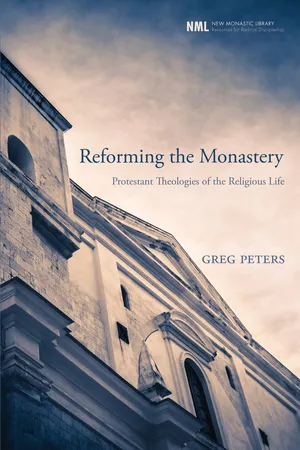
Richard Froude wrote in 1833 to John Henry Newman that "the present state of things in England makes an opening for reviving the monastic system." Seemingly original words at the time. Yet, monasticism is one of the most ancient and enduring institutions of the Christian church, reaching its zenith during the High Middle Ages. Although medieval monasteries were regularly suppressed during the Reformation and the magisterial Reformers rejected monastic vows, the existence of monasticism has remained within the Reformation churches, both as an institution and in its theology. This volume is an examination of Protestant theologies of monasticism, examining the thought of select Protestant authors who have argued for the existence of monasticism in the Reformation churches, beginning with Martin Luther and John Calvin and including Conrad Hoyer, John Henry Newman, Karl Barth, and Donald Bloesch. Looking at the contemporary church, the current movement known as the "New Monasticism" is discussed and evaluated in light of Protestant monastic history.
Information
Topic
Theology & ReligionSubtopic
Christian Churchone
The Protestant Reformers
It is generally concluded that the Protestant Reformers protested not against monastic life as such, but against the theological understanding of this kind of life in which free grace is replaced by works-righteousness. This conclusion is certainly borne out in the writings of Martin Luther, and it is this particular understanding of the monastic life, alongside other concerns, that motivates Luther’s (at times) harsh rhetoric against the institution of monasticism. John Calvin, on the other hand, had a different set of concerns that motivated his writings against monasticism, as did other Reformers. This chapter will investigate the writings of Luther, Calvin, and other important Reformers regarding their views of monasticism. Though they oftentimes judged monasticism harshly, the Reformers, as will be seen, left the door slightly ajar for seeing the institution of monasticism in positive terms.
Martin Luther
Martin Luther was born on November 10, 1483, destined by his father to become a lawyer. He entered the University of Erfurt in 1501, graduating with his master’s degree in 1505. Attempting to please his father, Luther enrolled in the school of law at Erfurt but very soon thereafter dropped out, subsequently entering the Augustinian friary at Erfurt in July, 1505. A very conscientious and introspective young man, Luther’s time in the monastery proved difficult as he fretted about his salvation and ongoing sin. In later life, he described his time in the monastery as a time when he “lost hold of Christ the Savior and comforter and made of him a stock-master and hangman over [his] poor soul.”18 As Luther strove to be the best monk that he could be, he continued to sense his failure as a monk and feared for his salvation. After receiving his doctorate in theology in 1512, Luther was tasked to lecture on the books of Psalms, Romans, and Galatians at the University of Wittenberg. It was during his course of studies on these books that he came to see that justification is by faith alone through grace and comes by way of faith in Jesus Christ. This insight put Luther at odds with the official teaching of the Roman Catholic Church, as did Luther’s stance against the church’s selling of indulgences. On January 3, 1521, Pope Leo X excommunicated Luther, finalizing Luther’s break with the Roman Catholic Church. On June 13, 1525, Luther married the former Cistercian nun Katherine von Bora, finalizing his break with the institution of monasticism. There are two texts of Martin Luther’s in particular where we are able to see his views clearly on the institution of monasticism: The Freedom of a Christian (written in October 1520) and The Judgment of Martin Luther on Monastic Vows (written in 1521 but published in February 1522).
The Freedom of a Christian was written in both German and Latin, with the German edition intended for the laity and the Latin edition intended for the more educated reader. In the German edition, Luther states that the purpose of the work is “to discern what a Christian person is and what freedom Christ has acquired and given this person.”19 For Luther, a “Christian person is a free sovereign, above all things, subject to no one.” At the same time, a “Christian person is a dutiful servant in all things, subject to everyone” (70). These two contradictory positions, asserts Luther, are held in balance by the fact that one is relative to the soul and spiritual, while the other is related to the flesh and is physical. The Christian’s freedom belongs to the inward, spiritual person, since nothing external can make a person free, because “freedom and righteousness . . . are not bodily or external” (71). What Luther is stating here is that there is a disconnect between that which is spiritual and that which is material. This is not some form of Greek dualism but is, instead, an insight of Luther into how we are as believers. For “What help is it to the soul if the body is not captive, fresh, and healthy, and eats and drinks, and lives as it wants? From the other perspective, what harm comes to the soul if the body is confined, sick, and weary, and hungers, thirsts, and suffers in the way it does not like?” This conclusion allows Luther to begin arguing that how one behaves outwardly, that is, their state of life, does not have a direct bearing on one’s soul and, by extension, one’s level of justification or holiness. For example, says Luther, “it does not help the soul at all if the body puts on holy clothing as the priests and clergy do, nor does it help to be in churches and sacred places.” The only thing that can make the soul “alive, righteous, free and Christian” (71) is the gospel and the word of God preached by Christ.
This leads Luther to a discussion of what exactly constitutes the word of God: “It is nothing but the preaching of Christ in accordance with the gospel, spoken in such a way that you hear your God speaking to you. It shows how your whole life and work are nothing before God but must eternally perish with everything that is in you.” In this way, Christians come to see their depravity and that they are bound for destruction. Yet, it is also the word of Christ that brings the Christian assurance that she can move beyond this state of destruction to a state of redemption. For this purpose “God places the dear Son, Jesus Christ, before you and allows you to be addressed by this living and comforting Word.” The purpose of this revelation of the Son of God is so that each person will surrender himself or herself to the Word and trust in God alone for salvation. In this manner, “all your destruction will be overcome, and you will be righteous, genuine, satisfied, upright, and fulfill all the commandments and be free of all things” (72). True freedom, writes Luther, comes by way of one’s full justification by faith in Jesus Christ. The implication of this theology, of course, is that good works no longer justify but are the result of one’s justification. Works become those actions and dispositions that are for the purpose of practicing and strengthening the faith “because no other work can make a Christian.” In short, Luther wants to make sure his readers understand that “faith alone without any works makes one righteous, free, and blessed” (73). Thus, “This is Christian freedom: faith alone, which brings about not that we might become idle or do evil but that we have need of no works to attain righteousness and blessedness” (75).
Now that Luther has laid the foundation for the spiritual and that which is relative to the soul, in the second part of The Freedom of a Christian he concerns himself with the outward person. Luther imagines, based on his previous arguments regarding the nature of faith, that someone could be tempted, like the so-called rich fool in the Gospel of Luke, to simply “relax, eat, drink, be merry” (12:19). That is, since faith alone is sufficient to make one righteous, why should one go about doing good works? Luther believes that the believer’s perfection will occur only at “Judgment Day”; therefore, in this life, the “Christian person is a dutiful servant and subject to everyone.” Again, though the Christian is free, she is also a servant, under obligation to do “all kinds of things.” From the perspective of the soul, one is justified through faith and has everything necessary for salvation, even while one’s faith and trust in God should continue to grow until they reach heaven. “However,” Luther writes, “one still remains in this bodily life on earth and must rule one’s own life and relate with people. Now works begin to play a role, and one must not be idle.” Works are the result of faith and are not constituent parts of or necessary to faith. The good works that result from faith are manifested in the life of the believer by “fasting, waking, working, and every discipline in moderation” (81).
When the Christian attempts to do these good works as a manifestation of her inward justification, she “discovers a recalcitrant will that wants to serve the world and seek its own pleasure” (81). Faith is unable to tolerate this disobedient will, so it attempts to discipline it. Here Luther quotes from 1 Corinthians 9:27 (“I punish my body and enslave it”) and Galatians 5:24 (“Those who belong to Christ . . . have crucified the flesh with its passions”), showing that this disciplining of the will takes a very physical, bodily form. In spite of the believer’s need to discipline his body, these works must never be seen as causing one’s righteousness, says Luther. Since the believer is already righteous by faith, these good works are the result of that faith, not necessary to instill or activate one’s faith. Luther states, “Works should be done only with the idea that the body becomes obedient and purified of its evil passions” (81). Again, we see in Luther the close connection between works and the mortification of the body. Because the soul is purified, it longs to see the body purified also. In summary,
Thus these two verses are true: Good and righteous works will never make a good and righteous person, but a good and righteous person does good and righteous works. Evil works never make an evil person, but an evil person does evil works. Therefore, the person must always be good and righteous beforehand, ahead of all good works, and good works follow and flow out of a righteous and good person. (83)
In the third section of The Freedom of a Christian, Luther turns from bodily good works to consider good works as being “useful and serving other people” (86). Having in mind the needs of others, says Luther, is evidence of the genuine Christian life. As slaves, Christians “become willing servants once again in order to help the neighbor” (87). This other-centeredness that flows out of one’s faith is evidenced by love for one’s neighbor and not by one’s fixation on their own spiritual life. From this perspective, Luther commends monasticism, as long as it has the good of others in mind: “All the works of priests, monasteries, and religious foundations should be done in the same way too, that all do the work of their position in life or order for nothing else than the welfare of others.” The priests, monks, and nuns should rule their bodies, for example, in such a way as to be an example for others to do the same. However, this is often not the case since “commands and laws of the pope, bishops, monasteries, foundations, rulers, and lords” (88) stipulate and insist that these good works done for the example and benefit of others are not the results of one’s justification, but are necessary to be justified. It is necessary, then, that the believer judge rightly between the commands “of the blind and mad prelates and the right-minded ones” regarding his involvement in living the monastic life, since any work that is not oriented toward serving another is not a good, Christian work. “I worry,” writes Luther, “that few foundation churches, monasteries, altars, masses, and testaments are Christian and, along with that, the special fasting and prayers to some of the saints. For I fear that in all of these works each person seeks only his or her own benefits, presuming thereby to do penance for his or her sins and be saved” (89).
Though Luther is not adamantly against monasticism per se in The Freedom of a Christian, he is concerned that many who practice it or may practice it will come to see it as salvific, as opposed to a fruit or good work of one’s faith. Having been inwardly justified, the believer is expected, since she is a slave, to do good works, especially for the benefit of others. Yet, there are those in the Roman Catholic Church, says Luther, who would attempt to reverse the ordo salutis from “justification by faith leads to good works” to “good works lead to justification.” This is the error of the late medieval Roman Catholic Church, according to Luther, and it leads him to believe that there are many called to be monks and nuns who do it only because some “evil’ or “mad” prelate convinced them that they should do so for the sake of their salvation, rather than for the good of the world and their neighbor. Luther, however, has other reasons to question the validity of monasticism, especially the vows taken by those who choose to live this manner of life.
In 1521, a priest residing in a village near Wittenberg, Bartholomew Bernhardi, married with the consent of his parish. The Archbishop of Mainz and Magdeburg, Albert, demanded that Frederick of Saxony turn over the offending priest to the ecclesiastical authorities, but Frederick refused, instead referring the case to a commission of jurists. This led Philip Melanchthon, Luther’s fellow reformer, to argue that it was both the Scriptures and the Christian tradition that allow priests to be married. Though “imprisoned” at Wartburg Castle at the time, Luther wrote Theses on Vows in 1521, arguing that vows of clerical celibacy contradict the fundamental principle of justification by faith and are therefore not binding on the individual. The following month, in a letter to George Spalatin, Luther noted the upcoming publication of a full work on monastic vows. This was further precipitated by the fact that many monks were leaving their monasteries, including the monks of Luther’s own monastery in Wittenberg. When he returned from his “imprisonment” in Wartburg in spring 1522, the only person left in the monastery was the prior, Conrad Helt. Nearly thirty monks had left the monastery the previous November. As long as these men were leaving the monastery out of conviction from God and with a good conscience, Luther was supportive. However, he expected that many of these monks were leaving instead to avoid the discipline of the monastery and because they could not live up to the vows that they made before God. Thus, The Judgment of Martin Luther on Monastic Vows was intended to serve as a guide for those who had left the monastic enclosure or were thinking about doing so. After a delay, the book was published in February 1522 with a revised edition published in June 1522. Both the original text and the revised text were translated into German in the same year.
The preface to On Monastic Vows was a letter that Luther wrote to his father on November 21, 1521. In this letter, Luther explains to his father his need to enter into the monastic life and how now, in hindsight, he sees the folly in his decision. He first explains to his father that he had primarily entered the monastery due to “the terror and the agony of sudden death,” that is, when he had feared for his life during a lightning storm near Stotternheim in 1505.20 He then admits to his father that his monastic vows were “not worth a fig” since they had been taken in such a way as to violate God’s commandment of honoring one’s father and mother: “It was a wicked vow, and proved that it was not of God not only because it was a sin against your authority, but because it was not absolutely free and voluntary” (332) due to Luther’s fear following the lightning storm. Luther, however, is thankful for the experience of being a monk living under vows, so that when he attacks those who perpetuate such errors he can oppose them from firsthand experience as opposed to writing and speaking about something with which he has no experience. In Luther’s estimation, monastic vows are a sign of human presumption and are the result of the “mad and silly papists” (333) exalting the virtue of continence and virginity to be the highest states of the spiritual life. In Luther’s opinion, the Scriptures approve virginity, but they do not praise it as a higher state than the married life. Thus, the Roman Catholic hierarchy is in gross error when they make virginity out to be a higher, more holy form of life than the married estate.
Luther continues by asking his father whether he seeks to remove him now from the monastery, just as he had wished to do in 1505. The younger Luther asks, “What difference does it make whether I retain or lay aside the cowl and tonsure? Do [they] make the monk?” (334–35). Martin Luther believes that the most important development in his life in his years as a monk is that he now realizes that the cowl and tonsure do not make the monk; rather, since God makes the monk, Luther’s c...
Table of contents
- Title Page
- Acknowledgments
- Introduction
- Chapter 1: The Protestant Reformers
- Chapter 2: The Anglican Tradition
- Chapter 3: Karl Barth and Dietrich Bonhoeffer
- Chapter 4: Donald Bloesch and the Evangelical Tradition
- Conclusion
Trusted by 375,005 students
Access to over 1.5 million titles for a fair monthly price.
Study more efficiently using our study tools.
Frequently asked questions
Yes, you can cancel anytime from the Subscription tab in your account settings on the Perlego website. Your subscription will stay active until the end of your current billing period. Learn how to cancel your subscription
No, books cannot be downloaded as external files, such as PDFs, for use outside of Perlego. However, you can download books within the Perlego app for offline reading on mobile or tablet. Learn how to download books offline
Perlego offers two plans: Essential and Complete
- Essential is ideal for learners and professionals who enjoy exploring a wide range of subjects. Access the Essential Library with 800,000+ trusted titles and best-sellers across business, personal growth, and the humanities. Includes unlimited reading time and Standard Read Aloud voice.
- Complete: Perfect for advanced learners and researchers needing full, unrestricted access. Unlock 1.5M+ books across hundreds of subjects, including academic and specialized titles. The Complete Plan also includes advanced features like Premium Read Aloud and Research Assistant.
We are an online textbook subscription service, where you can get access to an entire online library for less than the price of a single book per month. With over 1.5 million books across 990+ topics, we’ve got you covered! Learn about our mission
Look out for the read-aloud symbol on your next book to see if you can listen to it. The read-aloud tool reads text aloud for you, highlighting the text as it is being read. You can pause it, speed it up and slow it down. Learn more about Read Aloud
Yes! You can use the Perlego app on both iOS and Android devices to read anytime, anywhere — even offline. Perfect for commutes or when you’re on the go.
Please note we cannot support devices running on iOS 13 and Android 7 or earlier. Learn more about using the app
Please note we cannot support devices running on iOS 13 and Android 7 or earlier. Learn more about using the app
Yes, you can access Reforming the Monastery by Greg Peters in PDF and/or ePUB format, as well as other popular books in Theology & Religion & Christian Church. We have over 1.5 million books available in our catalogue for you to explore.