eBook - ePub
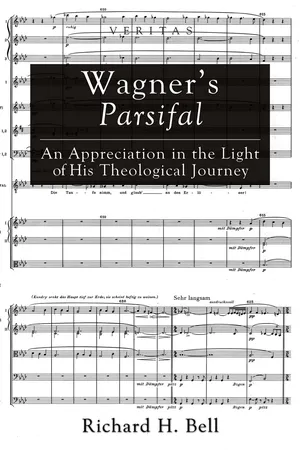
Wagner’s Parsifal
An Appreciation in the Light of His Theological Journey
- 400 pages
- English
- ePUB (mobile friendly)
- Available on iOS & Android
eBook - ePub
About this book
Parsifal, Wagner's final opera, is considered by many to be one of the greatest religious musical works ever composed; but it is also one of the most difficult to understand and many have questioned whether it can be considered a "Christian" work at all. Added to this is the furious debate that has surrounded the composer as an anti-Semite, racist, and inspiration for Hitler. Richard Bell addresses such issues and argues that despite any personal failings Wagner makes a fundamental theological contribution through his many writings and ultimately in Parsifal which, he argues, preaches Christ crucified in a way that can never be captured by words alone. He argues that Wagner offers a vision of the divine and a "theology of Good Friday" that can both function as profound therapy and address current theological controversies.
Information
Topic
Theology & ReligionSubtopic
Christian Theology1
How Can Wagner Inform the Christian Theologian?
Introduction
I start on a positive note. Wagner has composed music of inexpressible beauty that has given joy, comfort, and pleasure to countless people. Debussy described Parsifal as “one of the finest monuments in sound ever to have been raised to the everlasting glory of music.”1 Wagner’s art has inspired painters, poets, novelist, dramatists, and, of course, composers. Restricting ourselves to composers alone, and only a small handful, if it were not for Wagner we would not have the composers Bruckner, Mahler, Strauss, Schönberg, Sibelius, and Elgar as we now know them. In view of this I have a sense of profound gratitude that the composer Wagner was given to us. One could add that the Christian theologian should be especially grateful for not only has such wonderful music been given to us, but also Wagner’s stage works are rich in theology, and time and again in his writing and conversation he stressed the fundamental importance of Jesus’ self-sacrifice and that “the true task is to glorify the pure figure of Christ.”2
There has been a steady stream of theologians who have offered a grateful appreciation of Wagner’s art.3 However, the greeting Wagner has received from theologians often matches in its rancor Alberich’s “fond farewell” (“Liebesgruß”) as he leaves the stage in Scene 4 of Das Rheingold.4 Consider the following examples. The entry on “Wagner” in the New Catholic Encyclopedia begins thus: “Wagner was the supreme egoist, living luxuriously off his friends’ largesse, intriguing against his opponents, dallying with inaccessible women. At the same time, in his pseudophilosophic writings . . . as in his librettos, he posited a clean world populated by a purified, redeemed humanity (his Volk), unfettered by law and religious dogma.”5 One of the most influential Protestants of the twentieth century, Karl Barth, described Wagner as “dreadful” (“greulich”).6 Margaret Brearley in an article on Hitler and Wagner often brackets the two together and concludes that “in the case of both Wagner and Hitler evil was cloaked in religious garb.”7 And there are non-theologians who, in assessing the “Christian” character of Wagner and his art, have been hardly more flattering. So regarding Wagner’s final stage work, Gutman declares: “Parsifal is not only un-Christian, it is anti-Christian.”8 Köhler, who considers Wagner a “confirmed atheist,”9 finds his person and art questionable and, like Brearley, sees him as Hitler’s inspiration.10 There has been no shortage of extremely negative views of Wagner’s personality and a good proportion of those who attack his person also find his art fundamentally evil.
It can therefore come as no surprise that when I have confessed my love and admiration for the works of Wagner, especially in Christian circles, I have usually received reactions ranging from a wry smile to explicit disapproval. For how can a figure like Wagner, the “antisemite,”11 the philanderer,12 the megalomaniac,13 and “inveterate scrounger”14 be considered compatible with Christian faith? Further, do not the works themselves contain unseemly stories? The agnostic philosopher Schopenhauer was shocked by the immorality of the Volsung twins Siegmund and Sieglinde and their treatment of Hunding in Die Walküre and Siegfried’s attitude to Mime in Siegfried. In the margin of the Ring libretto, which Wagner had sent him,15 he wrote right across the upper margin of pages 42–43 “One can put morals on one side; but one should not slap them in the face.”16 After Sieglinde’s words “were my arms to enfold the hero” (“umfing’ den Helden mein Arm”)17 he reduces her sentiments to: “Go and murder my husband”;18 and after Sieglinde’s words “How broad is your brow, the scrollwork of veins entwines in your temples!” (“Wie dir die Stirn so offen steht, der Adern Geäst in den Schläfen sich schlingt”)19 he writes: “This is infamous” (“Es ist infam.”)20 At the end of Siegfried Act I Scene I (as Siegfried tells Mime that he will leave him) he wrote “scandalous ingratitude, villainous morals” (“Empörender Undank, maulschellierte Moral.”)21 I suspect Schopenhauer found Die Walküre particularly distasteful because Wagner not only portrays immorality but presents it such that we sympathize with the Volsung twins who not only commit incest but know they are doing so!22 If Paul entreats the Philippian Christians: “whatever is true, whatever is honourable, whatever is just, whatever is pure, whatever is pleasing, whatever is commendable, if there is any excellence and if there is anything worthy of praise, think about these things” (Phil 4:8), why do some Christians go to the theatre to experience works such as the Ring with its portrayal of adultery, incest, and murder?
Over the years I have pondered how to respond to all this. One way is to say that I have to accept that Wagner’s works contain an alien and unacceptable ideology and simply get on and enjoy them.23 Barry Emslie even goes to the point of saying that Wagner’s antisemitism and racism “were to him sources of inspiration”24 and concludes that “we will never be able to appreciate, to enjoy properly, the full aesthetic and intellectual experience of the complete Wagner oeuvre unless we accept that it violates the stringent rules of respectable moral catechisms. How the individual handles this is entirely his or her own problem.”25
A second strategy is to say that everyone, Christian or not, has a dark side, and Wagner’s music, by a strange psychological process, helps us deal with that side.26 Should not the Christian acknowledge this “darker side” of their personhood? Having acknowledged it can one not try to deal with it through the artworks of Wagner? Many of his stage works are, after all, like “animated textbooks of psychoanalysis”;27 further, through experiencing them we come to terms with this darker side and the strange interaction of the singer’s voice of the “ego” and the orchestral “id”28 brings us to a self-understanding and self-transformation that few other artworks can achieve. Wagner, who anticipated so many insights of Freud and Jung, can function as our therapist;29 and we have the most beautiful music thrown in as an added extra!
A third strategy is to ask whether Wagner, both the person and the work, are as “bad” as is often made o...
Table of contents
- Title Page
- List of Musical Examples
- Foreword
- Preface
- Acknowledgements
- Abbreviations
- Chapter 1: How Can Wagner Inform the Christian Theologian?
- Chapter 2: Background to Parsifal I
- Chapter 3: Background to Parsifal II
- Chapter 4: The Dramatic Outline of Parsifal
- Chapter 5: Encounter with “Christ” in Parsifal
- Chapter 6: Theological Reflections I
- Chapter 7: Theological Reflections II
- Chapter 8: Theological Reflections III
- Chapter 9: Theological Reflections IV
- Chpater 10: Theological Reflections V
- Chapter 11: Revealing the World and the Divine through Parsifal
- Chapter 12: Wagner in the Pew and Pulpit
- Bibliography
Trusted by 375,005 students
Access to over 1.5 million titles for a fair monthly price.
Study more efficiently using our study tools.
Frequently asked questions
Yes, you can cancel anytime from the Subscription tab in your account settings on the Perlego website. Your subscription will stay active until the end of your current billing period. Learn how to cancel your subscription
No, books cannot be downloaded as external files, such as PDFs, for use outside of Perlego. However, you can download books within the Perlego app for offline reading on mobile or tablet. Learn how to download books offline
We are an online textbook subscription service, where you can get access to an entire online library for less than the price of a single book per month. With over 1.5 million books across 990+ topics, we’ve got you covered! Learn about our mission
Look out for the read-aloud symbol on your next book to see if you can listen to it. The read-aloud tool reads text aloud for you, highlighting the text as it is being read. You can pause it, speed it up and slow it down. Learn more about Read Aloud
Yes! You can use the Perlego app on both iOS and Android devices to read anytime, anywhere — even offline. Perfect for commutes or when you’re on the go.
Please note we cannot support devices running on iOS 13 and Android 7 or earlier. Learn more about using the app
Please note we cannot support devices running on iOS 13 and Android 7 or earlier. Learn more about using the app
Yes, you can access Wagner’s Parsifal by Richard H. Bell in PDF and/or ePUB format, as well as other popular books in Theology & Religion & Christian Theology. We have over 1.5 million books available in our catalogue for you to explore.