- 292 pages
- English
- ePUB (mobile friendly)
- Available on iOS & Android
eBook - ePub
About this book
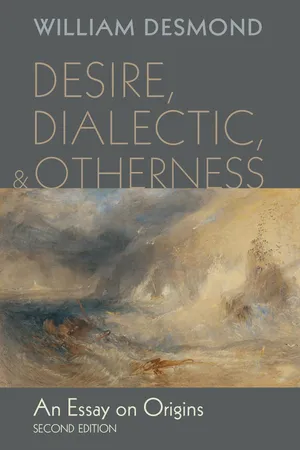
Many philosophers since Hegel have been disturbed by the thought that philosophy inevitably favors sameness over otherness or identity over difference. Originally published at a time when the issue was not so widely discussed in the English-speaking world, William Desmond here offers a constructive and positive approach to the problem of difference and otherness. He systematically explores the question of dialectic and otherness by analyzing how human desire inevitably seeks immanent wholeness in a manner that opens it to irreducible otherness. He faces the difficulties bequeathed to Continental thought by Hegelian dialectic and its tendency to subordinate difference to identity, whether appropriately or not. Unlike many recent critics of Hegel, he argues that we must preserve what is genuine in dialectic. Granting the positive power of dialectic, Desmond offers his first articulation of a further philosophical possibility--what he terms the Metaxological--a discourse of the "between," a discourse doing justice to desire's search for wholeness without any truncating of its radical openness to otherness. In a wide-ranging yet unified discussion, Desmond tackles such issues as the nature of the self, the ambiguous restlessness and inherent power of being revealed by human desire, desire's relation to transcendence, its openness to otherness in agapeic good will and in relation to the sublime as an aesthetic infinitude. Finally, Desmond brings this metaxological understanding to bear on the metaphysical question of the ultimate origin.
This book is a remarkable introduction to Desmond's metaxological philosophy, prefiguring many of the ideas with which his later thought is associated. This second edition contains a substantial new preface and an afterword to each chapter in which Desmond reflects on the material from the standpoint of his current thinking.
Information
Topic
PhilosophySubtopic
Mind & Body in PhilosophyPart 1
Intentional Infinitude
1
Desire, Lack, and the Absorbing God
Man is the active animal, intensely restless and forever questing.1 Living on the move, no sooner do human beings settle in a place but its limits become manifest to them, and their restlessness reappears within its borders. As marked by desire, their being often sends them bustling over the globe to gain a habitation and a home. As temporal beings, their present slips away into the past, while the future they anticipate shows them not to be self-same, not to be coincident with themselves. Behind themselves in a past, in front of themselves in a future, in the present, humans are not absolutely self-identical.2
Desire’s restlessness reveals in us a certain protean power, and not surprisingly, its ambiguous fluidity calls forth myriad interpretations, ranging from Plato’s eros to contemporary Freudian views.3 Our interest lies more with Plato, perhaps, in that we want to explore the sense in which human desire is metaphysical, not just psychological in a manner abstracted from its ontological matrix. I will start with something minimal—namely, the sense of lack and need that all human beings experience—and ask how we might be led by a progressive, immanent unfolding to some glimpse of the ontological power, the power of being, inherent in desire. Such a power need not be explicitly grasped for it, nonetheless, to be active all along. Understood dialectically, desire may give us access to a certain power of active difference that is internal to the self’s identity, an inherent power of self-differentiation. This power, in turn, may point to a certain character of being: the ability to be self-articulating, and to be so in openness to what is other. Beginning with finite desire and the sense of lack that permeates it, I want to look at various responses to human restlessness; self-frustrating efforts to fulfill it finitely, equally self-frustrating flight from it into an absorbing god, and, finally, a genuine turn toward the tension of one’s own nature and the challenge of self-knowledge it poses.
Finite Desire and Lack
As Socrates reminds us in the Symposium, when we desire something, we experience the lack of that thing. The first point we should make about this lack is that it shows that desire cannot be completely self-enclosed. Desire is desire for something and so already reaches beyond itself. For this reason, lack is not solely negative: it attests to the stirring of an impetuous power through which desire begins to be more than itself. Negatively understood, it is a witness to unfulfillment; positively understood, it may make desire aware of itself and so awaken it to what is more than itself. Consider the case of hunger, for example. The lack’s intensification here brings a correspondingly acute sharpening of the sense of what is needed to requite the lack, the negative soliciting its opposite positive. And this importunate sense of the opposite positive is not just an external superposition on desire; it is an internal development that arises from its own negative factor. Thus, when hunger is aggravated in the extreme, when we become ravenous, the emptiness inside is matched by an obsession with food outside. Colloquially, we then say that we could eat a horse. This means that if the negative of hunger is sharpened to the extreme, then the concomitant imperative of the positive of food will spring up so urgently that we contemplate the limit possibility of eating anything at all, as long as it appeases the cavernous gap within. Even here (a point whose full significance we will see later), something, no matter what, is better than nothing. We might describe this as desire’s tenacious witness to the primordial power of the “yes.”
We see, then, that there is a dynamism within the lack expressed by desire, the deepening of which engenders a correlative need that the demand of life be met. This is because what desire wants, needs, and is committed to is fulfilling life. Put more directly, desire is desire for life, a dynamic expression of life and a restless reaching out to larger life. Moreover, this conversion of lack into an affirmative expression of life is the process whereby desire puts itself in a suitable position to thrust out to life beyond itself. Thus, desire is not determined solely by what is initially beyond it; rather, it overcomes its seemingly null character through its own self-expansion. It reveals the immanent exigence to invert its own lack.
Suppose we now look at desire from the standpoint of its possible end, or goal. We cannot here undertake a full discussion of the teleological view of desire, its strengths and its difficulties. As will become clear later, I do not think we can avoid a certain teleological view of human desire (see chapter 3 below). But this is not to imply any Cartesian clarity and distinctness with respect to that teleology. Nor is it tο deny the paradoxical power of desire to try to thwart any teleology (see chapter 3 on equivocal desire), as, for instance, when someone knowingly “drifts” through life—that is, paradoxically purposes to be without purpose and makes it his aim to be aimless. Nor does a teleology of desire necessitate a totalitarian tyranny of the self over otherness.4 Granting provisionally that desire seeks fulfillment in some end, the difficulty with finite desire is that it comes up against the obstruction of external life. In reaching beyond itself, it is faced with what seems, at least initially, to be not fully congruent with an immanent process of self-development. We must explore briefly how some sense of an end enters desire at all stages of its development, and how this makes desire possible in the first place. Just as desire inverts lack, so also, it may reverse its goal’s absence into an anterior presence.
The initial absence of an end reveals desire’s precariousness, for it opens a rift within desire, which, in turn, may threaten to collapse and issue in nothing. Divergent courses become possible: either desire may become party to deepening this absence, thereby losing itself in its own progressive impoverishment; or it may seize on a different possibility. If desire is to be sustained as desire, however, the second course is unavoidable. For if we take the first course, we become immersed in a spreading despair, one that absolutizes the absence of an end. But where desire lives on, absence can never be total. Desire is a form of life which, while originating in lack, wars with lack, seeking thereby to keep despair at bay. For this reason, we cannot say that despair is another form of desire. It takes itself out of desire’s sphere, not simply by forsaking the goal, but also by willing to annihilate desire totally. It perverts desire by inverting it; by not seeking its fulfillment, it becomes totally averse to it. Despair finds desire as such repulsive.5
By contrast, desire looks forward, keeping its prospect alive even when it is suspended in the middle of an uncertain, though for it not absolute, absence. Far from being some simplistic exclusion of despair, desire is the adventure of action, which braves and puts to the test any hope. We may be perpetually aware of the absence of the end, but even in this, some sense of the end is apparent within desire. Anticipation is a relation which, in being dissatisfied with the gulf between a desire and its goal, refuses sheer absence. Even though we may not possess an end, that end may intrude on desire; and the more hope triumphs over despair, the more importunate this intrusion becomes. It may be so insistent at times that we become confused as to whether we have yet to possess the end or have already in fact enjoyed it. In the act of sexual congress, for instance, the end inserts itself in desire prior to the climax of the deed. And it can do this with such puissance that desire reaches a level of lively excitation not far short of the outburst of consummation. Under such circumstances, desire may even lose sight of the upshot yet to be attained and lose itself in the fever with which its hope infects it.
Thus, through anticipation, the end penetrates the course of desire, not only from without but also from within. In the absence of an immanent end—and the presence of such can range from the vaguest of hunches to the most self-conscious of purposes—desire is not properly desire at all, but random motion without direction. Such purposeless motion is not even groping, for groping casts about for direction and has an obscure sense of seeking a goal. Without the presence of an end, however dimly apprehended, desire would never be precipitated in the first place, much less be specified with respect to a determinate bearing or tendency. There would be but purely inert being, wanting nothing, absolutely immobile. Within inert being, desire opens up a space in which active forms of life may come to emergence. The fact that we are not completely self-same testifies to such a disruptive power. The end does not lie solely beyond desire, as a dim, distant future easily postponed while the present remains undisturbed. On the contrary, it disquiets the present, deposits desire within it, and issues in a relation to what is beyond inert thereness. It is an ingredient in the origination of desire, giving birth to it and forcing it to seek some consummation. It is not merely a disruptive power that subverts the fixity of immobile being; it is, rather, a generative power in refashioning in active form what, in passive form, it dissolves, excites, and animates.
In sum, we find here the first unfurling of the power of self-articulation. As it emerges, this power will help shape the forms of activity that will subsequently develop as desire moves from first precipitation to possible consummation. It will transform the space between beginning and end into an articulated middle ground through which desire passes on its adventure. It will seek to bind together a beginning and an end, while at the same time setting them apart and interposing between then a sequence of passing stages that may constitute a way to fulfillment.
This is no reduction of human desire to pure bodily urge. The picture is far more complex. With the eruption of the sense of lack and the intrusion of the end in anticipation, the experience of desire reveals, rather, something of the self-articulation of man’s bodily being. It testifies to the emergence from homogeneous bodily being of a sense of a determinate self. In the initial stages of human development, a determinate self can hardly be said to exist, being, as it were, submerged in its body.6 Desire introduces disjunction into this submersion and sows the seed of a determinate self through the sense of difference and dissatisfaction. We begin to come to ourselves as different in our lack and our want; this sense of need is connected with the initial articulation of human identity in its peculiar paradoxical character (well known to Augustine, Hegel, and Sartre, among others) as aware of itself as not being fully identical with itself.7 The paradox of human identity is that, because its origin is linked with desire, it is also nonidentity—that is, the space where the sense of difference enters the world. Desire discomfits us, thrusts our bodies out of themselves, as it were, out of the womb of the world’s body, and stirs our first sense of naked difference and identity.
Desire expels the body from itself and through the body’s self-differentiation begins to disclose the difference between self and what is other by differentiating between the “in-here” and the “out-there.” It is to be found at the origin of self-consciousness in necessitating our presence to ourselves as lacking. Hence it is tied up with the differentiation of the body into a corporeal and conscious intentionality.8 At a certain point in the development of self-consciousness it transforms the body by converting its impulses into intentions. This emergent sense of self may be seen, for instance, in the experience of nakedness, where we clearly differentiate not only between the inner and outer, but also between our own bodies and a larger sense of self-identity that is not exhausted by our immediate exteriority. In the experience of nakedness, as the myth of the Fall perhaps indicates, we find some first intimations of the import of human difference. Of course, our reaction may well be an impulse to overcome difference, to destroy it even, though, as the myth also tells us, the path back is forever barred to us.
Particular Possessions and the Infinitude of Desire
Let us now consider desire’s relation to difference in its efforts to possess its end. The question now bears more directly on the divorce of desire from an external end that may rebuff it as it reaches out to life beyond itself. In speaking of desire’s end, we must distinguish two senses. The first refers to the termination of the act of desire itself: thus the end of hunger is no longer to feel hungry; the end of hunger is the activity of eating. The second sense does not designate the activity but the object possessed: thus food is the end of hunger in this sense; the end of hunger is not just eating, but the eating of food. To avoid confusion we will speak of end in this second sense as the telos.9
But we must be more specific about the type of telos involved, for desire is specified by its telos being thereby articulated as a desire for this or a desire for that. We desire, but not altogether amorpho...
Table of contents
- Title Page
- Preface to the First Edition
- Preface to the Second Edition
- Introduction
- Part 1: Intentional Infinitude
- Chapter 1: Desire, Lack, and the Absorbing God
- Chapter 2: Desire and Original Selfness
- Chapter 3: Desire’s Infinitude and Wholeness
- Part 2: Actual Finitude
- Chapter 4: Desire, Transcendence, and Static Eternity
- Chapter 5: Desire, Knowing, and Otherness
- Chapter 6: Desire, Concreteness, and Being
- Chapter 7: Desire, Otherness, and Infinitude
- Part 3: Actual Infinitude
- Chapter 8: Desire and the Absolute Original
- Bibliography
Trusted by 375,005 students
Access to over 1.5 million titles for a fair monthly price.
Study more efficiently using our study tools.
Frequently asked questions
Yes, you can cancel anytime from the Subscription tab in your account settings on the Perlego website. Your subscription will stay active until the end of your current billing period. Learn how to cancel your subscription
No, books cannot be downloaded as external files, such as PDFs, for use outside of Perlego. However, you can download books within the Perlego app for offline reading on mobile or tablet. Learn how to download books offline
Perlego offers two plans: Essential and Complete
- Essential is ideal for learners and professionals who enjoy exploring a wide range of subjects. Access the Essential Library with 800,000+ trusted titles and best-sellers across business, personal growth, and the humanities. Includes unlimited reading time and Standard Read Aloud voice.
- Complete: Perfect for advanced learners and researchers needing full, unrestricted access. Unlock 1.5M+ books across hundreds of subjects, including academic and specialized titles. The Complete Plan also includes advanced features like Premium Read Aloud and Research Assistant.
We are an online textbook subscription service, where you can get access to an entire online library for less than the price of a single book per month. With over 1.5 million books across 990+ topics, we’ve got you covered! Learn about our mission
Look out for the read-aloud symbol on your next book to see if you can listen to it. The read-aloud tool reads text aloud for you, highlighting the text as it is being read. You can pause it, speed it up and slow it down. Learn more about Read Aloud
Yes! You can use the Perlego app on both iOS and Android devices to read anytime, anywhere — even offline. Perfect for commutes or when you’re on the go.
Please note we cannot support devices running on iOS 13 and Android 7 or earlier. Learn more about using the app
Please note we cannot support devices running on iOS 13 and Android 7 or earlier. Learn more about using the app
Yes, you can access Desire, Dialectic, and Otherness by William Desmond in PDF and/or ePUB format, as well as other popular books in Philosophy & Mind & Body in Philosophy. We have over 1.5 million books available in our catalogue for you to explore.