eBook - ePub
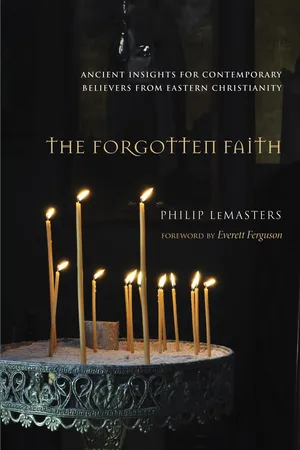
The Forgotten Faith
Ancient Insights for Contemporary Believers from Eastern Christianity
- 164 pages
- English
- ePUB (mobile friendly)
- Available on iOS & Android
eBook - ePub
The Forgotten Faith
Ancient Insights for Contemporary Believers from Eastern Christianity
About this book
There's more to Eastern Christianity than ethnic food bazaars, enclaves of immigrants, and clergy with beards. The mystical theology, spiritual disciplines, and rich liturgical worship of the Orthodox Church provide sustenance for anyone seeking resources for growth in the Christian life. Ancient teachings and practices persist in Eastern Christianity that hold together much of what Catholics and Protestants have separated. Believers of all stripes increasingly resonate with Orthodoxy's healthy synthesis of prayer, doctrine, liturgy, asceticism, and call to holiness in all areas of life. This ancient faith speaks with refreshing clarity to contemporary Christians who want to learn from a living tradition that is too little known in Western culture. This volume presents profound insights that will enrich, challenge, and inspire readers of all backgrounds. It invites everyone to encounter a spiritual tradition that is ancient, contemporary, and fascinatingly different.
Information
Topic
Theology & ReligionSubtopic
Biblical Studies1
The Burning Bush
god is who he is
My father passed away a few days after his ninety-fourth birthday. Daddy was by nature a quiet, reserved person. When I was growing up, people often assumed that he was my grandfather because he had turned fifty the year I was born. I still love, respect, and admire my father and am thankful to have had him as my primary example of how to be a husband and a dad. I could not have asked for a better role model.
Daddy remains, nonetheless, a mystery to me in some ways. Let me be clear: that is not a criticism, but a simple statement of fact. He had already lived half a century before I was born. The Great Depression and World War II were his formative experiences as a young adult, while I grew up in post-Vietnam and post-Watergate America. He was widowed without children before marrying my mother, then my brother and I came along a few years later. A colonel in the Army Reserves and a high school assistant principal, Daddy had a quiet authority and strength about him. He rarely spoke of his military service and was not one to initiate conversations very often. With the exception of Mom, I imagine that most people heard him say very little, at least once he was done making announcements over French High School’s public address system. My friends in Beaumont even joked once that he probably communicated with our family by writing messages on a chalkboard. But Daddy was not aloof or disinterested in others. He was simply quiet and did not have to have the first or last word. I wish I were more like him in that respect. The world should have more people like Claude LeMasters.
These memories of Daddy remind me that, no matter how much we love someone, they remain mysteries to us in at least some ways. People are not math problems or chemistry equations. Even if we can often predict what they will say or do, we never know their thoughts, feelings, or motives with perfect clarity. Even if we did, we would likely misinterpret them due to our own issues. Quiet people may seem a bit more mysterious than the rest of us, but even compulsive talkers are beyond our full grasp. We hear what they say, but do not always know why they feel compelled to say it. Even the most truthful statements that we make about ourselves are limited by our vocabulary, self-understanding, and how much of ourselves we want to reveal. The same is true about our knowledge of God. Though many have ignored it, the Bible makes this point clearly.
For example, Moses understandably asked God for his name when he was in the process of reluctantly agreeing to lead the Exodus out of Egypt. It is good at least to know the identity of the deity asking you to garner support for an implausible escape from slavery that could easily result in your death. Moses probably thought “Thanks a lot, God” when the voice from the burning bush said in response, “I AM WHO I AM” (Exod 3:13ff.). In other words, this God is beyond full definition or rational comprehension; to obey him is going to require lots of trust. To know someone’s name in that time and place was to have a certain power over them. Magicians were used to saying the magic words and getting the results they wanted. Well, the God of the burning bush is nothing like that. So Moses had to step out in faith to serve a God who remained in many ways a mystery.
If even our parents, spouses, children, and best friends are beyond our full rational comprehension, how much more must that be true with the Almighty? Even our best efforts to name, define, and control him will always fall short. The imagery of the call of Moses makes that point clear. God spoke to him from a burning bush that was not consumed by the flames. Moses had to take off his shoes and then fell on his face before the Lord. This was not a simple exchange of ideas or even a graduate seminar in theology. A mortal human being (who already had a checkered past) truly encountered God, the Creator of heaven and earth, and was told his name. It was not time for conventional chitchat or even sophisticated philosophy. It was time to bow down in worship.
Eastern Orthodox Christianity remembers Moses when it comes to talking about God. We learn from him that true knowledge of God is participatory and relational; ultimately, it is about worship and prayer, not intellectual definitions. The point is not to rest content with mouthing abstract truths or doctrines about the Lord. The goal is to enter into his life and to be transformed by his grace.
If that sounds too mystical, consider this example. An iron poker left in a roaring fire will eventually become red hot. While remaining iron, it takes on heat and light, key qualities of fire. It is transformed by being in the fire. The same will be true of human beings who open their hearts to God in prayer, as they are filled with the gifts of the Holy Spirit and as they show Christ’s love to their neighbors. As people find healing from the wounds of sin in their lives and grow as Christians, they share more fully in God’s salvation. Our Savior said that his followers are to be perfect as their Father in heaven is perfect, so we all have a long way to go (Matt 5:48). In the Orthodox Church, we call this process theosis, which means advancing in holiness and union with the Lord. You might say that we become like an iron left in the Burning Bush (yes, the capital letters are intentional). As St. Peter put it, we become “partakers of the divine nature” by grace (2 Peter 1:4).5
Well, what do these fiery images have to do with knowing God? Actually, they get to the heart of the matter. Historic Christianity has doctrines about God as Father, Son, and Holy Spirit, Jesus Christ as divine and human, and other matters that are fundamental to the faith. In case all the talk about mystery has you wondering, the Eastern Orthodox Church does not fudge on doctrine at all. We believe that the Holy Spirit has led the Church across the centuries in defining what needed (and still needs) to be taught in order to proclaim the fullness of salvation in Jesus Christ. But theological claims do not exist for their own sake. Instead, they are necessary to protect and point to the mystery that is beyond words. And even the best words that we use do not plumb the depths of God. We remain mortals who need to take off their shoes and fall on their faces before the Lord. He is God Almighty and we are certainly not.
Consider a concrete example. The Council of Chalcedon made clear in AD 451 that Jesus Christ is one person with two natures.6 Our Savior is the God-Man, fully divine and fully human at the same time. He does not mix up these natures in a way that makes him neither divine nor human. He is both—full, complete, and unchanged. The Council taught this doctrine because of debates between different theologians who had compromised either the Lord’s divinity or his humanity, such that the Church would not be able to give an account of how he is the Savior. If Jesus Christ is not fully God, how can he conquer death and bring us into the eternal life of God? If he is not fully human, how can he save us who are fully human? Very important matters were at stake in Chalcedon.
But a moment’s thought will show that these definitions point to a mystery that is beyond definition. Even the technical language used by the council was negative in the sense of ruling out errors more than making positive statements. Surely, no one could ever prove beyond question that the Lord is both fully human and divine—or even explain precisely how the Incarnation works. It would do more harm than good to say that we had. We are speaking here of matters of faith, which, by definition, are beyond full explanation by rational proof.
That does not mean, of course, that they are not true. Think for a moment about the human beings you love the most in this life. You can make statements about them of which you are totally convinced. But you cannot put their generosity, humility, faithfulness, empathy, or beautiful personalities under a microscope. You have to experience them as you do in order to know what you know about them. Your relationship is your knowledge of them; there is nothing objective about it. You also probably do not have full-blown theories to explain your loved ones and their characteristics. People are mysteries, not ideas, and we have to accept that living, breathing human beings are beyond our full rational comprehension.
The words and ideas that we use to describe our loved ones are very important, however. In light of what we have experienced, we do the best we can to express the truth about another person. The same is true for how we talk about God. We use language that is faithful to our experience of the Lord, that witnesses to what we have seen and heard. We have no right to use language about other human beings that distorts their identity or is not true to how we have known and experienced them. Likewise, the Orthodox Church sticks with teachings about God that reflect the experience of many generations of faithful believers. And we are not concerned only with formal dogmatic pronouncements. Hymns, icons, worship services, prayers, and the accounts of the lives of holy people we call saints all point to how God has revealed himself to us. Everything in the life of the Church should protect that precious truth, even if the truth is not terribly popular.
In some more circles today, it is fashionable to avoid using any masculine language for God at all for fear of putting down women. I have also heard of people who did not have a good relationship with their dads and consequently do not like to think of God as Father. Some simply say “God” instead of “Father,” while others have invented new trinities such as “Creator, Redeemer, and Sustainer” or even “Lover, Mother, and Friend.”
Eastern Christians believe that these developments are misguided and spiritually dangerous. The revealed names for God have to do with mystery and call for prayer and worship, not editorial revision. In the events described in the Old Testament, God revealed Himself as “I AM WHO I AM.” The New Testament describes God’s self-revelation as Father, Son, and Holy Spirit. When St. John the Baptist baptized Jesus Christ, the voice of the Father proclaimed “This is my beloved Son with whom I am well pleased,” while the Holy Spirit descended upon Christ in the form of a dove (Matt 4:16–17). The Holy Trinity is not the speculation or invention of academic theologians, but the truth about God as revealed directly by him. And in case there is any doubt about using the term Father, remember how the Lord instructed the disciples to pray, saying “Our Father.” Yes, that is the Lord’s Prayer from the Lord himself, the incarnate Son of God. It is hard to get better theological support than that.
Of course, language about the Trinity fits the category of mystery.7 The Council of Nicaea in AD 325 rejected Arius’s teaching that Jesus Christ was not fully divine and insisted that the Father and Son are of a common nature or essence. The First Council of Constantinople in AD 381 clarified that the Holy Spirit is also the Lord and giver of life who is worshiped and glorified together with Father and Son. Here is the formal articulation of the doctrine of the Holy Trinity. Precisely how three are one and one is three is surely beyond rational calculation. The math does not add up. Of course, we are not dealing here with counting chickens, but with bowing before the mystery as revealed to us in Jesus Christ and his Body the Church. Christians invoked the Trinity in prayer and baptism from the origins of the faith. God revealed himself as Trinity in the Lord’s baptism, and formal definitions of the doctrine became necessary when Arius and others denied that Jesus Christ is really divine. Had there been no controversy about such issues, councils to resolve the disputes would not have been called.
Many people’s eyes glaze over when the conversation turns to such seemingly abstract matters. There is nothing theoretical about this debate, however. Questions of the divinity of the Son and the Holy Spirit are crucial for a faith in which people experience Jesus Christ as their Savior and worship him as God. The same is true for the Holy Spirit, as it is by his power that Christ is in our hearts and we find salvation. Just look at how the Lord’s followers were transformed on the day of Pentecost and continue to be strengthened to this day by the gifts of the Holy Spirit (Acts 2:1ff.). Ways of speaking about Jesus Christ and the Holy Spirit as less than divine were not true to the experience of the Church and distorted what God had revealed to his people. Had the Church not boldly proclaimed that the Father, the Son, and Holy Spirit are all equally God, the Christian faith would have been mortally wounded. A Jesus who is not divine cannot bring us into the eternal life of God. And without a divine Holy Spirit, how can Christ live in our hearts? (E.g., Gal 4:6.)8
Likewise, to reject the use of the term Father for reasons having to do with gender or other reservations reflects a failure to appreciate the mystery of God.9 When Christians call God our Father, we do not mean that he is a little old man in heaven with a white beard. The Father was never incarnate, never became part of his creation with a body, while gender distinctions are bodily and biological. He is in so many ways a mystery to us. The Church actually does not say much about him in the Nicene Creed. “I believe in one God, the Father Almighty, maker of heaven and earth and of all things visible and invisible.” Yes, that is it.
We do know that the Father so loved the world that he gave his only begotten Son that all who believed in him should not perish, but have everlasting life (John 3:16). The parable of the Prodigal Son, spoken by the Son of God, portrays a shockingly humble, forgiving, and loving Father who treated his rascal of a son in a way that no self-respecting father of that time and place would have done (Luke 15:11–32). The clues that we get about the character of the Father from Jesus Christ are certainly not those of an oppressive male chauvinist. Christ has truly shown us the Father and we should like what we see.
My father was a great person and I will love and miss him for the rest of my life, but he is not the model for God the Father. It is the other way round. ...
Table of contents
- Title Page
- Foreword
- Preface
- Introduction
- Chapter 1: The Burning Bush
- Chapter 2: Salvation, Sex, and Food
- Chapter 3: Mary: Don’t Be Afraid!
- Chapter 4: Football, Liturgical Worship, and Real Life
- Chapter 5: Fools, Monks, and Martyrs
- Chapter 6: Constantine and the Culture Wars
- Conclusion
- Bibliography
Trusted by 375,005 students
Access to over 1.5 million titles for a fair monthly price.
Study more efficiently using our study tools.
Frequently asked questions
Yes, you can cancel anytime from the Subscription tab in your account settings on the Perlego website. Your subscription will stay active until the end of your current billing period. Learn how to cancel your subscription
No, books cannot be downloaded as external files, such as PDFs, for use outside of Perlego. However, you can download books within the Perlego app for offline reading on mobile or tablet. Learn how to download books offline
Perlego offers two plans: Essential and Complete
- Essential is ideal for learners and professionals who enjoy exploring a wide range of subjects. Access the Essential Library with 800,000+ trusted titles and best-sellers across business, personal growth, and the humanities. Includes unlimited reading time and Standard Read Aloud voice.
- Complete: Perfect for advanced learners and researchers needing full, unrestricted access. Unlock 1.5M+ books across hundreds of subjects, including academic and specialized titles. The Complete Plan also includes advanced features like Premium Read Aloud and Research Assistant.
We are an online textbook subscription service, where you can get access to an entire online library for less than the price of a single book per month. With over 1.5 million books across 990+ topics, we’ve got you covered! Learn about our mission
Look out for the read-aloud symbol on your next book to see if you can listen to it. The read-aloud tool reads text aloud for you, highlighting the text as it is being read. You can pause it, speed it up and slow it down. Learn more about Read Aloud
Yes! You can use the Perlego app on both iOS and Android devices to read anytime, anywhere — even offline. Perfect for commutes or when you’re on the go.
Please note we cannot support devices running on iOS 13 and Android 7 or earlier. Learn more about using the app
Please note we cannot support devices running on iOS 13 and Android 7 or earlier. Learn more about using the app
Yes, you can access The Forgotten Faith by Philip LeMasters in PDF and/or ePUB format, as well as other popular books in Theology & Religion & Biblical Studies. We have over 1.5 million books available in our catalogue for you to explore.