eBook - ePub
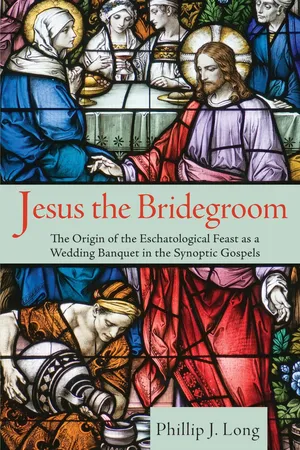
Jesus the Bridegroom
The Origin of the Eschatological Feast as a Wedding Banquet in the Synoptic Gospels
- 298 pages
- English
- ePUB (mobile friendly)
- Available on iOS & Android
eBook - ePub
Jesus the Bridegroom
The Origin of the Eschatological Feast as a Wedding Banquet in the Synoptic Gospels
About this book
Did Jesus claim to be the "bridegroom"? If so, what did he mean by this claim? When Jesus says that the wedding guests should not fast "while the bridegroom is with them" (Mark 2:19), he is claiming to be a bridegroom by intentionally alluding to a rich tradition from the Hebrew Bible. By eating and drinking with "tax collectors and other sinners," Jesus was inviting people to join him in celebrating the eschatological banquet. While there is no single text in the Hebrew Bible or the literature of the Second Temple Period which states the "messiah is like a bridegroom," the elements for such a claim are present in several texts in Isaiah, Jeremiah, and Hosea. By claiming that his ministry was an ongoing wedding celebration he signaled the end of the Exile and the restoration of Israel to her position as the Lord's beloved wife. This book argues that Jesus combined the tradition of an eschatological banquet with a marriage metaphor in order to describe the end of the Exile as a wedding banquet.
Information
1
Introduction
Background to the Problem
Frequently New Testament commentaries will state that the image of a banquet, or more specifically, a wedding banquet, was a common messianic image in the first century.1 However, other than Isa 25:6–8, sources for the image of a banquet for the messianic age in the Hebrew Bible are sparse, and there is very little to support the view that a wedding banquet was a widespread image of the messianic age in Second Temple period Judaism. E. P. Sanders therefore doubts the symbolic value of the messianic banquet as a wedding celebration in the first century.2 Jesus used imagery that was designed to recall Jewish messianic hopes current in the first century. For example, Sanders cites Jesus’ selection of twelve disciples as re-creating Israel in his followers. A Jew living in Palestine in the first century would be able to understand the point of a Jewish teacher who talked about a kingdom and selected twelve men as his disciples.3 Similarly, Davies and Allison deny that there are any Second Temple period sources for the idea of a messianic feast as a wedding banquet.4
Yet the image of a banquet clearly appears in the Synoptic Gospels in both the actions of Jesus as well as his teaching. In his table fellowship Jesus invites all people to eat and drink with him (Matt 8:11–12). In his teaching through parables Jesus describes his ministry as an invitation to a feast. Those who respond to this invitation are participating in the banquet, but those who do not respond will never be admitted to the banquet (Matt 22:1–14, Matt 25:1–12). This ongoing banquet is described as a wedding feast and Jesus himself claims to be the bridegroom (Mark 2:19–20). Because the metaphor of a wedding banquet is not found in the literature of the Second Temple Period, scholars frequently assume that this sort of language was created by the Gospel writers and that Jesus himself did not claim to be a bridegroom.
It is the contention of this book that Jesus did indeed claim to be a bridegroom and his ministry was an anticipation of the eschatological banquet. While there is no single text in the Hebrew Bible or the literature of the Second Temple Period which states the “messiah is like a bridegroom,” the elements for such a claim are present in several traditions found in this literature. Jesus created this unique image by clustering three traditions drawn from the Hebrew Bible and applying them to his ministry. First, the eschatological age is inaugurated by a banquet eaten in the presence of God (Isa 25:6–8). Second, the end of the exile is often described as a new Exodus and a new journey through the wilderness (Isa 40–55). Third, the relationship of God and his people is often described as a marriage (Hosea, Jer 2–4). Like any other teacher of the Second Temple Period, Jesus intentionally alluded to traditions drawn from the Hebrew Bible in order to describe a new situation. Jesus claims that his ministry is an on-going wedding celebration that signals the end of the Exile and the restoration of Israel to her position as the Lord’s beloved wife.
Statement of the Problem
The problem this book seeks to address is the origins of the wedding banquet imagery in the teaching of Jesus. In this dissertation I will argue that Jesus combined several related eschatological traditions drawn from the Hebrew Bible in order to depict his ministry as an on-going wedding celebration. This combining of traditions may be described as intertextual, but the term will need to be more broadly defined to include traditions as well as texts. While these traditions are present in the Hebrew Bible and the literature of the Second Temple Period, the combination of traditions was unique to historical Jesus. The main thesis of this dissertation is that Jesus himself combined the tradition of an eschatological banquet with a marriage metaphor in order to describe the end of the Exile as a wedding banquet.
Previous Scholarship on the Messianic Banquet
No single monograph has been devoted to the messianic banquet in Second Temple period Judaism, nor has there been a comprehensive study of the idea of a messianic banquet in the Hebrew Bible. Several articles and a few dissertations have examined the topic, although from different perspectives than proposed by the present study. Prior to 1990, most studies on parables simply repeated information found in Strack and Billerbeck5 or G. F. Moore.6 For example, J. C. O’ Neill contributed a short note on the origin of the bridegroom metaphor which listed a number of texts which he assumes are “background” for the idea.7 This list is given with no critical evaluation and includes items which may be dated well after the time of Jesus. R. A. Batey briefly surveyed possible sources for the image of a wedding banquet in the New Testament as part of his dissertation and subsequent monograph but paid very little attention to the development of what he called nuptial imagery in the Second Temple period.8
Two articles appeared in the early 1990s which sought to address the lack of serious study of the theme of messianic banquet in New Testament studies.9 Citing the common assumption that the idea of a messianic banquet is pervasive in the Second Temple period, J. Priest’s article proposed to re-evaluate the evidence for messianic banquet in the Second Temple period.10 Gathering virtually every text which might be read as a banquet in the Apocrypha and Pseudepigrapha, he finds two contrasting themes which are constantly present: the joy of the redeemed and the judgment and destruction of the enemies of God.11 While there is a great deal of variation in the description of the banquet in these texts, a renewal of nature resulting in abundant food and drink is consistent.
D. Smith contributed a short article on the messianic banquet in which he sought to demonstrate several motifs which make up the messianic banquet in biblical and Second Temple period literature: a joyous banquet, the presence of the messiah, judgment, and a pilgrimage of the nations.12 Smith suggested that Jesus’ wedding banquet metaphor was a “variation on the messianic banquet theme” which combined the common image of marriage to describe God’s relationship with his people with mythological traditions.13 He specifically cites Isa 55:1–5 as foundational for this combination.
Both Priest and Smith mention the presence of a communal meal in the Messianic Rule found at Qumran but do not provide a detailed analysis.14 L. Schiffman’s monograph on the Messianic Rule indicates that a messianic banquet idea was present in the Qumran community.15 Commenting on the so-called Messianic Rule (1QSa), Schiffman argues the community believed the advent of the messianic age would include a banquet over which the priestly messiah himself would preside.16 While the conclusion is controversial, Schiffman argues the meal shared by the Qumran community was a daily re-enactment of the future messianic banquet.17 This meal may be based on Ezek 44:3, a passage which describes a meal which the Davidic prince will initiate at the time of the renewal of the temple.18
D. Steffen’s 2001 dissertation on the messianic banquet in Matthew charts a different course than this study.19 Steffen’s interest is in Matthew’s use of the messianic banquet to explain Gentile inclusion in present age rather the use of ...
Table of contents
- Title Page
- Preface
- Abbreviations
- Chapter 1: Introduction
- Chapter 2: The Use of Hebrew Bible Imagery in the New Testament
- Chapter 3: Eschatological Banquet in Isaiah
- Chapter 4: A Banquet in the Wilderness
- Chapter 5: Israel as the Wife of the Lord
- Chapter 6: From the Hebrew Bible to the Historical Jesus
- Chapter 7: The Wedding Banquet in the Synoptic Gospels
- Chapter 8: Conclusions and Suggestions For Further Research
- Bibliography
Trusted by 375,005 students
Access to over 1.5 million titles for a fair monthly price.
Study more efficiently using our study tools.
Frequently asked questions
Yes, you can cancel anytime from the Subscription tab in your account settings on the Perlego website. Your subscription will stay active until the end of your current billing period. Learn how to cancel your subscription
No, books cannot be downloaded as external files, such as PDFs, for use outside of Perlego. However, you can download books within the Perlego app for offline reading on mobile or tablet. Learn how to download books offline
We are an online textbook subscription service, where you can get access to an entire online library for less than the price of a single book per month. With over 1.5 million books across 990+ topics, we’ve got you covered! Learn about our mission
Look out for the read-aloud symbol on your next book to see if you can listen to it. The read-aloud tool reads text aloud for you, highlighting the text as it is being read. You can pause it, speed it up and slow it down. Learn more about Read Aloud
Yes! You can use the Perlego app on both iOS and Android devices to read anytime, anywhere — even offline. Perfect for commutes or when you’re on the go.
Please note we cannot support devices running on iOS 13 and Android 7 or earlier. Learn more about using the app
Please note we cannot support devices running on iOS 13 and Android 7 or earlier. Learn more about using the app
Yes, you can access Jesus the Bridegroom by Phillip J. Long in PDF and/or ePUB format, as well as other popular books in Theology & Religion & Biblical Criticism & Interpretation. We have over 1.5 million books available in our catalogue for you to explore.