- 366 pages
- English
- ePUB (mobile friendly)
- Available on iOS & Android
eBook - ePub
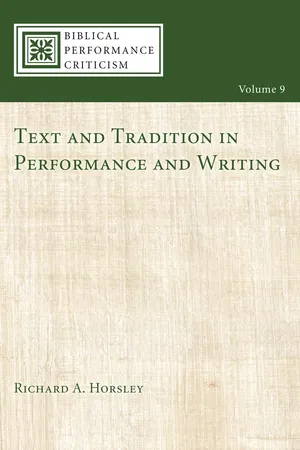
Text and Tradition in Performance and Writing
About this book
Embedded in modern print culture, biblical scholars have been projecting the assumptions and concepts of print culture onto the texts they interpret. In the ancient world from which those texts originate, however, literacy was confined to only a small number of educated scribes. And, as recent research has shown, even the literate scribes learned texts by repeated recitation, while the nonliterate ordinary people had little if any direct contact with written scrolls.
The texts that had taken distinctive form, moreover, were embedded in a broader and deeper cultural repertoire cultivated orally in village communities as well as in scribal circles. Only recently have some scholars struggled to appreciate texts that later became "biblical" in their own historical context of oral communication.
Exploration of texts in oral performance--whether as scribal teachers' instruction to their proteges or as prophetic speeches of Jesus of Nazareth or as the performance of a whole Gospel story in a community of Jesus-loyalists--requires interpreters to relinquish their print-cultural assumptions. Widening exploration of texts in oral performance in other fields offers exciting new possibilities for allowing those texts to come alive again in their community contexts as they resonated with the cultural tradition in which they were embedded.
Information
Topic
Teología y religiónSubtopic
Estudios bíblicos1
Oral Communication, Oral Performance, and New Testament Interpretation
Modern western print culture gave birth to biblical studies—and now threatens to hold it captive.1 Like classicists, New Testa-ment scholars who write mass-produced books and articles for individual silent readers have simply assumed that biblical “books” were widely distributed, readily available, and easily read at least by the time of Jesus and Paul. They assume, for example, that “authors” “wrote” the Gospels, which were fairly quickly “in circulation” to be “read” by early Christians.
Parallel but often separate lines of research in recent decades have shown that literacy was extremely limited in antiquity and that oral communication dominated, even among the literate elite. There was no “Great Divide” between an oral and a literate culture. Written texts in ancient Judea and the Roman empire were embedded in the wider oral communication. In their interface, written texts reflected oral communication and writing influenced oral communication. Many texts that were inscribed on scrolls continued to be cultivated orally. By repeated recitation they had become “inscribed” on the tablets of people’s hearts as well as on scrolls.
Ironically our only access to oral communication is through extant written texts. Hence it is important not to impose modern typographical assumptions and concepts in which our scholarship is embedded onto the oral communication that might be discernible in or underneath the written texts that are the only remains visible of the biosphere of communication from which they grew.2 It is important, therefore, to recognize that historically there have been different oral communications and literacies, and to investigate the specific social practices of reading and writing and oral communications. Practices of writing and reading are culturally embedded and ideological. Thus, while estimated percentages of “literacy” may be telling indicators for particular cultural situations, it is more important to discern the different uses of writing and their relationship with various forms of oral communications.3
Some significant implications for New Testament interpretation are already clear from the various lines of recent research.4 Insofar as the medium of communication in antiquity was predominantly oral, and even written texts were recited orally to communities of people, it will be necessary for New Testament interpretation to shift and expand its focus from written texts in themselves, to (oral) communication as interactive and the context(s) in which it happened. Moreover, just as writing was embedded in wider oral communication, so particular texts, orally performed and/or written, were embedded in wider cultural tradition(s) and collective social memory, which thus become all the more important for our interpretation. Furthermore, insofar as oral and/or written texts (like the “oral traditions” behind them) were used, in repeated recitation and application in communities and their contexts, interpretation would be appropriately focused on their cultivation and not their mere transmission.
Oral Communication, Literacy, and the Uses of Writing in the Roman Empire
Literacy was limited to a tiny percentage (10%) of the population in the Roman empire. More important than the rate of literacy, however, were the uses and functions of writing. Writing was used mainly by the political and cultural elite, often as an instrument of power. While they knew that it was used by the elite, the vast majority of the people had no use for writing.5
The largely localized ancient economy did not require widespread literacy. A tiny minority of urban artisans used brief written forms. By the first century BCE, Roman aristocratic families had written contracts drawn up for large-scale loans and other major transactions. Administration and control of the empire required considerable use of writing, such as the imperial correspondence carried out by slaves in the “family of Caesar.” The calculations of how much tribute could be taken from a given territory and its population were kept in writing (the “census” or “enrollment” of Luke 2:1). The Romans built massive monuments inscribed with names, slogans, and lengthy accounts of the great acts of the emperor in bringing Salvation and Security to the cities of the Empire. The operations of the Roman military also required extensive, if less public, writing. Writing in various forms was thus used mainly to maintain or expand military, economic and/or social power.
Writing also came to play a role in elite “literary” culture. Like every other aspect of life in the ancient world, however, this culture also was largely oral. Poetry of various forms was performed at festivals and in great households. Plays were performed in theaters. Orators displayed their rhetorical prowess at city festivals and before emperors. Sometimes orators used writing in the preparation of their orations. At least some literary culture was requisite for the urban and provincial elite of the Roman empire, although they depended on suitably trained slaves to handle correspondence and read aloud to them. Yet most of their life, including “literary” entertainment and the ceremonial conduct of “political” affairs, proceeded by means of oral communication.
Among the ordinary people in the Roman empire, urban artisans and rural peasants, transactions of all kinds took place in oral communication, usually face to face. Even “legal” agreements such as loans were conducted orally, perhaps confirmed by witnesses, the transfer of symbolic objects, and/or personal oaths. Such interaction was governed by age-old custom and ritual. Personal witnesses and testimony were far more trustworthy than written documents that could be altered by those who might use them for their own advantage. Indeed the people were often suspicious of writing as an instrument of their landlords or rulers.
It is curious that scholars of early Christianity who are aware of this limited literacy in the Roman empire continue to trust older generalizations about general literacy among Judeans and diaspora Jews. “According to Josephus, in first-century Judaism it was . . . a religious commandment that . . . children be taught to read . . . [R]abbinic sources suggest . . . that by the first century CE . . . even small communities had elementary schools.”6 The key passages from Josephus, however, indicate not that children were taught to read but that the teaching and learning of the laws were done through public oral recitation (at Sabbath assemblies). This suggests both that Jews, like others in the Roman empire, were generally not literate and that communications even of the most important matters was oral. Through recitation and hearing the laws would become “engraved on [the people’s] souls . . . and guarded in their memory” (Ant. 4.210; 16:43; c. Apion. 2.175, 178, 204; cf. Philo, ad Gaium 115, 210). Earlier studies failed to consider key aspects of the historical context, particula...
Table of contents
- Title Page
- Introduction
- Acknowledgments
- Abbreviations
- Chapter 1: Oral Communication, Oral Performance, and New Testament Interpretation
- Chapter 2: The Origins of the Hebrew Scriptures under Imperial Rule
- Chapter 3: Oral–written Scribal Cultivation of Torah—Not “Re-Written Bible”
- Chapter 4: Oral Composition-and-Performance of the Instructional Speeches of Ben Sira
- Chapter 5: Contesting Authority
- Chapter 6: Israelite Tradition and the Speeches of Jesus in Q
- Chapter 7: Hearing Q/Luke 12:2–12 as Oral Performance
- Chapter 8: The Speeches of Yeshua ben Sira— and the Speeches of Yeshua bar Marya
- Chapter 9: The Language(s) of the Kingdom
- Chapter 10: Oral Performance and the Gospel of Mark
- Chapter 11: Imagining Mark’s Story Composed in Oral Performance
- Chapter 12: Oral Performance in the Emergence of the Gospel of Mark as Scripture
- Epilogue
- Bibliography
Trusted by 375,005 students
Access to over 1.5 million titles for a fair monthly price.
Study more efficiently using our study tools.
Frequently asked questions
Yes, you can cancel anytime from the Subscription tab in your account settings on the Perlego website. Your subscription will stay active until the end of your current billing period. Learn how to cancel your subscription
No, books cannot be downloaded as external files, such as PDFs, for use outside of Perlego. However, you can download books within the Perlego app for offline reading on mobile or tablet. Learn how to download books offline
We are an online textbook subscription service, where you can get access to an entire online library for less than the price of a single book per month. With over 1.5 million books across 990+ topics, we’ve got you covered! Learn about our mission
Look out for the read-aloud symbol on your next book to see if you can listen to it. The read-aloud tool reads text aloud for you, highlighting the text as it is being read. You can pause it, speed it up and slow it down. Learn more about Read Aloud
Yes! You can use the Perlego app on both iOS and Android devices to read anytime, anywhere — even offline. Perfect for commutes or when you’re on the go.
Please note we cannot support devices running on iOS 13 and Android 7 or earlier. Learn more about using the app
Please note we cannot support devices running on iOS 13 and Android 7 or earlier. Learn more about using the app
Yes, you can access Text and Tradition in Performance and Writing by Richard A. Horsley in PDF and/or ePUB format, as well as other popular books in Teología y religión & Estudios bíblicos. We have over 1.5 million books available in our catalogue for you to explore.