eBook - ePub
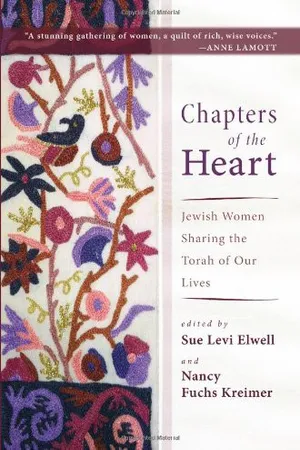
Chapters of the Heart
Jewish Women Sharing the Torah of Our Lives
- 226 pages
- English
- ePUB (mobile friendly)
- Available on iOS & Android
eBook - ePub
Chapters of the Heart
Jewish Women Sharing the Torah of Our Lives
About this book
Chapters of the Heart: Jewish Women Sharing the Torah of Our Lives invites readers into the lives of twenty women for whom Jewish language and texts provide a lens for understanding their experiences. The authors don't just use religious words (texts, theologies, or liturgies) like a cookbook. Instead they serve readers something closer to a real meal, prepared with love and intention.
Each essay shares one piece of its writer's heart, one chapter of experience as refracted through the author's particular Jewish optic. The authors write about being daughters, mothers, sisters, partners, lovers, and friends. They share their experiences of parenting, infertility, and abortion. One describes accompanying her young husband through his life-threatening illness. Another tells of her daughter's struggle with an eating disorder. Still another reflects on long decline of a parent with Alzheimer's.
All these writers wrestle with Jewish texts while growing as rabbis, as feminists, and as interfaith leaders. They open their hearts and minds, telling when Jewish tradition has helped make meaning and, on occasion, when it has come up empty. The results are sometimes inspiring, sometimes provocative. Readers will find new insights into God, into Judaism, and into themselves.
Information
Topic
Theology & ReligionSubtopic
Christian ChurchI
All the Days of Our Lives
(Psalm 27:4)
1
A Life with Things
Soon after my engagement, my future mother-in-law kept me lingering at her breakfast table in Lloyd Neck, New York. These people were technically Jews by birth and by a strong ethnic pride, yet it was a “WASPy” home, the first “WASPy” home I had ever been in. Their son, my fiancé, was in rabbinical school, a situation that so dismayed his father, a man who ran from the old-world Jewish chicken-bone nonsense he had grown up with into the arms of science. He was metaphorically sitting shiva for his son until the blessed day he left seminary to work on a doctorate in philosophy.
Mrs. Ochs (which is what I called her) dressed in a pale blue lingerie set with matching pale blue leather slippers. For breakfast, after cut-up grapefruit, she served homemade blueberry pancakes with softened butter in a ramekin and warmed syrup in a crystal pitcher. In a hand-painted Italian ceramic creamer she had found at a fancy estate sale, she served what she called, “hoff and hoff,” as native Bostonians do. Every food needed a proper container once it was transported to the table. Even cereals were redistributed from their packages into Tupperware, and the milk for the cereal was properly jugged.
“I trust you have registered for China?” she asked rhetorically. She had paused, mid-sentence to hold her face, to address the pain of tic douleroux. But she never said anything about it; this too was part of the household decorum. To kvetch, even when justified, was not done.
What did it mean to register for a country, a communist country at that? I had never mentioned a particular interest in China, even though Nixon, Kissinger, and Ford were making social trips there and were seeing what the officials wanted them to see. Maybe if she had asked me when the whole world was turning toward China during the Olympics, first with smog and human rights violations on our minds, and later, with Michael Phelps and the prepubescent Chinese gymnasts seizing our attention, I could have impressed her favorably and fudged an appropriate response. That mattered to me in the early years, before I gave up trying to fly under her critical radar. Still, I felt lucky she had brought up China, presuming we were going to have a discussion of substance about geography or politics, and avoid invitations or guest lists. I was just nineteen, and even though I had just become engaged, I could give a fig about things that would fill a home. I was in love. The only thing I wanted was to have this boy forever.
Mrs. Ochs went on to explain. “You need to give thought to selecting your china pattern, because it’s forever.”
“You don’t say,” I said, copying the expression she most fancied. It dawned on me that I might spend years ahead feigning interest in elegantly intrusive orations on home furnishings, upholstery, and the proper way to rear children (her way, 1950s style, with mother at home and children in playpens).
The next day, back home on the South Shore of Long Island, the Five Towns to be specific, Hewlett Harbor to be precise, I told my mother about what Mrs. Ochs had counseled me to do. My mother had heard of gift registries and she, an artist, who wore a mink coat with sneakers, shared my disdain. We agreed that it was rude, greedy, and presumptuous. Perhaps this business of registering for china was what WASPs did, another one of their quirks, like having trust funds but still driving beat-up station wagons.
“Failing to register, you’ll end up with gifts you don’t want,” Mrs. Ochs went on to say the next time I visited, sensing she might appeal to my pragmatism.
“You don’t say,” I said again, moving the conversation along.
I didn’t know we’d be getting wedding presents. I had been to only one wedding as the flower girl. My aunt had taught me about going down the aisle dropping petals from a basket (step, together, drop, repeat), but she had mentioned nothing about brides signing up at Tiffany, Bloomingdale’s, or Fortunoff so that they could outfit their real-life “Barbie’s Dream Houses” with the objects they desired, and in the patterns they preferred. Perhaps I just wasn’t listening.
A college junior, I had no idea just how many objects were necessary for daily life outside of a dorm. Didn’t we already have more than everything we needed? There was my parent’s cast-off furniture in their basement; the pots and pans, bun-warmer and yogurt-maker my grandparents had gotten as premiums for starting new checking accounts in several banks; the Chagall poster from my dorm room, and “Christina’s World” from my fiancé’s. In his seminary room, my fiancé had four dishes for meat and four for milk; among his classmates, with his hot plate, he was practically the Jewish Galloping Gourmet. Maybe we’d need a cookbook other than The Vegetarian Epicure, a glass measuring cup, and more cinderblock shelves, but we certainly didn’t need to fill a grad school flat with symbols of respectability.
Mrs. Ochs would not be giving up; her lectures grew impassioned. China, she explained, meant dishes, dishes you didn’t use for everyday, dishes that symbolized an enduring marriage. The steps you took to preserve your china in a hutch mirrored those you took to preserve your marriage. That your dishes came from many people reflected the community’s investment in your relationship. “With the china,” taking a less foreboding approach, she concluded, “you celebrate and make an impression.” She used a phrase I couldn’t parse: “Your wedding china is for ‘best.’” She clarified, “China is for company.”
My family did not, as a rule, have company, with the exception of the few times that my uncles Effie or Shep came for Shabbes so we could fix them up on Saturday night with my grade-school teachers who wore their hair teased way up in beehives. My mother bought Southern-fried chicken in a bag from the new Kosher take-out place, along with foil containers of egg-mushroom “barley,” potato and spinach knishes wrapped in wax paper, containers of “health” salad, coleslaw and potato salad, and a thick slice of kishke that was rationed off in slivers, lest too much kill a person with indigestion. She served this all up on paper plates for Shabbes dinner, Shabbes lunch, and Saturday night dinner. At the end of each meal, she was sucking the marrow out of the heap of bones on her grease-stained plate, making flute sounds.
Uncle Effie had married a woman from Montclair, une petite peu WASPy herself, and he called to say they were stopping by to visit on Saturday night, even though my mother told him explicitly not to come as she was going to bed early. It happened that she was annoyed with him, as usual, for some miniscule brotherly infraction, a failure to show respect. They came anyways, and my mother, already in pajamas, dimmed the lights in the dining room when she saw his car light coming around the bend. She told me lie low and do not laugh. She said, “Effie is in the doghouse.” Being a literalist, I said, “He’s not in a doghouse. He and Auntie Bobbie are at the front door and they are wearing sleeping hats and bathrobes and I’m letting them in.” Despite an awkward start, we all sat around the dining room table having a good time together, picking off pieces of a Wall’s marble cake still in the box, and using paper towels ripped off the roll as our plates.
My uncle and aunt, who sort of spoke together as a Greek chorus, both on and off the phone, threatened my mother: “One day, your daughter’s future in-laws will make their first visit to your house to meet you, and they’ll be eating off your mix and match plates, or God forbid, paper plates. Look at this—paper towels! Like peasants! They’ll be drinking some fancy French wine they brought you out of your yartzeit glasses. Do you know what they’ll think? They’ll think that the girl their son wants to marry was raised by wolves, that’s what they’ll think. They’ll pull him out of your house by the scruff of his neck. You’ll never marry her off!”
As for good dinnerware, we did not have any, unless you counted the paper plates that were extra-strength. (This predated knowing there were carbon footprints to minimize. It came before recycling, unless you count using an empty borscht jar to store chicken soup so that the fat would rise to the top when you placed it in the refrigerator all night.) For everyday use, only we in my family could tell our milk and meat sets apart. I’m not sure how, for none of the dishes matched, except for a few odd pieces, such as cups and saucers, items we never used as pairs. I suspect there may have originally been two full sets, but my mother was notoriously clumsy, breaking and chipping dishes regularly, particularly when she washed up. They had fallen in the act of kitchen duty. Her siblings called her gelengtere, which she said meant “the clumsy one.” At one point, she said, she thought it was her name. Their appellation condemned her, but also was liberatory, permitting her to act without worrying what others thought. The ranks of our diminished dish sets were filled out with odd lots she had picked up at a store she said was called Six-Fifteen, calling her trips there for bargains her “fix,” a tiny nod to the drug culture passing us all by.
As for beverage service, we drank our juice out of yartzeit glasses that my mother had washed out after the dead had been properly remembered, the wax had melted, and the wick and its metal tag had been fished out. This was as close to a complete, matching set of anything we possessed. The glasses were so sturdy that they bounced off the mock-brick linoleum each time my mother dropped them. And with each year, our glass cemetery increased: one glass burned for the day of death, three burned for the festivals, and another, if I recall, around the time of the High Holidays, which was when the ancestors had been visited at their cemeteries in Queens or Brooklyn. Drinking out of yartzeit glasses was simply too creepy for me. I’d sooner make a cup out of my hands rather than blur the boundaries between the glass that held the light of my ancestor’s soul one day and Tropicana from the Dairy Barn the next. They could go into the new dishwater everyday on the hottest germ-killing cycle, but there was no washing off death.
When my mother broke dishes, she sometimes said in Yiddish, “Zol es zain a kappara”—“let it be an atonement.” She prayed that this broken dish would stand as the substitute for something far more cherished that might otherwise have been broken, like a person’s ankle. Sometimes she shouted, “Mazal tov,” as though she were at a wedding. She’d wish that all who were in hearing distance would pray about something good that might happen rather than dwell upon her clumsiness or upon what we had lost. For emphasis, sometimes she’d add, “It’s just a thing.”
In Lloyd Neck, my future mother-in-law concluded her plea for registering for china by pointing to the dishes arranged in her dining room hutch, gesturing as if she were a docent at the Met about to lecture on the Ming dynasty: “This is my china, my bone china.” She then intoned British terms I was unfamiliar with: “Lenox, Royal Doulton, Wedgwood.” You would think our tour of faience had turned a corner and we had landed in the “Eighteenth-Century British” wing. She concluded, repeating facts I already knew by now: “My daughter Janet married,” pausing here to accumulate gravitas, “at the Hotel Pierre. She registered for china.” True, but . . . her daughter’s marriage had been falling apart for years, and Mrs. Ochs foretold that her older son’s, soon to be celebrated, was bound for breakage even before his wedding day. If china was supposed to inoculate, it hardly seemed foolproof.
I had taken to studying Talmud and learned that the ancient rabbis knew that some situations in life called out turning to objects instead of prayer. The insight probably came from their womenfolk who kept their eyes ever open for the practical prayer of holy things, even if the practices came from the neighboring peoples they were supposed to avoid. They tested out what worked and passed it on. There was the totefet, a charm packet worn as a necklace to ward off the evil eye. For wearing or holding in one’s hand, there were amulets of parchment written by proven experts and amulets of roots of herbs, knots of madder roots, spice bundles in packets, and preserving stones to heal or even prevent illness or miscarriage. The women were adamant that these objects worked, and rabbis inevitably declared they could be worn or carried even on the Sabbath, when such activity would otherwise be proscribed.
My favorite Talmudic object, a do-it-yourself project, counteracted the burden of a fever that wouldn’t go away. The feverish sufferer was sent to sit at a crossroads and capture a large ant. The ant was then enclosed in a copper tube, and the tube was closed with lead. The tube was further sealed with sixty different types of seals, and the feverish person carried it about, shaking it and saying, “Your burden upon me, and my burden upon you,” until the fever or its burden is gone. Rav Acha, imagining the possibility that the ant might have previously been seized and entombed by someone with an even worse affliction than ...
Table of contents
- Title Page
- Gratitude
- Introduction
- Abbreviations
- Part 1: All the Days of Our Lives
- Chapter 1: A Life with Things
- Chapter 2: On Raising a Son
- Chapter 3: Between Sisters
- Chapter 4: The Face under the Huppah
- Chapter 5: Loving Our Mothers
- Chapter 6: Portals to Sacred Family Life
- Part 2: From the Narrow Places
- Chapter 7: “Sing, O Barren One!”
- Chapter 8: El Na Refa Na La
- Chapter 9: Facing Pain, Facing My Fears
- Chapter 10: My Mother as a Ruined City
- Chapter 11: Wrestling with God and Evil
- Part 3: Opening the Gates
- Chapter 12: In the Right Time
- Chapter 13: My Life as a Talking Horse
- Chapter 14: My Interfaith Friendships
- Chapter 15: The Remembrance of These Things
- Part 4: Be Still and Know
- Chapter 16: Shattering and Rebirth
- Chapter 17: Letting Go and Drawing Close
- Chapter 18: Leaving Egypt Again
- Chapter 19: A Heart So Broken It Melts Like Water
- Chapter 20: With the Song of Songs in Our Hearts
- Biographies of Contributors
- Authors’ Endnotes
- Glossary
Trusted by 375,005 students
Access to over 1.5 million titles for a fair monthly price.
Study more efficiently using our study tools.
Frequently asked questions
Yes, you can cancel anytime from the Subscription tab in your account settings on the Perlego website. Your subscription will stay active until the end of your current billing period. Learn how to cancel your subscription
No, books cannot be downloaded as external files, such as PDFs, for use outside of Perlego. However, you can download books within the Perlego app for offline reading on mobile or tablet. Learn how to download books offline
Perlego offers two plans: Essential and Complete
- Essential is ideal for learners and professionals who enjoy exploring a wide range of subjects. Access the Essential Library with 800,000+ trusted titles and best-sellers across business, personal growth, and the humanities. Includes unlimited reading time and Standard Read Aloud voice.
- Complete: Perfect for advanced learners and researchers needing full, unrestricted access. Unlock 1.5M+ books across hundreds of subjects, including academic and specialized titles. The Complete Plan also includes advanced features like Premium Read Aloud and Research Assistant.
We are an online textbook subscription service, where you can get access to an entire online library for less than the price of a single book per month. With over 1.5 million books across 990+ topics, we’ve got you covered! Learn about our mission
Look out for the read-aloud symbol on your next book to see if you can listen to it. The read-aloud tool reads text aloud for you, highlighting the text as it is being read. You can pause it, speed it up and slow it down. Learn more about Read Aloud
Yes! You can use the Perlego app on both iOS and Android devices to read anytime, anywhere — even offline. Perfect for commutes or when you’re on the go.
Please note we cannot support devices running on iOS 13 and Android 7 or earlier. Learn more about using the app
Please note we cannot support devices running on iOS 13 and Android 7 or earlier. Learn more about using the app
Yes, you can access Chapters of the Heart by Sue Levi Elwell,Nancy Fuchs Kreimer, Elwell, Kreimer in PDF and/or ePUB format, as well as other popular books in Theology & Religion & Christian Church. We have over 1.5 million books available in our catalogue for you to explore.