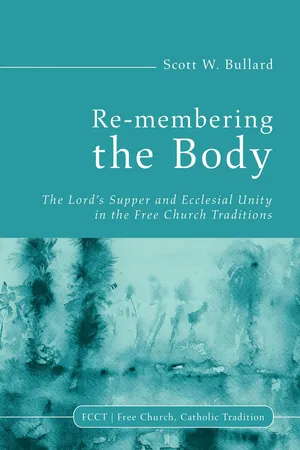
eBook - ePub
Re-membering the Body
The Lord’s Supper and Ecclesial Unity in the Free Church Traditions
- 188 pages
- English
- ePUB (mobile friendly)
- Available on iOS & Android
eBook - ePub
Re-membering the Body
The Lord’s Supper and Ecclesial Unity in the Free Church Traditions
About this book
For centuries, Baptists have regarded the Eucharist, or Lord's Supper, as "merely symbolic" rather than as sacramental. Historically speaking, Baptists have also participated in the practice of the Supper less frequently than other Christian groups, all the while lodging complaints about a lack of ecclesial unity. In response to these trends, this book argues for a sacramental understanding of the Eucharist and focuses on the way in which the Eucharist conveys grace by drawing the church together as the body of Christ. It focuses especially on the theology of James Wm. McClendon Jr., who was Baptist but nonetheless illustrated that through the Eucharist God "re-members" the church as the body of Christ. Together with Lutheran theologian Robert Jenson and Catholic theologian Cardinal Henri de Lubac, McClendon's work has had an enormous impact on contemporary free church discussions about the Supper and ecclesial unity. In a final chapter, therefore, the study examines a number of contemporary Baptists dubbed the "new Baptist sacramentalists." These men and women are influenced by McClendon, Jenson, and de Lubac, and they offer a fresh approach to the ongoing puzzle of the church's disunity through the Eucharist.
Information
Topic
Theology & ReligionSubtopic
Christian Theology1
Reconsidering Communion from a Free Church Perspective
The Disappearance of the Eucharist’s Unitive Function
This book is a Baptist retrieval of the Eucharist, or Lord’s Supper, as a vital basis for the unity of the Church as the body of Christ. In the pages to follow, I argue that over the last two centuries a thick conception of the unity brought about by the Eucharist has greatly diminished. However, down through the centuries, the Church has said that this is a “sacrament”1 that pulls members of the Church “godward” and, significantly, together as the body of Christ.2 As Henri de Lubac once said, the social aspect of the Supper “is the constant teaching of the Church, though it must be confessed that in practice it is too little known.”3
I argue in the pages that follow that de Lubac’s critique is true not only of his own tradition (Catholicism) but of the Church universal and especially of Baptists. Indeed, against the grain of the larger Christian tradition, Baptist and other “free church” theologians have not only traditionally neglected the unitive function of the Supper,4 they have largely denied that anything “happens” in the Supper at all, positing a purely (or “merely”) symbolic role for the Supper wherein the Supper has no unique power in pulling members of the Church either godward or together.5 More than a few Baptist theologians, however, insist that the Supper is more than symbolic. In the words of James Wm. McClendon Jr., one of the most important Baptist thinkers in the twentieth century, the Supper is a “sign of salvation,”6 and for McClendon “it is the nature of signs not only to betoken but to do something.”7 Consistent with de Lubac’s claim about the social aspect being overlooked, however, McClendon skims over the unifying aspect of the Supper in his account of the Church’s “signs” in his Systematic Theology. This slight is most notable in the section of volume 2 in which he champions a key part of his theological project—the solidarity of the Church. Ultimately, eucharistic unity is a parenthetical consideration for McClendon, summed up in one paragraph as “a (re-membering) sign.”8
In contrast to McClendon, whose view of the Supper is considered a lofty one within his own tradition, de Lubac regards the Eucharist as the very “heart of the Church.”9 Indeed, in a way similar to but stronger than what McClendon indicates when he describes the Supper as a re-membering sign, de Lubac argues that the early Church’s understanding of the relationship between the Eucharist and the Church’s unity was that “the Eucharist makes the Church.”10 As a continuation of Paul, who proclaims that “we who are many are one body, for we all partake of the one loaf” (1 Cor 10:17), we encounter this theme in patristic literature, wherein the Church’s participation in the Supper is crucial for becoming Christ’s body.11
De Lubac contends that the point of the body imagery is the unity of the Church, the ecclesial body of Christ. Indeed, he points out that as recently as Aquinas, it was the ecclesial body that was understood as the “real presence” of Christ in the world as a result of its participation in the Eucharist, while the Eucharist itself was said to be the “mystical presence”—“mystical” not because it was a misunderstood or “optional” concern, but because it was that body which lessened the temporal caesura between the ecclesial body and the historical body of Christ.12 As William T. Cavanaugh says, the Eucharist, as the corpus mysticum, “insures the unity between the two times and brings the Christ event into present historical time in the church body,” the corpus verum.13
Lutheran theologian Robert Jenson acknowledges and even occasionally employs de Lubac’s claims, and yet he more frequently points out that while there is scriptural warrant for referring to the Church and the Eucharist as Christ’s body, many Protestants and members of free churches believe that too much emphasis upon the Church and Eucharist as Christ’s body invites a certain overestimation of the Church’s position in relation to the triune God.14 Jenson therefore attempts to carefully articulate a view of the Eucharist as effecting the body of Christ without absorbing the Church into the Trinity. Whether he succeeds in this endeavor is often debated, and yet I argue that Jenson—due primarily to his being a Protestant situated in North America—helps the contemporary Western reader see more clearly than does de Lubac why it is legitimate and utterly necessary to speak of an ecclesially embodied Christ.
Why McClendon?
In the pages that follow, I shall contend that most of what is needed for an argument for eucharistic unity is in place in McClendon’s work, a unity that would not simply improve ecumenical relations but that would, as the work of Cavanaugh claims, ultimately enable the Church catholic to see itself as a body—and one capable of resisting the impulses that have gripped the world around it.15 However, I shall also argue that while McClendon has moved beyond a purely symbolic notion of the Supper, he fails to capitalize fully upon his understanding of the Supper in calling the Church to be “one.” To modify this shortcoming in McClendon’s theology specifically, and in free church theology more generally, I want to add to the discussion on the relationship between the Supper and the Church’s unity the voices of de Lubac, Jenson, and finally, a new generation of Baptist theologians who employ all three of these thinkers16—along with many others—in order to affirm sacramentalism within and for the life of Baptist churches.17 This is quite important, for as I shall show in chapter 2, Baptist churches largely consider themselves groups of like-minded individuals who are voluntarily associated with one another. This is a thoroughly modern self-understanding and one that I shall argue is finally incompatible with the biblical understanding of the Church. That the Church is the “body of Christ” means that the Church is a (one) living reality, more than a name for a human institution made up of like-minded or coincidentally similar individuals. Biblical Christianity reminds us that this oneness comes about through the sacraments—especially for St. Paul we are “baptized into the body” (1 Cor 12:3), “we who are many are one body, for we all partake of the one loaf” (1 Cor 10:17).
McClendon points the way forward for Baptists and other free church traditions to a high view of both the Supper and the Church within the framework of his “baptist type of ecclesiology,” an overturned hierarchy in which the emphasis is placed upon local congregations.18 However, I will ask whether a free church ecclesiology can survive the radically communal faith valued so highly by McClendon without a rich and fulsome understanding of the Eucharist. Is the unity for which McClendon calls possible within the framework of a “free” ecclesiology? This is one question being asked with increasing frequency by free church theologians,19 and by employing de Lubac and Jenson, I shall argue that a eucharistic construal of the unity of the Church is necessary to sustain McClendon’s understanding of the Church as a “convictional community.”20 Membership in the Church, for McClendon, is intrinsic to the Christian life. In his work it is the Church that ensures that its members live up to the expectations of the Christian faith—a practice he calls “watch-care.”21 This and other communal understandings of the Church cannot be sustained, however, if his Baptist descendants continue to imbibe the modern and postmodern notion that the Church is just another voluntary society rather than see themselves as “members of one another” through the Eucharist and other churchly practice...
Table of contents
- Title Page
- Series Preface
- Acknowledgments
- Chapter 1: Reconsidering Communion from a Free Church Perspective
- Chapter 2: James McClendon
- Chapter 3: Henri de Lubac
- Chapter 4: Robert Jenson and the Gathered Body of Christ
- Chapter 5: The Eucharist Makes the (Free) Church
- Bibliography
Trusted by 375,005 students
Access to over 1.5 million titles for a fair monthly price.
Study more efficiently using our study tools.
Frequently asked questions
Yes, you can cancel anytime from the Subscription tab in your account settings on the Perlego website. Your subscription will stay active until the end of your current billing period. Learn how to cancel your subscription
No, books cannot be downloaded as external files, such as PDFs, for use outside of Perlego. However, you can download books within the Perlego app for offline reading on mobile or tablet. Learn how to download books offline
Perlego offers two plans: Essential and Complete
- Essential is ideal for learners and professionals who enjoy exploring a wide range of subjects. Access the Essential Library with 800,000+ trusted titles and best-sellers across business, personal growth, and the humanities. Includes unlimited reading time and Standard Read Aloud voice.
- Complete: Perfect for advanced learners and researchers needing full, unrestricted access. Unlock 1.5M+ books across hundreds of subjects, including academic and specialized titles. The Complete Plan also includes advanced features like Premium Read Aloud and Research Assistant.
We are an online textbook subscription service, where you can get access to an entire online library for less than the price of a single book per month. With over 1.5 million books across 990+ topics, we’ve got you covered! Learn about our mission
Look out for the read-aloud symbol on your next book to see if you can listen to it. The read-aloud tool reads text aloud for you, highlighting the text as it is being read. You can pause it, speed it up and slow it down. Learn more about Read Aloud
Yes! You can use the Perlego app on both iOS and Android devices to read anytime, anywhere — even offline. Perfect for commutes or when you’re on the go.
Please note we cannot support devices running on iOS 13 and Android 7 or earlier. Learn more about using the app
Please note we cannot support devices running on iOS 13 and Android 7 or earlier. Learn more about using the app
Yes, you can access Re-membering the Body by Scott W. Bullard in PDF and/or ePUB format, as well as other popular books in Theology & Religion & Christian Theology. We have over 1.5 million books available in our catalogue for you to explore.