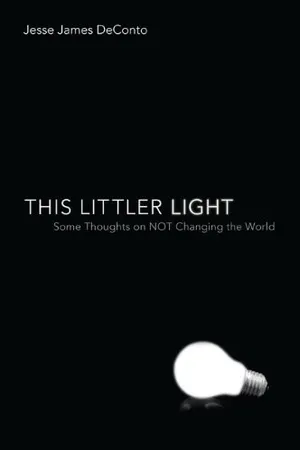
- 244 pages
- English
- ePUB (mobile friendly)
- Available on iOS & Android
eBook - ePub
About this book
Like other evangelical kids, Jesse James DeConto felt called to shine the light of truth into the world. His job as a journalist and his young marriage, though, would radically change him. First, he learned that Christians have no corner on truth: Working out in the world, trying to be the "Roaring Lamb" he'd been trained to be, he met atheists and agnostics who seemed to do better at embodying Christian love than many Christians did. Confessing the church's failures was one thing, but the author had to face his own weakness the hard way, when the cheap threads that held his marriage intact finally snapped.
Jesse found himself at the end of his twenties with a broken bank account, a broken body, and a broken family. In the midst of that pain, he discovered his brokenness better equipped him to share God's grace than his striving ever had. He learned to say with theologian Karl Barth that "his importance may consist in his poverty, in his hopes and fears, in his waiting and hurrying, in the direction of his whole being toward what lies beyond his horizon and beyond his power."
Information
Topic
Theology & ReligionSubtopic
Biblical Studies1
Please, Jesus
For just the tiniest smidge of a fraction of a nanosecond, I opened my armor and let the pain show. I had to be strong, but Langley saw through me.
“Are you OK?” he asked when we met outside North Carolina Central Prison on St. Patrick’s Day, 2006.
Hours earlier, I lay on an operating table and allowed a young urological resident to cut into my manhood, to sterilize me, to make sure I would never father a son, to protect my dear, sweet daughters from adding more stress to a home already full of it. I had scarred my body to save my marriage. Even as I lay there and let the doctor stick a knife in me, I was hoping for a miracle, hoping this fix wouldn’t take.
Not long after our second daughter’s birth, Lily had started pressuring me for a vasectomy. She’d been through two surprise pregnancies, one ending in a miscarriage that had sapped her will even to get out of bed. After we married—at twenty-two and twenty-three years old—she often said she’d never planned on a marriage or a family. When she said things like that, like when she wrote that short “story” imagining her life with that biker dude she’d rejected in favor of me back at our Baptist college, I took it to heart: She was unhappy, and it was my fault. Aurora had the little sister she’d asked for, and Lily was done. For a year and a half, my wife pestered me, relaying her Appalachian grandmother’s concern: “When’s he gonna get fixed?”
On the one hand, I thought it was the loving thing to do. Lily was constitutionally frail, with a minor heart condition, multiple allergies, and what you might call a low zest for life. She said birth control made her stomach hurt. We’d already had one condom fail. She’d given me two precious girls, she didn’t want any more, and she certainly didn’t want to endure another miscarriage, so how could I make her take that risk? And was I myself willing to take the risk, knowing the conflict in our home?
On a brief detour from my daily newspaper career, I was taking five graduate-school classes, working as a research assistant, freelance writing to make some extra cash, and trying to figure out my next career move so I could buy Lily a house. We were living in a brand new student family apartment at the University of North Carolina-Chapel Hill, and I worried about what the neighbors thought about my screaming: about her hot iron that burned a hole in the kitchen counter, about the uninsured bills we were paying to an alternative healer because Lily didn’t trust mainstream pediatricians, about another meal left for me to cook or laundry to wash when I got home, about her hours of aimless web-surfing, about credit card bills that were eating into our savings because she had to have the best of everything. No one in my shoes would have wanted to deal with her selfish idiosyncrasies, and no one in her shoes would have wanted to deal with my hot temper.
I thought I understood her unhappiness, and why she tried to fix it with fancy clothes and fantasies of the good life. Not only had her parents abandoned her to her grandparents when she was a baby, but they had flitted into and out of her life, giving her glimpses of the wealth and freedom they seemed to have chosen over her. They flitted, that is, until her mother decided she didn’t like me—or didn’t like the idea of her daughter getting married—and refused to come to our wedding. That kind of rejection might make anyone turn inside herself and never come out. But my understanding it wouldn’t mend the tear it caused in our marriage. In fact, it only played upon my weakness: my pride, my need not to fail, my intense probing to heal her wounds, which instead seemed to cut her deeper. The strife was the strife, regardless of how much I might have believed I would resolve it one day. How could I bring another child into this home?
Still, it didn’t feel right, altering my body like this, permanently. I’d never even been able to pull the trigger on a tattoo, for goodness sake. It seemed to me there was something sturdy in the Vatican’s ban on birth control, something worth reckoning with. I mean, I didn’t think having six or seven kids would be the responsible thing to do, but was it right to say, no, never, no more, after just two? Didn’t God make us male and female to procreate? Wasn’t our creativity how we displayed the image of God on earth? And could you get any more creative than making a new human life? As much as Lily had insinuated, how could I feel guilty about our first pregnancy, our precious, unexpected Aurora? Wasn’t that God’s plan for marriage? Weren’t our little girls something to celebrate? Did I have a right to cut asunder what God had created? Was there any way to reconcile these two competing moral duties: Loving my own flesh and loving my wife?
I had thought about consulting the busy priest at our Episcopal church, or maybe Duke University’s eminent theological ethicist Stanley Hauerwas, who worshiped with us and surely had thought about the ethics of birth control. But why bother them with something so personal? I had good, dear friends, but they were spread out all over the country, even the world, and I didn’t think any of them could relate to my predicament. Whenever they asked, I would tell them that marriage was the hardest thing I’d ever had to do. Nothing they could say would ever change that. We were raised by churches that taught us divorce was wrong in all cases, but they never talked about what those cases might look like. It was like this: If there’s adultery, the wounded party has to forgive. And if there’s forgiveness for that, then there must be forgiveness for just about anything. If you were in a bad marriage, you just had to work harder. That sort of categorical imperative made sense to me: I thought I was as smart and capable as just about anybody, and where I was weak, I just had to outwork ’em. I thought I could keep my marriage intact by force of will. Just trust and obey.
Mom suggested maybe twenty-nine years old was a bit young for a vasectomy, but this was my cross to bear. As I saw it, this operation was my self-crucifixion, my obedient, joyless martyrdom, the climax of my tortured submission to my wife’s will, the apogee of my stoic self-reliance, my sacrifice for our salvation. Six moves in six years of marriage because one day I’d be able to make her happy. Estrangement from my parents and siblings because she needed me all to herself. To prove my worth to Lily, I made myself worthless to another woman. I went all in. I was either going to knock the ball out of the catcher’s mitt, or break my neck trying.
“Yeah, I’m fine,” I told Langley. “I just had a minor surgery.”
The doctor had told me to rest, but I couldn’t miss this night. It might turn into a once-in-a-lifetime experience. See, this night Langley would get himself arrested with fourteen other activists protesting the execution of convicted murderer Patrick Moody. More importantly, some of Langley’s friends would sit with Patrick’s mother Rondelle on the night she knew her son would die. Lily always said activists like these were just looking for attention, and sometimes I thought maybe she was right. But no matter what I thought about civil disobedience or the death penalty, I had to acknowledge the suffering of a murderer’s family: They had raised a child who became a killer, and now they had to watch him die. The only people who had it worse were the victims’ families, but at least they had society on their side. If you think about it, a murderer’s family had also been victimized in a way: They had lost the innocent child they once knew, and it was that innocent child—not just a cold-blooded killer—who would shake and sputter and finally stop breathing in that execution chamber. Not only that, but those families also had to suffer as guilty by association. Their son or husband or brother or father was a murderer. I shuddered to think of what that must feel like, and I had to admire people who offered their time to soothe some of that suffering.
“I kind of feel like Patrick’s sick, and we know he’s going to die, and that we’re kind of together for a funeral, and it’s kind of a natural thing, and not that, you know, he’s going to be executed and he shouldn’t be,” Langley’s wife Sheila had said the prior evening. She was two months pregnant, characteristically thin, in her late twenties with long, straight, brown hair, the daughter of a Catholic-hippie family from rural New York. Langley, also long-haired and skinny from a vegetarian diet and frequent fasting, had rearranged bedroom furniture around their home in Raleigh, North Carolina, to accommodate Patrick’s extended family—his brother, aunt, uncle, stepfather, and mother.
“He’s going to die and that’s sad,” Sheila went on, “but the fact that he’s being executed isn’t really being talked about, which is fine. It just feels like it’s a regular funeral. You know?”
“Yeah, it’s really interesting. You can see ’em get quiet, and they’re thinking about it,” said her housemate Roberta, in her forties, pensive, bookish, with pixie hair and dark-rimmed glasses, a mother of two boys, with her youngest, a teenager still at home. “And then they say, ‘That is really sad.’”
Sheila: “Because how do you think about it?”
“I know,” said Roberta, shaking her head, exhaling sharply, chuckling darkly.
Sheila: “I don’t know how else you deal with it.”
We were in the kitchen of Nazareth House, the Catholic Worker intentional community that Langley, Sheila, Roberta, and her husband Scott had recently opened to offer hospitality to the families of death-row inmates at North Carolina Central Prison. We lounged against the cabinets I had helped to scrape and paint, or sat on the old gray-on-white speckled countertop, just inside the back door with a little placard that said “Peace to All Who Enter Here.” I’d been writing for newspapers and magazines for six years, and I, too, was trying to make peace—not only for people suffering through no fault of their own, but also peace with myself. I had ...
Table of contents
- Title Page
- Acknowledgements
- Permissions
- Introduction
- Chapter 1: Please, Jesus
- Chapter 2: Love Not the World
- Chapter 3: God’s Work and the Good News
- Chapter 4: Girls and God
- Chapter 5: Making Love
- Chapter 6: Cub Reporter
- Chapter 7: I Will Sing for the Meek
- Chapter 8: No One Said It Was Easy
- Chapter 9: Dirty Sheets and Purple Horses
- Chapter 10: The Image of the Trinity
- Chapter 11: Intentional Community
- Epilogue: The Silence of the Lamb
Trusted by 375,005 students
Access to over 1.5 million titles for a fair monthly price.
Study more efficiently using our study tools.
Frequently asked questions
Yes, you can cancel anytime from the Subscription tab in your account settings on the Perlego website. Your subscription will stay active until the end of your current billing period. Learn how to cancel your subscription
No, books cannot be downloaded as external files, such as PDFs, for use outside of Perlego. However, you can download books within the Perlego app for offline reading on mobile or tablet. Learn how to download books offline
We are an online textbook subscription service, where you can get access to an entire online library for less than the price of a single book per month. With over 1.5 million books across 990+ topics, we’ve got you covered! Learn about our mission
Look out for the read-aloud symbol on your next book to see if you can listen to it. The read-aloud tool reads text aloud for you, highlighting the text as it is being read. You can pause it, speed it up and slow it down. Learn more about Read Aloud
Yes! You can use the Perlego app on both iOS and Android devices to read anytime, anywhere — even offline. Perfect for commutes or when you’re on the go.
Please note we cannot support devices running on iOS 13 and Android 7 or earlier. Learn more about using the app
Please note we cannot support devices running on iOS 13 and Android 7 or earlier. Learn more about using the app
Yes, you can access This Littler Light by Jesse James DeConto in PDF and/or ePUB format, as well as other popular books in Theology & Religion & Biblical Studies. We have over 1.5 million books available in our catalogue for you to explore.