- 290 pages
- English
- ePUB (mobile friendly)
- Available on iOS & Android
eBook - ePub
About this book
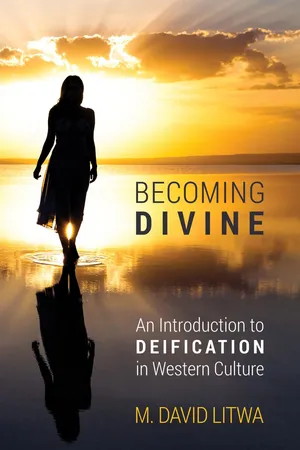
Some have called it the essence of sin, others the depth of salvation. Regardless of one's evaluation of it, however, deification throughout Western history has been a part of human aspiration. From the ancient pharaohs to modern transhumanists, people have envisioned their own divinity. These visionaries include not only history's greatest megalomaniacs, but also mystics, sages, apostles, prophets, magicians, bishops, philosophers, atheists, and monks. Some aimed for independent deity, others realized their eternal union with God. Some anticipated godhood in heaven, others walked as gods on earth. Some accepted divinity by grace, others achieved it by their own will to power. There is no single form of deification (indeed, deification is as manifold as the human conception of God), but the many types are united by a set of interlocking themes: achieving immortality, wielding superhuman power, being filled with supernatural knowledge or love--and through these means transcending normal human (or at least "earthly") nature.
Information
Topic
Theology & ReligionSubtopic
Christian TheologyChapter 1
Merging with the Sun
The Deification of Amenhotep III
Hail to you, O Re, in your rising,
Amun in your beautiful setting.
You rise and you shine upon your mother’s back,
Appearing in glory as king of the ennead. . . .
As to the gods, their hearts are glad
When they see you in the morning bark.
Re has a (following) breeze continuously.
As to the evening bark,
it has destroyed the one who attacked it.
You cross both your heavens in triumph!
—Hymn to the Rising Sun6
In an inscription from western Thebes (modern Luxor), the god Amun-Re hails Pharaoh Amenhotep III as “my son of my body, my beloved Nebmaatra, my living image, my body’s creation.”7 According to ancient Egyptian lore, the god Amun-Re had visited Amenhotep’s mother Mutemwia in the form of her husband Thutmoses IV. Mutemwia was asleep in one of the inner rooms of the palace. In a temple inscription we read, “She [Mutemwia] awoke on account of the aroma of the god and cried out before him. . . . He went to her straightaway, she rejoiced at the sight of his beauty, and love for him coursed through her body. The palace flooded with the God’s aroma.” Reliefs in the Luxor temple show Mutemwia delicately touching the fingertips of Amun-Re.8 Actual intercourse is not described. We only learn that “the majesty of this God did all that he desired with her,” with the result that Mutemwia declared, “Your dew fills my body!” After the transfer of divine “dew,” the God Amun-Re informs Mutemwia that the name of her child is “Amenhotep, ruler of Thebes. . . . He shall exercise the beneficent kingship in this whole land, he shall rule the Two Lands [of Egypt] like Re forever.”9
Such is the miraculous birth of Pharaoh Amenhotep III (ruled 1391–53 B.C.E.), one of the most famous and powerful Pharaohs in Egyptian history.10 Although the deity of the Pharaohs is a commonplace in Egyptology (a standard title of the Pharaoh was “the good god”11), only three Pharaohs—Hatshepsut, Amenhotep III, and Ramesses II—provide an extended account of their literal birth from a god.12 It is often alleged that Hatshepsut—a female Pharaoh—engineered her divine birth to legitimate her rule. Amenhotep III and Ramesses II, however, did not need a divine birth story to justify their authority. They—along with presumably many other Pharaohs—did not doubt their physical birth from Amun-Re. Then as now myth was reality, because myths constitute a world.13
Amenhotep III ruled in the period of the New Kingdom (ca. 1550–1069 B.C.E.), a time when the deification of the living ruler became prominent in Egypt. He was the ninth ruler of the Eighteenth Dynasty, son of great conquerors, and grandfather of king Tutankhamen (the famous “king Tut”). Amenhotep was a powerful and long-lived Pharaoh, but was not eccentric like his son and successor Akhenaten (sometimes considered to be the first “monotheist”). Nor was he a great general like Ramesses II, “the Great,” who ruled a century after him. The divinity that Amenhotep III claimed—at least initially—was based on his kingly office, and was sealed by royal ritual. Virtually all Egyptian Pharaohs considered themselves to be sons of Re, the Sun God. Late in his reign, however, Amenhotep seems to have considered himself to be a living manifestation of the Sun God himself. We will follow him—as best we can—on his road toward this new self-understanding.
The King’s Ka
In the twelfth scene of his birth story depicted on the walls of the Luxor temple, Amun-Re mentions the king’s “ka.” The ka was the divine spirit of the king, a spirit he shared with all pharaohs who came before him and all who would come after.14 Although the king’s ka was shaped and molded as the “twin” of the king at his birth, it was officially inherited at his coronation. For the Pharaoh, the ka was the divine principle in his person: the “immortal creative spirit of divine kingship.”15 It was the spirit of the creator and king of gods Amun-Re himself.
Apart from his ka, Amenhotep III was a normal human being, subject to all human foibles and frailties. Endowed with the divine force of ka, however, Amenhotep III was son of the living God and a god himself. Although one can focus on the human or the divine side of the Pharaoh, privileging one aspect misses the point. Was Pharaoh divine? Yes—insofar as he was the incarnation of the royal ka. The ka was different from the king, and yet one with him. It entered him in his coronation, and only left him at death.16 “When the king died,” writes Lanny Bell, “his body was buried with Osiris . . . and his ka returned to heaven. There the ka continued to be worshiped as a form of the Sun God, whose essence it shared and into whom it now again merged.”17
Coronation Titulary
At his coronation, Amenhotep—like all pharaohs since the fourth dynasty—had invoked over him five royal names, each with an individualized epithet that reflected the power and future policies of the monarch. Two of the names—the “Horus name” and “Golden Horus name” served to identify the pharaoh with the god Horus, falcon-headed god of the skies. That Horus was “golden” is important since gold was “the flesh of the gods.” In the modern world, one of the billboard signs for Pharaonic Egypt is the flashing gold mask of “king Tut.” This mask—one of the few surviving—shows Pharaoh encased in the flesh of a deity.
The birth name of the king—Amenhotep (meaning, “Amun is at peace”)—was his “son of Re name.” All kings were considered to be sons of the Sun God Re. Amenhotep’s specific throne name was “Nebmaatra,” meaning, “Re, lord of truth.” Implicitly this name identified him with the Sun God himself.
Amenhotep later came to prefer names that associated him with the Sun: “heir of Re,” “chosen one of Re,” “image of Re.” Egypt’s vassal states in western Asia spoke of Pharaoh in solar terms. Abi-Milku, for instance—who ruled the Phoenician city of Tyre during Amenhotep’s final years—was one of the many Canaanite chieftains who addressed Pharaoh simply as “the Sun.” In one letter he writes,
The [Egyptian] king is the Sun who comes forth over all lands day by day according to the way of being the Sun, who gives life by his sweet breath and returns with his north wind. Who gives forth his cry like Baal and all the land is frightened by his cry.18
The cry of the king is that of the solar falcon “soaring high on the thermals of a cloudless day, invisible against the blinding sun, its shriek seem...
Table of contents
- Title Page
- Preface
- Abbreviations
- Introduction: Enter Deification
- Chapter 1: Merging with the Sun
- Chapter 2: The New Dionysus
- Chapter 3: “You Have Been Born a God”
- Chapter 4: “We are Being Transformed”
- Chapter 5: “Immortalized in This Very Hour”
- Chapter 6: “I Have Been Born in Mind!”
- Chapter 7: “I Have Become Identical with the Divine”
- Chapter 8: “The Flash of One Tremulous Glance”
- Chapter 9: “I am the Truth”
- Chapter 10: “God’s Being is My Life”
- Chapter 11: “Uncreated by Grace”
- Chapter 12: “By Faith a Human Becomes God”
- Chapter 13: “Then Shall They be Gods . . .”
- Chapter 14: “Rather be a God Oneself!”
- Chapter 15: The Posthuman God
- Conclusion
- Bibliography
Trusted by 375,005 students
Access to over 1.5 million titles for a fair monthly price.
Study more efficiently using our study tools.
Frequently asked questions
Yes, you can cancel anytime from the Subscription tab in your account settings on the Perlego website. Your subscription will stay active until the end of your current billing period. Learn how to cancel your subscription
No, books cannot be downloaded as external files, such as PDFs, for use outside of Perlego. However, you can download books within the Perlego app for offline reading on mobile or tablet. Learn how to download books offline
Perlego offers two plans: Essential and Complete
- Essential is ideal for learners and professionals who enjoy exploring a wide range of subjects. Access the Essential Library with 800,000+ trusted titles and best-sellers across business, personal growth, and the humanities. Includes unlimited reading time and Standard Read Aloud voice.
- Complete: Perfect for advanced learners and researchers needing full, unrestricted access. Unlock 1.5M+ books across hundreds of subjects, including academic and specialized titles. The Complete Plan also includes advanced features like Premium Read Aloud and Research Assistant.
We are an online textbook subscription service, where you can get access to an entire online library for less than the price of a single book per month. With over 1.5 million books across 990+ topics, we’ve got you covered! Learn about our mission
Look out for the read-aloud symbol on your next book to see if you can listen to it. The read-aloud tool reads text aloud for you, highlighting the text as it is being read. You can pause it, speed it up and slow it down. Learn more about Read Aloud
Yes! You can use the Perlego app on both iOS and Android devices to read anytime, anywhere — even offline. Perfect for commutes or when you’re on the go.
Please note we cannot support devices running on iOS 13 and Android 7 or earlier. Learn more about using the app
Please note we cannot support devices running on iOS 13 and Android 7 or earlier. Learn more about using the app
Yes, you can access Becoming Divine by M. David Litwa in PDF and/or ePUB format, as well as other popular books in Theology & Religion & Christian Theology. We have over 1.5 million books available in our catalogue for you to explore.