eBook - ePub
Eucharist and Globalization
Redrawing the Borders of Eucharistic Hospitality
- 340 pages
- English
- ePUB (mobile friendly)
- Available on iOS & Android
eBook - ePub
About this book
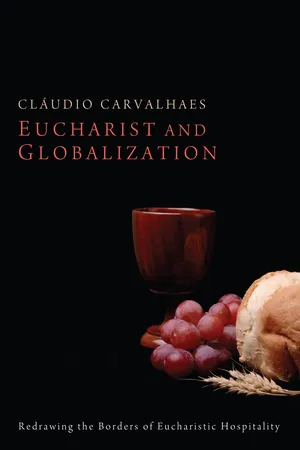
The ritual of eating and drinking together is one of the most important Christian events. Often called Eucharist, Lord's Supper, or Communion, this sacrament is about the presence of Christ transforming not only those who participate in it but also the world. In this book, the author engages this Christian liturgical act with movements of people around our globalized world and checks the sacramental borders of hospitality. The author calls our attention to the sacramental practices of Reformed churches and, from this liturgical practice, challenges Christian churches to expand the borders of hospitality. Engaging several critical lenses around the notion of the sacrament--namely, Greco-Roman meals, Calvin's theology, and feminist and Latin American theologies--the author challenges theological and liturgical understandings of the Eucharist. He fosters an interreligious dialogue around the table and ends up using ritual theory to expand the circles of traditions, vocabularies, and practices around the sacrament. Proposing a borderless border eucharistic hospitality, the author encourages readers to ask who and where we are when we get together to eat and drink, and how this liturgical act around Jesus' table/meal can transform the lives of the poor, our communities, societies, and the world.
Information
Topic
Theology & ReligionSubtopic
Christian Rituals & Practice1
Borders, Globalization, and Eucharistic Hospitality
One can take it as a certain experience of hospitality, as the crossing of the threshold by the guest who must be at once called, desired and specified, but also always free to come or not to come.
—Jacques Derrida
In this chapter, I will begin by developing a correlation between hospitality, liturgy and globalization. Then, I show how borders are always permeable. Next I deal with Jacques Derrida’s notion of “unlimited hospitality” that informs the main argument of this book. Finally, I relate “unlimited hospitality” to the liturgical idea of borderless borders.
Sacramental Hospitality, Borders, and Globalization
During my childhood, my family was surprised by the arrival of unexpected guests. Members of my mother’s extended family, who were all very poor, would usually arrive just before lunch time and we were always unprepared. The bell would ring and at the gates of the house there would be from one to seven people saying “Hi, we were around and decided to stop by to visit.” Sometimes my mother would send me to the supermarket right away to buy food and when we did not have money, she would improvise with whatever we had at home.
In my Christian home, I learned that we should love our neighbors, be mindful of those who had less than we, and be ready to welcome the stranger. However, whenever my mother’s extended family disturbed the order of my personal life, my home, my school work, and even our limited food supply, I could not always follow the necessary practices that these teachings of love and hospitality entailed. Because my mother would never tell them to leave or even let them go without feeding them, I often hated them. Since I had no other choice but to be disrupted and surrender to the situation, I learned at home that hospitality was a hard thing to practice.
Later, when I became a pastor of a small church in Santa Fe, a shantytown in the outskirts of São Paulo and then a pastor of a non-documented immigrant community in Fall River, Massachusetts, I had to revisit constantly the hospitality I learned during my childhood. As a pastor, hospitality had become a more complicated matter since it was extended to a broader perspective of issues that needed to be observed.
In my mother’s house, I had her protection and knew our guests were family. But in these religious places/liturgical spaces—whether at the door of the church or even in the middle of the worship service—I was constantly asked to offer hospitality to people with whom I had neither connections nor anything in common. I had no idea who they were or where they came from. I could not tell if they were Christians, a part of the larger community, robbers, fugitives from the police, people searching for comfort, illegal immigrants who had just crossed the Mexican border, or immigration police in disguise.

Presented by a harsh reality of my people, and trying to serve them conscientiously, I had to decide many times whether I would offer sacramental hospitality to those who were waiting at the door. It was at the doors of these two small churches, Santa Fe and Fall River, that poor and illegal immigrants were confronting the symbolic borders and orders of ecclesiastical spaces, liturgical practices, theological beliefs, eucharistic rules and political laws, both ecclesiastical and nationwide.
It is within these blurred, complicated, and interconnected borders that liturgical practices and spaces must engage and be engaged. The messy, nervous, and uneasy interrelations of these borders are a challenge to every Christian believer and privileged place for the field of worship. They require entire communities to figure out ways to incarnate the gospel of Jesus and enact hospitality especially to “the least of these,” those who are on the “other side” of the borders.
The Eucharist can help us with ways to understand these borders and the ways Christian hospitality might be (un)framed. At the eucharistic table, one is able to describe the ways in which Christian hospitality is understood, presented, and performed. At the same place, one also sees ecclesiastical borders which delimit the ways a community defines who is in and who is out and determines the norms and standards of its identity; theological borders which give content to the ecclesiastical borders and ensure that liturgical procedures are correctly done and expressed in obedience and faith to God; liturgical borders which limit and locate the liminal space, giving contours (and content in their own way) to the theological and ecclesiastical borders, depicting a proper language, bodily gestures and ritual actions to make the rite right and familiar; social/economic borders which define the sacred spaces where social classes attest how God acts and who belongs there; political borders which show that the limits of eucharistic hospitality have to do with political choices and allegiances, economic commitments and social engagements.
The borders that mark the eucharistic sacrament also delineate ways in which the country should/could/must develop its own borders, its political commitments and degrees of order. Within the liturgical space, the “inner” life of the gospel is always already connected with the “outer” side of the world. Both are inside and outside of themselves and within and around the liturgical borders, where hospitality and identities are endlessly negotiated. In fact, when one looks at the “outside” part of the liturgical world border, one sees that one of the major challenges for our time, and consequently to the liturgical field, is the problem of globalization and the problem of the exclusion of millions of people from a life with a minimum of dignity.
One of the pointed problems related to globalization is human mobility. The movement of approximately 200 billion people around the globe raises questions of human access/excess, displacement, exclusion, citizenship, borders, and hospitality. Within the United States, immigration, especially the non-documented community, is increasingly gaining national political attention.17 In June of 2006, a group of scholars wrote a letter to President Bush:
Legitimate concerns about the impact of immigration on the poorest Americans should not be addressed by penalizing even poorer immigrants. Instead, we should promote policies, such as improving our education system, that enable Americans to be more productive with high-wage skills. We must not forget that the gains to immigrants coming to the United States are immense. Immigration is the greatest antipoverty program ever devised.18
Massive human migration around the globe has a deep impact on the ways we understand hospitality, on the ways we relate and connect to the Christian faith and celebrate the table of Jesus Christ in our bordered liturgies.
What does the border of the eucharistic table have to do with immigration, the bill that created a wall of separation at the borders, signed by President Bush, and the excluded people around the world? This question has to do with the idea of hospitality vis-à-vis the understanding of the incarnation of Christ and how the Christian church performs it.
Hence, hospitality, or sacramental hospitality, is about much more than welcoming people at the church door or distributing name tags to guests or saving the best spots in the parking lot. It has to do with the transformation of ourselves through theological, ecclesiological, and liturgical demands. Thus, in order to think about hospitality, one has to find its ways within and around the liturgical, sacramental, theological, ecclesiastical, and political borders. These borders are porous and permeable.

Borders are everywhere. Every border regulates and contains and excludes. Borders are controlling apparatus, concrete and symbolic, real and imaginary, paradoxical and de-termined, entangling space and power within various other areas such as knowledge, identities, politics, economics. Borders also mark spaces: margins, frontiers, hinges, lines and thresholds in constant relation with something else, separating, and marking space and differing positions. Borders, controlled from the inside, keep out everything that cannot be accepted, invited, and lived. The various degrees of invitation entail categories of participation according to some chosen criteria. Some will be invited as short term guests, others as distinguished guests, others as a long term guests, and so on. Borders also serve as signs of protection, safety, and order. They convey stability, permanence and duration. On the other hand, this protection and stability demand that those who are inside do not challenge the authenticity of the borders. Gloria Anzaldua says that the borders of “culture take away our ability to act—shackle us in the name of protection.”19
However, in spite of the idea of protection and separation that borders convey, they are often made of a porous structure with unattended spaces. Borderlands are nervous spaces filled with anxiety.20 They are permeable to that which they do not yet know. Algerian-French Jewish philosopher Jacques Derrida says that “[i]t is clear that concepts of stability, permanence and duration . . . are too lax and open to every uncritical investiture.”21 Border control and protection are threatened and unguarded by the arrival of the unpredictable, which make the idea of borders frail spaces where different crossings can occur.
He wanted to study Spanish and went to a restaurant-coffee shop downtown in that Mexican city. He order coffee and opened his grammar books. It was a beautiful af...
Table of contents
- Title Page
- Acknowledgments
- Introduction
- Chapter 1: Borders, Globalization, and Eucharistic Hospitality
- Chapter 2: Eucharist and Hospitality and the Early Christian Meals
- Chapter 3: Reformed Eucharist and Hospitality
- Chapter 4: Feminist Liturgies, Borders, and Hospitality
- Chapter 5: Latin American Hospitality and Sacraments
- Chapter 6: Christians and Yorubá People Eating Together
- Chapter 7: Performing Hospitable Eucharistic Borderless Borders
- Conclusion: Onkotô?
- Bibliography
Trusted by 375,005 students
Access to over 1.5 million titles for a fair monthly price.
Study more efficiently using our study tools.
Frequently asked questions
Yes, you can cancel anytime from the Subscription tab in your account settings on the Perlego website. Your subscription will stay active until the end of your current billing period. Learn how to cancel your subscription
No, books cannot be downloaded as external files, such as PDFs, for use outside of Perlego. However, you can download books within the Perlego app for offline reading on mobile or tablet. Learn how to download books offline
Perlego offers two plans: Essential and Complete
- Essential is ideal for learners and professionals who enjoy exploring a wide range of subjects. Access the Essential Library with 800,000+ trusted titles and best-sellers across business, personal growth, and the humanities. Includes unlimited reading time and Standard Read Aloud voice.
- Complete: Perfect for advanced learners and researchers needing full, unrestricted access. Unlock 1.5M+ books across hundreds of subjects, including academic and specialized titles. The Complete Plan also includes advanced features like Premium Read Aloud and Research Assistant.
We are an online textbook subscription service, where you can get access to an entire online library for less than the price of a single book per month. With over 1.5 million books across 990+ topics, we’ve got you covered! Learn about our mission
Look out for the read-aloud symbol on your next book to see if you can listen to it. The read-aloud tool reads text aloud for you, highlighting the text as it is being read. You can pause it, speed it up and slow it down. Learn more about Read Aloud
Yes! You can use the Perlego app on both iOS and Android devices to read anytime, anywhere — even offline. Perfect for commutes or when you’re on the go.
Please note we cannot support devices running on iOS 13 and Android 7 or earlier. Learn more about using the app
Please note we cannot support devices running on iOS 13 and Android 7 or earlier. Learn more about using the app
Yes, you can access Eucharist and Globalization by Cláudio Carvalhaes in PDF and/or ePUB format, as well as other popular books in Theology & Religion & Christian Rituals & Practice. We have over 1.5 million books available in our catalogue for you to explore.