eBook - ePub
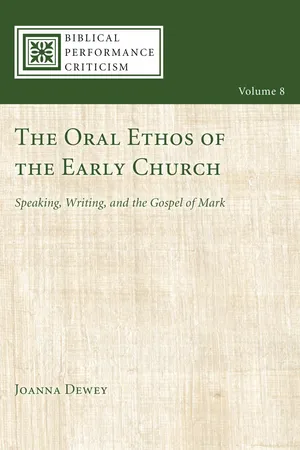
The Oral Ethos of the Early Church
Speaking, Writing, and the Gospel of Mark
- 222 pages
- English
- ePUB (mobile friendly)
- Available on iOS & Android
eBook - ePub
About this book
To experience the gospel message as first-century people heard it is to move into an oral world, one with very little reliance on manuscripts. The essays in this book explore this oral world and the Gospel of Mark within it. They demonstrate the oral style of Mark's gospel, which suggests that it was composed orally, transmitted orally in its entirety by literate and nonliterate storytellers, and survived to become part of the canon only because it was widely known orally. Women's storytelling also thrived during the first centuries of Christianity. With the transition to manuscript authority beginning in the middle of the second century, women's voices were often minimized, trivialized, or completely omitted in written versions. Further, when the Gospel of Mark was one of four written Gospels these voices were quickly ignored. An ancient audience hearing Mark performed, however, enjoyed a vibrant experience of the gospel message and its urgent call to follow.
Information
Part 1
The Oral-Written Media World
1
Textuality in an Oral Culture
A Survey of the Pauline Traditions
Introduction
In studying the development of early Christianity scholars have generally assumed that the first-century media world functioned much as our modern print media world does, giving priority to logical linear thinking and to written texts. Since the early days of form criticism, we have acknowledged that there was an oral stage prior to the written gospels. We have, however, assumed that the progression from oral performance to written text was a continuous linear development, with writing rapidly becoming the primary medium for Christians, and with written texts supplanting oral tradition as soon as they were composed. We have tended to equate Christianity with written documents, whether with extant texts or our own hypothetical reconstructions. We have yet fully to grasp the implications the ancient oral/aural media world has for understanding the formation of early Christianity.
It is true that scholars have become more aware of ancient orality since the publication of Werner Kelber’s The Oral and the Written Gospel: The Hermeneutics of Speaking and Writing in the Synoptic Tradition, Mark, Paul, and Q in 1983, and since the formation of the Bible in Ancient and Modern Media Group of the Society of Biblical Literature by Thomas Boomershine in the same year.1 As a result, it is no longer unusual to find biblical scholars who have read the work of Walter Ong and who stress that early Christians heard rather than read the gospels. Nonetheless, we are still a long way from understanding the high degree of orality in ancient Mediterranean cultures and the ways orality and literacy interacted, working together and working against each other. We have only begun to investigate how literates and nonliterates shared the same culture and, at the same time, participated in quite different cultural worlds. We do not yet have an overview of how orality and literacy affected the development of the early churches and the formation of the New Testament canon. We have yet to consider fully how Christianity itself participated in orality and literacy. We are just beginning to develop a sense of the first-century media world and how Christianity fits within it.
Stated provocatively, my guiding hypothesis is that Christianity began as an oral phenomenon in a predominantly oral culture within which the dominant elite were literate and made extensive use of writing to maintain hegemony and control. Only gradually did Christianity come to depend upon the written word. The growing number of Christian texts and of literate Christians2 in the second and following centuries helped facilitate the shift to manuscript-based authority and to the hegemony and control of Christian churches by a small, educated male elite.3 Our tendency to equate Christianity with written texts, and to see these texts as typical of all of early Christianity, leads us to construct a distorted and one-sided view of the nature and spirit of the early churches. This chapter represents an exploratory step toward investigating the hypothesis by studying the roles of literacy, textuality, and orality in the Pauline traditions.
In order to do so, we need some grasp of the extent and uses of literacy in antiquity. Therefore, Part I looks at literacy and, to a lesser extent, at oral-communication media in the first-century Mediterranean world. Part II is an investigation of the role of literacy and orality in the extant texts related to Paul: the undisputed letters, the deuteropauline letters, the canonical Acts of the Apostles, and the apocryphal Acts of Paul. I have chosen to focus on the Pauline materials for two reasons: first, we have sufficient materials to make such a study possible; and second, the Christian churches based in urban Mediterranean cities were likely the most literate of the early Christian groups. These two factors, of course, are not unrelated. In Part III, I shall suggest some implications that recognition of the relative unimportance of textuality among early Christians has for our reconstruction of early Christian history.
Part I: Literacy and Orality in the Ancient Mediterranean
The first-century media world was a manuscript culture with high residual orality.4 But to define it that way is to define it from the perspective of the elite, those few who could read and write, and who ruled the empire. Most people living during the first century were not literate: occasionally for specific, very limited purposes they made use of writing, but that writing was done by someone else. Furthermore, writing and reading were not silent, individual activities. They were closely allied to the oral world, to speech. Pieter Botha writes, “Greco-Roman literacy—the little that existed—remained a kind of imitation talking.”5
It is still not unusual to read scholarly estimates of widespread literacy in ancient cities. Recently, however, we have become aware that these estimates are gross overestimates. Scholars investigating cross-cultural agrarian and advanced agrarian societies estimate that only between 2 and 4 percent of ancient Mediterranean people were literate.6 It is generally agreed that literacy rates were much lower among women than among men, and much lower in rural than in urban areas. William V. Harris’s massive 1989 work, Ancient Literacy, attempts to summarize all the ancient evidence on literacy, and the following discussion draws heavily on his work.7 He gives somewhat higher estimates than the social scientists do, suggesting perhaps as much as 15 percent for males in Italian cities,8 and similar or lower levels for males in the eastern Mediterranean. What constituted literacy is also not clear. Reading and writing were distinct skills in antiquity; literacy could mean anything from the simple ability to write one’s own name to fluency in both reading and writing. Harris tends to use a minimal definition of literacy. But whatever definition one chooses, it seems safe to conclude that literacy was not widespread in antiquity. For the pu...
Table of contents
- Title Page
- Acknowledgments
- Introduction
- Abbreviations
- Part 1: The Oral-Written Media World
- Chapter 1: Textuality in an Oral Culture
- Chapter 2: The Gospel of John in Its Oral-Written Media World
- Part 2: Oral Patterning in Mark and Implications for Interpretation of Mark
- Chapter 3: The Literary Structure of the Controversy Stories in Mark 2:1—3:6
- Chapter 4: Mark as Interwoven Tapestry
- Chapter 5: Oral Methods of Structuring Narrative in Mark
- Chapter 6: The Gospel of Mark as an Oral/Aural Event
- Chapter 7: The Gospel of Mark as Oral Hermeneutic
- Part 3: Wider Implications of the Oral Media World
- Chapter 8: From Storytelling to Written Text
- Chapter 9: Women on the Way
- Chapter 10: The Survival of Mark’s Gospel
- Chapter 11: Our Text of Mark
- Bibliography
Trusted by 375,005 students
Access to over 1.5 million titles for a fair monthly price.
Study more efficiently using our study tools.
Frequently asked questions
Yes, you can cancel anytime from the Subscription tab in your account settings on the Perlego website. Your subscription will stay active until the end of your current billing period. Learn how to cancel your subscription
No, books cannot be downloaded as external files, such as PDFs, for use outside of Perlego. However, you can download books within the Perlego app for offline reading on mobile or tablet. Learn how to download books offline
We are an online textbook subscription service, where you can get access to an entire online library for less than the price of a single book per month. With over 1.5 million books across 990+ topics, we’ve got you covered! Learn about our mission
Look out for the read-aloud symbol on your next book to see if you can listen to it. The read-aloud tool reads text aloud for you, highlighting the text as it is being read. You can pause it, speed it up and slow it down. Learn more about Read Aloud
Yes! You can use the Perlego app on both iOS and Android devices to read anytime, anywhere — even offline. Perfect for commutes or when you’re on the go.
Please note we cannot support devices running on iOS 13 and Android 7 or earlier. Learn more about using the app
Please note we cannot support devices running on iOS 13 and Android 7 or earlier. Learn more about using the app
Yes, you can access The Oral Ethos of the Early Church by Joanna Dewey in PDF and/or ePUB format, as well as other popular books in Theology & Religion & Biblical Criticism & Interpretation. We have over 1.5 million books available in our catalogue for you to explore.