eBook - ePub
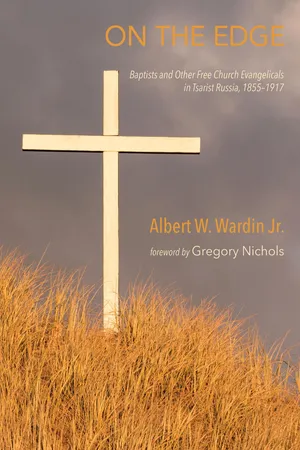
On the Edge
Baptists and Other Free Church Evangelicals in Tsarist Russia, 1855–1917
- 544 pages
- English
- ePUB (mobile friendly)
- Available on iOS & Android
eBook - ePub
On the Edge
Baptists and Other Free Church Evangelicals in Tsarist Russia, 1855–1917
About this book
How indigenous was the Evangelical Free Church movement in Tsarist Russia? Was it simply a foreign import? To what extent did it threaten the political stability of the nation and encroach upon the existing Russian and German churches? On the Edge examines the efforts of the regimes to suppress the movement and how the movement not only survived but also expanded. To what extent did the movement bring upon itself unnecessary opposition because of aggressiveness and tactics? Albert Wardin describes the contributions the movement made to the religious life of Russia and examines its numerical success.
Information
Topic
Theology & ReligionSubtopic
Christian TheologyPart One
1
The Russian Empire At Mid-Century
In the middle of the nineteenth century, Russia was a leading world power. The empire incorporated Russian Poland and the Baltic in the west, Bessarabia and Ukraine in the south, crossed the Caucasus Mountains toward Turkey and Persia, and traversed the Ural Mountains into Siberia and on to the Far East on the Pacific Ocean. At this time it also included Alaska on the North American continent. Although selling Alaska to the USA in 1867, its expansion continued into Central Asia during the latter half of the nineteenth century. By the turn of the century, it incorporated 8,600,000 square miles, while Europe to the west had less than half the area.
Much of its terrritory was a vast plain, lacking the geographical variety of Western Europe. Distances were vast. Its climate was continental, beset with extremes—cold winters and hot summers. Rainfall was adequate in northern regions but decreased farther south, becoming desert in Central Asia. The tundra, a treeless area, prevailed in the north, followed farther south by a forest region and then to steppes with its excellent black earth. In contrast to the rest of Europe with its maritime climate and variety of soil and vegetation, Russia was monolithic, separate in its own distinct Eurasian world. In spite of its vast size, its limited access to the Atlantic Ocean and lack of ice-free ports isolated it from much of the world.1
The People
The population of the Empire in 1850 was about sixty-seven million but its density was only twelve persons per square kilometer, an eighth of Great Britain and a sixth of France. Population was concentrated in the central provinces of European Russia. Over ninety percent of the population was rural. Its largest city was St. Petersburg, the capital, with over half a million.
The population was multi-national. About three-fourths of its people were Slavic—Russian, Belorussian, and Ukrainian. Another Slavic people were the Poles in the west who numbered five million. Baltic peoples (Lithuanians and Latvians) lived in the west; Finno-Ugrians (including Estonians and Finns), lived in the north with Finnish tribal peoples to the east; and Romanians in Bessarabia. The Caucasus included a medley of people including Armenians, Georgians, and Turkish peoples, while Turkish and Mongolian peoples inhabited central Asia. Many tribal peoples lived in Siberia.
A leading nationality, which will be an important bridge in the movement of evangelical free churches, were the Germans, which numbered around one million, growing to around 1,800,000 by the end of the century. As early as the sixteenth century under Ivan the Terrible, Germans settled in Moscow, some as captives in the Livonian Wars, but many came as officers, craftsmen, merchants, and technicians. With Russia’s incorporation of Baltic territories under Peter the Great in the eighteenth century, Baltic Germans were added and in turn found high places of service in the Russian state. Under Catherine the Great in the last half of the eighteenth century and her grandson Alexander I in the early nineteenth, large numbers of Germans settled on agricultural lands in the Volga region and Ukraine. Later in the century, other Germans migrated from Russian Poland and Germany into Volhynia in Ukraine.
The diverse populations produced a variety of cultural differences. While the Slavic peoples were Orthodox, other peoples such as Poles and Baltic peoples looked to the West and were primarily either Roman Catholic or Lutheran. Germans were predominantly Protestant but with a significant Roman Catholic minority. Jews were a large minority in Russian Poland and the western provinces. Moslems were well represented in the Caucasus and Central Asia. Schismatics were found in various parts of the empire but were particularly important in the Caucasus. Pagan tribes and Buddhists lived in Siberia and the Far East.
Racial, linguistic, religious, and social differences produced diverse lifestyles and perceptions. This was particularly noticeable between German and Slav. Germans were commonly regarded as people of self-discipline, order, hard work, frugality, and energy. They in turn regarded the Slavs as more relaxed, punctuated with sudden bursts of energy, even disorderly and squanderers of time. Although the regime drew on the skills of the Germans in government, trade, and agriculture, numbers of Russians began to resent the predominance of Germans in government and their cultural influence and economic strength in society in the last decades of the nineteenth century. They also became increasingly concerned about German power on the world scene.
Although the aristocracy was less than 1.5 percent of the population, they appropriated much of the nation’s wealth. The upper ranks of the nobility, numbers of them living in extreme luxury, were strongly westernized, speaking French or other languages as well as Russian. Some of the population was in manufacture, mining, trade, and the military, but the masses toiled on the land with possibly around forty-five percent of the population serfs. Serfdom was a backward economic system that hindered innovation and mobility. The serf owned the feudal lord either payments in money or kind or labor services. The land holdings of the serf were part of a village commune. Serfs were unskilled, unmotivated, generally illiterate, and poor workers.2
Government and the Economy
At mid-century the Tsar was Nicholas I (1825–1855), who was an absolute monarch. Nicholas admired the patriarchal Prussian regime and sought to govern by militaristic principles. The Third Department of the Chancery employed political police who guarded against subversion. Rigid censorship prevailed, and travel abroad was curtailed. The minister of education, S. S. Uvarov, enunciated the doctrine of “Official Nationality”—Autocracy, Orthodoxy, and Nationality. Autocracy was the principle of governance, the Orthodox Church was arbiter in religious values, and Nationality reflected the role of the Russian people. Legal rights for the masses were few.
Socially and economically a great chasm existed between the nobility and gentry on the top and the serfs at the bottom. Although manufacturing increased in the first half of the nineteenth century, Russia was far behind in economic development and education. Russia was farther behind the West in 1850 than in 1800. Russia possessed some hard-surfaced roads but most roads were poor and distances were great. In 1855 it possessed only 1,000 kilometers of railroad, only a sixth of Germany’s mileage. Russia, however, improved shipping on its waterways. Schooling was limited with unqualified teachers and low standards. Nevertheless Russia produced notable figures in literature, music, and art. Beginning in the sixteenth century, Russia borrowed from the West and welcomed foreign technicians, merchants, and military figures who would enhance its strength. Both Peter the Great and Catherine the Great widely adopted western standards and encouraged western migrants. But Russia with its own eastern traditions was also xenophobic and sought to preserve its own unique heritage. The Slavophiles romanticized Russia’s past, e...
Table of contents
- Title Page
- Foreword
- Preface
- Part 1: Prologue
- Part 2: Prospects-German and Baltic Beginnings, 1855–1884
- Part 3: Prospects-Ukrainian and Russian Beginnings, 1860–1884
- Part 4: Prospects-The Aristocratic Impulse, 1874–1884
- Part 5: Peril, 1884–1905
- Part 6: Possibilities and Uncertainties, 1905–1917
- Images
- Maps
- Bibliography
- Periodcals
Trusted by 375,005 students
Access to over 1.5 million titles for a fair monthly price.
Study more efficiently using our study tools.
Frequently asked questions
Yes, you can cancel anytime from the Subscription tab in your account settings on the Perlego website. Your subscription will stay active until the end of your current billing period. Learn how to cancel your subscription
No, books cannot be downloaded as external files, such as PDFs, for use outside of Perlego. However, you can download books within the Perlego app for offline reading on mobile or tablet. Learn how to download books offline
Perlego offers two plans: Essential and Complete
- Essential is ideal for learners and professionals who enjoy exploring a wide range of subjects. Access the Essential Library with 800,000+ trusted titles and best-sellers across business, personal growth, and the humanities. Includes unlimited reading time and Standard Read Aloud voice.
- Complete: Perfect for advanced learners and researchers needing full, unrestricted access. Unlock 1.5M+ books across hundreds of subjects, including academic and specialized titles. The Complete Plan also includes advanced features like Premium Read Aloud and Research Assistant.
We are an online textbook subscription service, where you can get access to an entire online library for less than the price of a single book per month. With over 1.5 million books across 990+ topics, we’ve got you covered! Learn about our mission
Look out for the read-aloud symbol on your next book to see if you can listen to it. The read-aloud tool reads text aloud for you, highlighting the text as it is being read. You can pause it, speed it up and slow it down. Learn more about Read Aloud
Yes! You can use the Perlego app on both iOS and Android devices to read anytime, anywhere — even offline. Perfect for commutes or when you’re on the go.
Please note we cannot support devices running on iOS 13 and Android 7 or earlier. Learn more about using the app
Please note we cannot support devices running on iOS 13 and Android 7 or earlier. Learn more about using the app
Yes, you can access On the Edge by Albert W. Wardin Jr. in PDF and/or ePUB format, as well as other popular books in Theology & Religion & Christian Theology. We have over 1.5 million books available in our catalogue for you to explore.