eBook - ePub
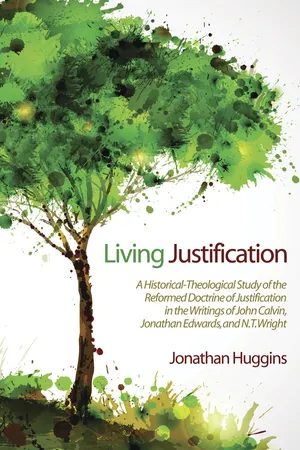
Living Justification
A Historical-Theological Study of the Reformed Doctrine of Justification in the Writings of John Calvin, Jonathan Edwards, and N. T. Wright
- 244 pages
- English
- ePUB (mobile friendly)
- Available on iOS & Android
eBook - ePub
Living Justification
A Historical-Theological Study of the Reformed Doctrine of Justification in the Writings of John Calvin, Jonathan Edwards, and N. T. Wright
About this book
This book is a historical-theological study of the Reformed doctrine of Justification. After providing a brief history of the doctrine, the work focuses on analyzing the writings of John Calvin, Jonathan Edwards, and N. T. Wright to discern points of development, continuity, and discontinuity within the Reformed tradition itself. Drawing upon their works, this book argues for a "living" theological practice and identity for those who work to formulate Reformed Doctrine.
Information
Subtopic
Église chrétienne1
Introduction
This book will examine the doctrine of justification within the classical Reformed tradition and the developments that have taken place within that tradition since the time of the Protestant Reformation. It will focus on the doctrine of justification itself, as understood and articulated within the Classical Reformed tradition, with John Calvin as the key theologian. But it will also trace some developments within the Reformed tradition up to the present. We do not intend to look at everyone who has written on the subject since then, but rather will focus on two very important and influential Reformed theologians. We will examine the works of Jonathan Edwards (1703–1758) and N. T. Wright (1948–). Both of these writers have contributed some important work on justification, but at different and diverse times in history. This literary study will provide a comparative analysis of the thought and writings of Calvin, Edwards, and Wright on justification, noting the similarities and differences between them in particular areas.
Edwards and Wright are both part of the Reformation heritage, but articulate the doctrine of justification in some different ways than did the sixteenth-century Reformers. As time passed there was less need to articulate doctrines, like justification, in response to medieval Catholicism (as the Reformers seemed to have done). Once the immediate context of those sixteenth-century battles was passed, theologians were able to explore and articulate these doctrines with less Reformation-Era constraint (though certainly not without their own conflicts from within and without). Thus, Edwards could incorporate his philosophical and theological musings, and Wright could incorporate the findings of twentieth-century historical scholarship. Both affirm the basic idea of justification as being “declared righteous in Christ” but without some of the Reformation-era particulars and without some of the medieval thought paradigms.
The sixteenth century was an important time period in the process of defining and clarifying doctrines that the Reformed tradition would regard as biblical. Many have considered the theological conclusions of the Protestant Reformers (such as Martin Luther and John Calvin) to be binding on all later Protestant tradition. However, others think that the Reformers’ method is more important to emulate than their particular conclusions. These seek to beware of the Reformed Confessions becoming a sort of cognate authority alongside Scripture itself, and thus compromising the Reformation conviction of sola scriptura and the humanist impulse of ad fontes. Some of these also want the Reformed tradition to be living and open to fresh articulation—while remaining essentially faithful to the theological tradition that has been passed on. This work will examine the writings of John Calvin as the key theologian of the Reformed tradition, and use his writings as a basis from which to discover continuities and discontinuities in the later reformed writings of Edwards and Wright.
As history moved beyond the Reformation era and scholars were no longer part of the immediate theological conflicts between the Reformers and the medieval Roman Catholic Church, there emerged a movement to memorialize and solidify the Reformers’ theology into Confessional statements (i.e., The Augsburg Confession, The Westminster Confession of Faith, The Three Forms of Unity).1 New generations of scholars were able to explore the doctrine and its related subjects with less constraint or fear of sounding too “Roman Catholic.” New times and new places gave rise to new generations of biblical exegetes and theologians. One in particular who embodied this independent spirit was the eighteenth-century North American theologian, Jonathan Edwards. Edwards was firmly rooted in the Reformed tradition. He preached and wrote to support the conclusions of the Reformers on justification by faith alone, but he also explored the doctrine and its related issues with an independent spirit—not concerned to simply restate his Reformed tradition as it was articulated in the various Confessions and Catechisms. He articulated the nature of faith and the important connections it has with love in a way that was new to the Reformed tradition. Edwards was also capable of bringing creative imagination and philosophical argumentation into his writing on the subject. He considered himself a Calvinist, but was also eager to assert his independence and reliance upon Scripture itself. Although Edwards did accept the basic paradigms and thought categories of the Reformers as his own (i.e., merit based system of salvation, and the need for the imputation of Christ’s righteousness for justification), he did not worry over making sure his doctrine was contrasted with Roman Catholicism, or fear the appearance of possible connections and overlaps with Catholic theology. Some recent scholars, such as Thomas Schafer, George Hunsinger, and Anri Morimoto,2 have noted this in Edwards and suggest that he offers some important possibilities for ecumenical discussion. Therefore, Edwards becomes an interesting figure in the history of the Reformed tradition, and suggests that the tradition is living, and thus open to re-articulation.
N. T. Wright is a distinguished Professor of New Testament at St. Andrews University. He has taught New Testament studies at some of the world’s most prestigious universities (Oxford and Cambridge). He has also served as the Anglican Bishop of Durham. He was once the Canon Theologian of Westminster Abbey. He is a noted scholar whose influence and readership literally span the globe. Wright considers himself a “Reformed theologian” in the sense that he is committed to the Scriptures alone as that source wherein and whereby God exercises his authority. Wright firmly holds to the theological method of the Reformers but does not always agree with their conclusions. In particular, Wright makes use of the vast amount of historical research available to scholars today. These resources, especially the discoveries of Archaeology, were not as available to previous generations of theologians. Thus, Wright asserts that bible scholars and theologians today can have arguably a clearer view into the historical context of the Bible. In fact, he believes this inevitably will affect our articulation of doctrine. A more accurate understanding of the biblical world opens windows of understanding into the literary tools of the ancient world. This can give a reader a better grasp of themes and issues that the biblical writers were addressing. According to Wright, this should give one an advantage in understanding the bible over someone who lacks the same access to the ancient world. But if one has opportunity to understand the world of the Bible—especially the Greco-Roman world of the New Testament, shouldn’t one be able to understand those writings better? In other words, Wright believes that it is good, but not complete, to know merely the authors’ words, one must also be able to make proper inferences—which are usually historically and culturally conditioned. This is not a novel suggestion that Wright is making. Other Reformed theologians have agreed, stating, “As the light of new knowledge improves our understanding and interpretation of scripture, we may have to modify and sometimes even break with traditional beliefs.”3
All of this suggests that Wright believes the Reformers were correct in much of their doctrinal formulation. However, he suggests that they inevitably “under-understood” the text because they did not have the same level of access to the world of the Bible as scholars possess today. Instead, the Reformers formulated their doctrine in the fires of historical controversies far removed from the context of the bible itself. Therefore, Wright believes that historical research helps us do sola scriptura more faithfully than previous generations were capable of. And this should have a bearing on how we understand and articulate the Reformed doctrine of justification.
Theme and Focus
This research will be anchored in the history of doctrine and not seek to be an exegetical study of the biblical texts dealing with justification. We will, however, examine and comment on the biblical exegesis found in the works of Calvin, Edwards, and Wright—all of whom engaged in rigorous exegetical work. But this will not be an exhaustive analysis of their works but rather a more focused analysis of their writings on justification. The aim is essentially to do a comparative analysis of the works of Calvin, Edwards, and Wright to seek and discover developments within the classical Reformed tradition. John Calvin’s articulation, codified in some of the classical Reformed confessions, will stand as our fundamental definition of the “Classical Reformed tradition.” This tradition is made up of the churches, theologians, and movements who have built upon and engaged Calvin’s thought at significant points in their efforts to develop a faithfully “Reformed” theology. Then we will trace points of continuity and discontinuity in the later works of both Edwards and Wright—as important examples of eighteenth-century and twenty-first-century scholarship. It will also be necessary to comment briefly on the historical situation of Edwards and Wright, and to compare and contrast that with Calvin’s.
For establishing what we will refer to as the “Classical Reformed tradition,” we will examine thoroughly John Calvin’s work in The Institutes of the Christian Religion,4 and his commentaries on the New Testament. He was the earliest and arguably the most brilliant systematizer of Protestant belief.5 His work has been so influential that it is common to refer to Reformed theology simply as “Calvinism”6 (though not all that is called “Calvinism” can be attributed to Calvin himself).7 B. B. Warfield wrote about Calvin and the Reformed tradition, “the greatest scientific (systematic) exposition of their faith in the Reformation age, and, perhaps the most influential of any age, wa...
Table of contents
- Title Page
- Acknowledgments
- Chapter 1: Introduction
- Chapter 2: A Short History of the Doctrine of Justification
- Chapter 3: John Calvin’s Doctrine of Justification
- Chapter 4: Jonathan Edwards’s Doctrine of Justification
- Chapter 5: N. T. Wright’s Doctrine of Justification
- Chapter 6: A Living Theological Tradition
- Bibliography
Trusted by 375,005 students
Access to over 1.5 million titles for a fair monthly price.
Study more efficiently using our study tools.
Frequently asked questions
Yes, you can cancel anytime from the Subscription tab in your account settings on the Perlego website. Your subscription will stay active until the end of your current billing period. Learn how to cancel your subscription
No, books cannot be downloaded as external files, such as PDFs, for use outside of Perlego. However, you can download books within the Perlego app for offline reading on mobile or tablet. Learn how to download books offline
Perlego offers two plans: Essential and Complete
- Essential is ideal for learners and professionals who enjoy exploring a wide range of subjects. Access the Essential Library with 800,000+ trusted titles and best-sellers across business, personal growth, and the humanities. Includes unlimited reading time and Standard Read Aloud voice.
- Complete: Perfect for advanced learners and researchers needing full, unrestricted access. Unlock 1.5M+ books across hundreds of subjects, including academic and specialized titles. The Complete Plan also includes advanced features like Premium Read Aloud and Research Assistant.
We are an online textbook subscription service, where you can get access to an entire online library for less than the price of a single book per month. With over 1.5 million books across 990+ topics, we’ve got you covered! Learn about our mission
Look out for the read-aloud symbol on your next book to see if you can listen to it. The read-aloud tool reads text aloud for you, highlighting the text as it is being read. You can pause it, speed it up and slow it down. Learn more about Read Aloud
Yes! You can use the Perlego app on both iOS and Android devices to read anytime, anywhere — even offline. Perfect for commutes or when you’re on the go.
Please note we cannot support devices running on iOS 13 and Android 7 or earlier. Learn more about using the app
Please note we cannot support devices running on iOS 13 and Android 7 or earlier. Learn more about using the app
Yes, you can access Living Justification by Jonathan R. Huggins in PDF and/or ePUB format, as well as other popular books in Théologie et religion & Église chrétienne. We have over 1.5 million books available in our catalogue for you to explore.