eBook - ePub
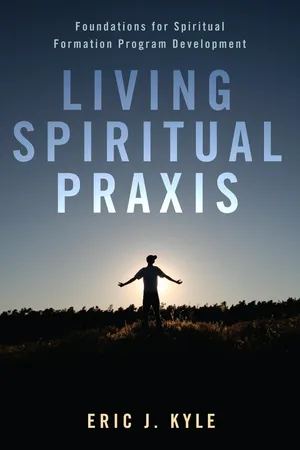
Living Spiritual Praxis
Foundations for Spiritual Formation Program Development
- 318 pages
- English
- ePUB (mobile friendly)
- Available on iOS & Android
eBook - ePub
About this book
Christian ministers working in congregations and with nonprofits seek to discern what it is that God has been doing and where it is that the "Spirit" might be leading them. In Living Spiritual Praxis Eric Kyle looks to address the lack of resources on the work and dynamics of Christian spiritual formation that actually develop a specific process for spiritual formation programs. Kyle strives to provide a guide for spiritual formation by using the "praxis-oriented" fields of action research and practical theology. He explores a process for understanding the nature and dynamics of a situation, discerning specific formative interventions, assessing various approaches, and continually assessing and modifying these understandings and approaches. Living Spiritual Praxis will be an invaluable resource for all Christians, leaders and laity alike, who are challenged by the spiritual formation of church members, communities, groups, and individuals.
Information
Topic
Theology & ReligionSubtopic
Christian Churchpart one
Theoretical Foundations
We begin our journey in this first part of the book by exploring some of the core theoretical foundations for our craft of living spiritual praxis. In the first chapter of this section, we will be exploring the nature and role of spiritual discernment for our vocation. Not only will we seek to better understand what discernment is and what it is founded upon, but we will also explore its practical steps and key components. In the end, the hopes are to provide a strong theoretical framework and methodological basis for engaging in discernment in relation to spiritual formation program development.
In the second chapter, we will then turn our attention to some of the basics of praxis and its relation to the field of spiritual formation. Here, our task will be to better understand what praxis is, where it comes from, and how it is engaged by other praxis-oriented fields. From these discussions, we will derive three methodologies that will become the foundations for our approaches program development. These three methodologies will then be taken up in part 2 of this book. Overall, then, the goal of this first part is to lay a strong theoretical foundation for the second part of this book where we will be exploring the three spiritual praxis methodologies.
1
Discerning Discernment
Detailing the Dynamics of a Spiritual Discipline
Type “discernment” into a book search engine, such as Amazon or Barnes and Noble, and you will find a couple hundred resources pop up. Discernment and decision-making has become a hot topic in recent years as leaders have sought to improve the quality of actions in churches, businesses, and ethical situations. In spiritual formation, its importance is no less central. For instance, early Christians, such as the writers of the Didache and the desert monastic communities, are found to emphasize the role of discernment.37 But what is it exactly? What are some of the foundational elements that we need to know about in order to engage in spiritual discernment? What are some of the basic steps that we can discerningly engage in? Drawing from a small sampling of mainline Protestant,38 Evangelical-Charismatic,39 and Roman Catholic40 sources, which represent both academic and practitioner perspectives,41 we will be exploring questions and topics such as these in an effort to better know what discernment is and how we might engage program development in spiritually discerning ways. While these explorations are by no means a comprehensive survey of the vast literature that is out there on this topic, they will help us to gain a deeper understanding into some of the basic theoretical and methodological movements of these all important processes of spiritual discernment. For, as we heard in the previous chapter, there can be no living spiritual praxis without them.
Foundations of Spiritual Discernment
Before we can engage in a specific set of processes for discernment, it will be helpful to explore some of the foundations of the nature of discernment. In this section, we will review a few key understandings of discernment, consider some of the necessary theological and epistemological bases for it, and gain insights into some its dynamics, pitfalls, and intended results. Overall, this section seeks to investigate these foundations.
Defining Discernment
While discernment does have a general meaning, it can be perceived differently depending on one’s worldviews. In an effort to move toward a working definition of spiritual discernment for our purposes in this project, we explore some of the different ways that theistic authors view it. In the end, we will come to understand spiritual discernment as a purposeful way of perceiving God’s presence and movements in our world.
Generally, Theistically
At its heart, discernment generally has to do with distinguishing between various parts or sources.42 Literally, writes Shalem Institute for Spiritual Formation’s Sister Rose Mary Dougherty, it means to “perceive clearly” or to “judge accurately.”43 It is essentially the process of being able to “distinguish between alternatives” and “discover answers to the questions that arise from issues in our lives.”44 In its most generalized form, then, discernment is associated with our efforts to choose rightly from among alternatives, thereby being able to discriminate one path or choice from another.
For theists, “spiritual” discernment is described in more explicitly theological terms. Stated most directly by spiritual director and Presbyterian pastor John Ackerman, “The process of discernment is that of distinguishing the Holy Spirit from other spirits,”45 and it is a view supported by some of our Catholic and charismatic authors as well.46 Rather than merely attempting to distinguish between two choices in a general way, then, theists seek to do so from their distinctively theological perspective.
Spiritual discernment is therefore ultimately about perceiving the movements of the Spirit in our midst, that we might live more in tune with God.47 It is about one’s quest to know and live in accordance with God’s will for our lives and our communities.48 Generally and theistically conceived, then, spiritual discernment seeks to discriminate among the various influences of our lives hoping to perceive the movements of God with greater clarity. As a result, there are two primary places that an individual can and should look to when discerning: their outer and inner lives.49
Outer Mandates and Guidance
Looking externally, spiritual discernment is sometimes conceived of as a quest to know “God’s universal will” for our lives.50 Couched in this way, discernment may be approached as a process of looking to external sources of authority, such as sacred texts or one’s religious tradition, for guidance and mandates regarding this universal will.51 For others, the external aspects of discernment are a process of “recognizing the kingdom in our midst,”52 helping us to “spot the presence of God in the concrete events and experiences of ordinary life.”53 While for others, it is a quest for “some guiding wisdom” that will help us in our daily lives.54 Regardless of the reasons, looking externally to one’s outer life is considered to be a central part of spiritual discernment.
Inner Movements
However, many of our authors also highlight the need to consider the inner movements of one’s life as well. Here, an emphasis is given to our inward listening for God’s yearnings and invitations for our lives.55 Going back to early Christian communities, listening inwardly “arose out of the desire to sort out the movements within us.”56 As Ackerman writes, “Discernment is inviting the mind of Christ to decide on a bas...
Table of contents
- Title Page
- Acknowledgments
- Introduction: The Need for Spiritual Formation Methodologies
- Part One: Theoretical Foundations
- Part Two: Methodological Movements
- Conclusion: Living Spiritual Praxis in Retrospect
- Appendix A: Various Steps to Discernment
- Appendix B: An Introduction to the Basics of Modeling
- Appendix C: Tom’s Original Program
- Appendix D: Tom’s Revised Program
- Bibliography
Trusted by 375,005 students
Access to over 1.5 million titles for a fair monthly price.
Study more efficiently using our study tools.
Frequently asked questions
Yes, you can cancel anytime from the Subscription tab in your account settings on the Perlego website. Your subscription will stay active until the end of your current billing period. Learn how to cancel your subscription
No, books cannot be downloaded as external files, such as PDFs, for use outside of Perlego. However, you can download books within the Perlego app for offline reading on mobile or tablet. Learn how to download books offline
We are an online textbook subscription service, where you can get access to an entire online library for less than the price of a single book per month. With over 1.5 million books across 990+ topics, we’ve got you covered! Learn about our mission
Look out for the read-aloud symbol on your next book to see if you can listen to it. The read-aloud tool reads text aloud for you, highlighting the text as it is being read. You can pause it, speed it up and slow it down. Learn more about Read Aloud
Yes! You can use the Perlego app on both iOS and Android devices to read anytime, anywhere — even offline. Perfect for commutes or when you’re on the go.
Please note we cannot support devices running on iOS 13 and Android 7 or earlier. Learn more about using the app
Please note we cannot support devices running on iOS 13 and Android 7 or earlier. Learn more about using the app
Yes, you can access Living Spiritual Praxis by Eric J. Kyle in PDF and/or ePUB format, as well as other popular books in Theology & Religion & Christian Church. We have over 1.5 million books available in our catalogue for you to explore.