eBook - ePub
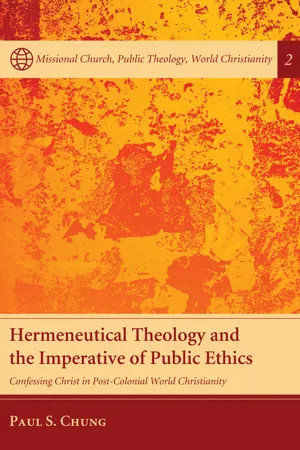
Hermeneutical Theology and the Imperative of Public Ethics
Confessing Christ in Post-Colonial World Christianity
- 426 pages
- English
- ePUB (mobile friendly)
- Available on iOS & Android
eBook - ePub
Hermeneutical Theology and the Imperative of Public Ethics
Confessing Christ in Post-Colonial World Christianity
About this book
Hermeneutical Theology and the Imperative of Public Ethics is a groundbreaking attempt to present constructive missional theology in an integrative and interdisciplinary framework as it provocatively utilizes and contextualizes Reformation theology and hermeneutics concerning ethical theology embedded within the wider horizon of World Christianity. Mission as constructive theology is explored and refined in an hermeneutical and interdisciplinary fashion, underlying a new horizon of postcolonial theology and mission in light of God's act of speech. Missional church founded up God's grace of justification and Christ's diakonia of reconciliation becomes ethically oriented public church as it is engaged in mutireligious diversity of people's lives and lifeworld in the postcolonial context of World Christianity.
Information
Topic
Theology & ReligionSubtopic
Christian TheologyI
Reformation Theology, Public Ethics, and God’s Mission
1
Martin Luther
Public Ethics and the Discipleship of God’s Mission
There have been strikingly critical remarks about Lutheran ethics. Ernst Troeltsch critiques Luther for failing to attain comprehensive sociological influence and significance because of his vocational ethic, which views the secular institution as the divinely appointed means for perfecting Christian morality.1 On the other hand, others charge Luther with ignoring the missionary duty of the church. Bosch, for instance, accuses Luther’s teaching on justification of paralyzing any missionary effort because it overemphasizes God’s initiative and is preoccupied with human depravity. Such a perspective propels a pessimistic view of humanity “as mere pawns on a chessboard.”2 Given this critique of Luther, I shall undertake a study exploring Luther’s contribution to public ethics and discipleship of God’s mission by heeding diverse dimensions of his theology.
God’s Mission in Trinitarian Framework and the Missional Church
Barthian grounding of mission as God’s sending has become a theological principle in an ecumenical context by inspiring Barth’s followers to advance God’s mission in the Trinitarian framework. Luther’s Trinitarian thinking is reluctant to conflate God in self (the immanent Trinity) with God for us (the economic Trinity). God in self belongs to God’s majesty and mystery while God for us in the world brings us to respect the freedom and majesty of God in self.
The doctrine of the Trinity embedded within the gospel becomes the sum of the gospel of justification, because the triune God is the God who reveals God’s self in the gospel of Jesus Christ through the Holy Spirit. Thus, Luther defines God as the “glowing oven full of love,”3 which underlines an active horizon of the Word of God. The Word of God is active and emancipatory because God is love. The triune God who is revealed as the glowing oven full of love is the One who speaks in terms of opus alienum (God’s strange work), nomos (law), and opus proprium (the gospel).
According to Luther, Jesus Christ opens to us “the most profound depths of his fatherly heart and his pure, unutterable love.”4 Thus, Luther’s concept of theologia crucis (theology of the cross) provides an insight into qualifying and characterizing the mission of the triune God. Conformity to Christ characterizes our discipleship and participation in Christ’s ministry and mission for God’s reign in the world. Trinitarian mission is grounded in Luther’s basic conviction that “the Father gives us all creation, Christ all his works, the Holy Spirit all his gifts.”5
Having considered this, God sent the church into the world and it exists for the sake of the world, because the church is the assembly of saints that occurs through the Word and the sacraments in the presence of the Holy Spirit. The Spirit is the One “who effects faith where and when it pleases God in those who hear the gospel, . . . not on account of our own merits but on account of Christ.”6
The church as the assembly of saints has essentially a missional character and public responsibility. Luther elaborates his missional ecclesiology in terms of the third article: the Holy Spirit. Our existence is made holy by the Holy Spirit and by the Word. We become holy in the community of saints through the forgiveness of sins, and we are in hope of the resurrection of the body, and the life everlasting. The word ecclesia, rendered in English to mean “church,” properly means an assembly rather than a consecrated house or building. The word church really means a common assembly, “a holy Christian people.” Furthermore, the church is defined as “the mother that begets and bears every Christian through the Word of God, which the Holy Spirit reveals and proclaims, through which he illuminates and inflames hearts so that they grasp and accept it, cling to it, and persevere in it.”7 So we see the missional church, in proclamation of the Word and the effectiveness of the Spirit, is grounded in Trinitarian activity for the world.
The classic doctrine of appropriation entails the possibility of bringing the triune God toward a language-event because we can call God in terms of Creator, Redeemer, and Sanctifier. God’s life in perichoresis (the mutual relatedness of the Triune God as inhering in God’s self-permeation without confusion) is inseparably connected with a hermeneutical process of defining the name of God (assigning to one person that which is common to all). The Augustinian rule becomes meaningful in a linguistically innovative manner: opera trinitatis ad extra sunt indivisa (the external works of the Trinity are indivisible). This rule does not necessarily mean for Luther the immutability and unrelatedness of the divine being in relation to the world.
Linguistic Featuring of the Trinityand the Mission of Word-Event
In Luther’s exposition of John’s Prologue, God is the Word speaking in, with, and to God’s self. God’s being is the subject of speaking because the Word of God as the force of communication enables communication within God’s self and for the world. This perspective undergirds Luther’s notion of gospel as viva vox Dei. God is living, effective, life-giving, forgiving, and emancipating in the gospel, since God’s Trinitarian being is comprehended in the internal structure of speech-event in terms of promise, dialogue, and communication. “God of himself speaks his word so that the godhead follows the word and remains with its nature in the word and is there in its essence.”8
In contrast to the Greek logos, the Word or incarnation in Christian tradition is pure event by affirming that the Word became flesh. The theological idea of incarnation emphasizes the unity between God the Father and God the Son whose Trinitarian mystery is conceived of in the phenomenon of language. John’s Prologue describes the sending of the Son and the mystery of the incarnation by way of the Word.
Luther demonstrates a linguistic understanding of the gospel as the living voice of God (viva vox evangelii) and this Word is ever new in proclamation. The gospel already points to the multiplicity of its proclamation, so that the meaning of the Word is closely connected with the event of proclamation. God’s act of speech is not only present in the ecclesial sphere, but is also working in the world of creation. Insofar as God binds God’s Word to us through the Spirit, we can believe in God. Faith grounded in the grace of Jesus Christ is the event in which God comes to us in the presence of the Spirit.9
The Word explicating itself in the multiplicity of words brings out the character of language as event. According to Gadamer, “being an event is a characteristic belonging to the meaning itself.”10 In light of God’s speech-event, Luther presents in his Smalcald Articles “the mutual convers...
Table of contents
- Title Page
- Part I: Reformation Theology, Public Ethics, and God’s Mission
- Part II: God’s Mission, Public Ethics, and Israel
- Part III: Public Ethical Theology and a Transformative Construal of the World
- Part IV: Theological Ethics and Missional Implication
- Part V: Postcolonial Public Theology and World Christianity
- Epilogue
- Bibliography
Trusted by 375,005 students
Access to over 1.5 million titles for a fair monthly price.
Study more efficiently using our study tools.
Frequently asked questions
Yes, you can cancel anytime from the Subscription tab in your account settings on the Perlego website. Your subscription will stay active until the end of your current billing period. Learn how to cancel your subscription
No, books cannot be downloaded as external files, such as PDFs, for use outside of Perlego. However, you can download books within the Perlego app for offline reading on mobile or tablet. Learn how to download books offline
We are an online textbook subscription service, where you can get access to an entire online library for less than the price of a single book per month. With over 1.5 million books across 990+ topics, we’ve got you covered! Learn about our mission
Look out for the read-aloud symbol on your next book to see if you can listen to it. The read-aloud tool reads text aloud for you, highlighting the text as it is being read. You can pause it, speed it up and slow it down. Learn more about Read Aloud
Yes! You can use the Perlego app on both iOS and Android devices to read anytime, anywhere — even offline. Perfect for commutes or when you’re on the go.
Please note we cannot support devices running on iOS 13 and Android 7 or earlier. Learn more about using the app
Please note we cannot support devices running on iOS 13 and Android 7 or earlier. Learn more about using the app
Yes, you can access Hermeneutical Theology and the Imperative of Public Ethics by Paul S. Chung in PDF and/or ePUB format, as well as other popular books in Theology & Religion & Christian Theology. We have over 1.5 million books available in our catalogue for you to explore.