eBook - ePub
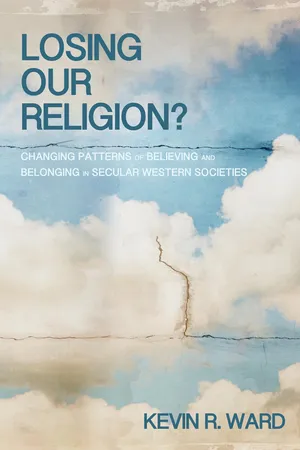
Losing Our Religion?
Changing Patterns of Believing and Belonging in Secular Western Societies
- 278 pages
- English
- ePUB (mobile friendly)
- Available on iOS & Android
eBook - ePub
Losing Our Religion?
Changing Patterns of Believing and Belonging in Secular Western Societies
About this book
Church-going in most Western societies has declined significantly in the wake of the social and cultural changes that began in the 1960s. Does this mean that people in these societies are losing any religious dimension in their lives, or is it being expressed in other forms and places? This study begins by looking at comparative data on how church-going patterns have changed in five countries--Britain, the United States, Canada, Australia, and New Zealand--examining reasons for the decline, how churches have responded to these changes, and why some churches have shown greater resilience. It then explores some of the particular challenges these changes pose for the future of churches in these societies and some of the responses that have been made, drawing on both sociological and theological insights. The conclusion is that, despite the loss of belonging, believing persists and religion continues to play a significant role in these societies, mediated in a variety of diffuse cultural forms. Cases illustrating these changes are largely drawn from New Zealand, which as the country most recently settled by Europeans has always been "secular" and thus provides helpful insights.
Information
Topic
Theologie & ReligionSubtopic
Christliche Kirche1
Are We Losing Our Religion?
In 1966, shortly before the Beatles began a tour of the United States, an interview with John Lennon was published in a popular music magazine in which he stated: “Christianity will go. It will vanish and shrink. I needn’t argue about that; I’m right and I’ll be proved right. We’re more popular than Jesus now.”1 The Beatles, and Lennon in particular, had by this stage become virtual spokespersons for the post-war generation and the comment caused an outcry across the country. Lennon survived the acrimony which erupted, and after the break-up of the band had an enormous solo hit with the song Imagine, which pictured a world from which religion had indeed vanished. About twenty years later REM, speaking for the generation which followed, also had a huge hit with their song Losing my Religion. It seems that “losing our religion” was a theme which resonated with young people in the later decades of the twentieth century.
In contrast to the attention given to popular music, the media in New Zealand has paid scant regard to the topic of religion over the past thirty or so years. When it has, it has by and large followed the lead of these songs. Baby Boomers and GenerationXers have indeed been “losing my religion,” and seem to believe that the world will be a better place, as Lennon suggested, when there is indeed “no religion.” New Zealand’s most prominent weekly magazine, The Listener, has in recent years, in a nod to the religious dimension of Christmas, featured in its festive copy each year some reflection on the state of religion and the churches in New Zealand. In its final edition of the twentieth century its lead article was entitled “Faith in the Future: Searching for Jesus Christ at Christmas.”
Over 50 years, the expression may have grown sharper, the message more urgent, but the conclusion is inescapable: you can see the end of Christianity from here, 2000 years after the birth of Christ . . . Consult all the statistics and all the data—falling church attendance figures, the growing absence of ‘Christian’ on census returns—and the news is bad and worsening for the Christian mainstream.
What are we witnessing? Not the death of spirituality, not the death of belief, not the death of meaning, but the death of religious institutions, the death of organised religion, the erosion of Christianity’s historical core, its hold on the heart of the West . . . It is the death of Christendom, says theologian Lloyd Geering.2
Lloyd Geering3 has probably commanded more media attention in New Zealand over this period than all the other religious commentators combined. He has consistently espoused this line, and for most of the period the available data seemed to provide support for it. More recently, when the most recent New Zealand census data were published in 2007,4 headlines in leading newspaper ran such lines as “Christian Church Withering,” “Pakeha5 Quit Traditional Churches ‘in Big Numbers,’” and “Churches on Slippery Slope.” One ran an editorial under the title “Withering Belief,” stating that “the nation is undergoing what amounts to a revolution in belief . . . symbolised by Christianity’s fast decline into what may soon be minority status.”6 The editorial went on to suggest that when that occurs New Zealand will have lost a “defining characteristic that has prevailed since the arrival of the missionaries in the early 19th century.” Over those 200 years Christianity “moulded culture and the institutions” so that we became, at least nominally, a Christian country.
Easter is also a time when the media chooses to focus on religion in society and in 2013, anticipating the results of census data currently being analyzed,7 the Christchurch Press ran such an article, under the heading “Are we Losing our Religion to Modern Life?” Picking up the theme that has dominated the city’s story for the past two years—the destruction caused by the 2010 and 2011 earthquakes—it began: “Christchurch’s churches have taken a bit of a battering over the past few years, with many lying broken and in pieces. And it seems the state of faith in the city has taken a hit too. The number of Christians in Christchurch is dropping, while those identifying as non-religious is steadily on the rise.”8
The story of Christianity’s 200 years in New Zealand is of course a relatively brief one, and one might make a case that it was never deeply embedded here. This kind of speculation, however, has not been limited to New Zealand. In almost all Western countries the influence and significance of the Christian church has been in decline since the beginning of the m...
Table of contents
- Title Page
- Preface
- Chapter 1: Are We Losing Our Religion?
- Chapter 2: Religion in a Post-Aquarian Age
- Chapter 3: Changing Patterns of Church Life
- Chapter 4: A Terminus Quo for the Mainline?
- Chapter 5: The Charismatic Movement and the Churches
- Chapter 6: Emerging from the Shadow of Christendom
- Chapter 7: Is the Future Churchless?
- Chapter 8: Being the Church in a Fragmented World
- Chapter 9: It Might be Emerging but is it Church?
- Chapter 10: Migration and the Future of Christianity
- Chapter 11: Sport and Religion
- Chapter 12: Religion Beyond the Boundaries
- Bibliography
Trusted by 375,005 students
Access to over 1.5 million titles for a fair monthly price.
Study more efficiently using our study tools.
Frequently asked questions
Yes, you can cancel anytime from the Subscription tab in your account settings on the Perlego website. Your subscription will stay active until the end of your current billing period. Learn how to cancel your subscription
No, books cannot be downloaded as external files, such as PDFs, for use outside of Perlego. However, you can download books within the Perlego app for offline reading on mobile or tablet. Learn how to download books offline
We are an online textbook subscription service, where you can get access to an entire online library for less than the price of a single book per month. With over 1.5 million books across 990+ topics, we’ve got you covered! Learn about our mission
Look out for the read-aloud symbol on your next book to see if you can listen to it. The read-aloud tool reads text aloud for you, highlighting the text as it is being read. You can pause it, speed it up and slow it down. Learn more about Read Aloud
Yes! You can use the Perlego app on both iOS and Android devices to read anytime, anywhere — even offline. Perfect for commutes or when you’re on the go.
Please note we cannot support devices running on iOS 13 and Android 7 or earlier. Learn more about using the app
Please note we cannot support devices running on iOS 13 and Android 7 or earlier. Learn more about using the app
Yes, you can access Losing Our Religion? by Kevin Ronald Ward in PDF and/or ePUB format, as well as other popular books in Theologie & Religion & Christliche Kirche. We have over 1.5 million books available in our catalogue for you to explore.