eBook - ePub
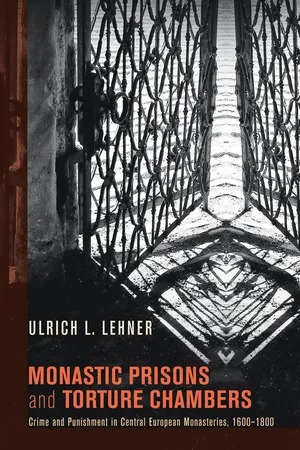
Monastic Prisons and Torture Chambers
Crime and Punishment in Central European Monasteries, 1600–1800
- 118 pages
- English
- ePUB (mobile friendly)
- Available on iOS & Android
eBook - ePub
Monastic Prisons and Torture Chambers
Crime and Punishment in Central European Monasteries, 1600–1800
About this book
Following the Council of Trent (1545-1563), Catholic religious orders underwent substantial reform. Nevertheless, on occasion monks and nuns had to be disciplined and--if they had committed a crime--punished. Consequently, many religious orders relied on sophisticated criminal law traditions that included torture, physical punishment, and prison sentences. Ulrich L. Lehner provides for the first time an overview of how monasteries in central Europe prosecuted crime and punished their members, and thus introduces a host of new questions for anyone interested in state-church relations, gender questions, the history of violence, or the development of modern monasticism.
Information
Topic
Theology & ReligionSubtopic
World History1
Confinement for Criminals and the Insane
Differences between Orders and Genders
A monastic prison had three purposes. It was a penitentiary for those who could be reintegrated into the community, an ordinary prison for incorrigible religious who had proved to be irreformable, and a space of confinement for the mentally disturbed.31
While it was common knowledge that monasteries dealt with mentally unstable people in this way, ecclesiastical historians often claimed that the fate of such monks and nuns was no worse than in the secular world. While this is true for severe cases, it is not so for milder ones. A mildly disturbed layperson could still live in freedom and was not confined to a dungeon, but until the end of the eighteenth century, religious who were likewise disturbed—even if nonviolent—were kept in the monastery prison, and like the mentally unstable in the secular world, “treated” with corporal punishment.32 The Austrian Capuchin brother Nemesian Peikl (d. 1784) was imprisoned in 1728 and not transferred to a psychiatric hospital until 1783. His was probably not a severe case of insanity; in fact, some sources describe him as weird but mentally lucid.33 His behavior, however, was embarrassing: “He kneels in front of others, walks into the garden, serves others and helps them carry water.”34 According to the general statutes of the order, genuflecting in front of others was an offense that carried a prison sentence, a fact that the monks did not find necessary to reveal to visiting government officials.35 Yet another example is that of the Capuchin Fr. Thuribius. In Poysdorf, Austria, he was confined to prison for being restless, shouting, and not keeping his unheated room clean. He was beaten by his own confreres often at their own will, and “whenever the prior got in a rage . . . he had [P. Thuribius] dragged into the library, where he would flog him with ox strings until he was unable to move.”36 The prior, deposed by Joseph II for his inhumane behavior, defended his actions in 1783 by stating that Thuribius was either insane and required such treatment because of his disease, or a bad person in need of punishment. It is also questionable whether the treatment of insane laypeople in monasteries was preferable to that in a secular institution (as is sometimes claimed by church historians), as a report about the treatment of inmates in the monastery of the Alexian brothers in Neuss near Cologne of 1781 shows. The patients and prison inmates were deprived not only of proper clothes but also of decent food and physical exercise, and they had to endure the violence of the brothers, who often employed it to “treat” their patients.37
The use of monastic cells as penitentiary rooms increased during the late Middle Ages. While in earlier periods of church history monks and nuns could be expelled for apostasy, attempted marriage, heresy or schism, blasphemy, violence against clergymen, theft, abortion, participation in a duel, homicide, abduction of minors, sexual relations with a minor under the age of sixteen, homosexuality and bestiality, etc., such expulsions were rare after the thirteenth century due to papal law. By the 1500s, expulsions from centralist orders were reserved to the generals of the orders in Rome.38 Perpetual imprisonment in a monastic dungeon became the usual sentence for crimes that would have been punished by death under secular law.39 Thus, a monastery prison indeed replaced the death penalty, but this did not mean that such a verdict excluded additional corporal punishment, as the history of the secular prison would suggest. Instead, even monks who had been sentenced to life in prison often had to undergo harmful physical punishment.40 Pope Pius IV (1559–1565) confirmed the usefulness of monastic prisons, and only a few orders, like the Jesuits, received the papal privilege of expelling incorrigible members.41 Less egregious crimes were punished with proportionate amounts of time in prison, but each order and sometimes each province had its own peculiarities. The Recollect Franciscans of Flanders stated in their statutes of 1718 that each convent had to have at least two cells that could be used for incarcerating a friar.42 The Spanish Hieronymites punished those monks who permitted or attended profane theater plays with six months’ suspension from office.43 Theft and excessive gambling also were punished severely.44
Leaving the monastery illicitly, that is, trying to escape, was grounds for being treated as an apostate. However, Pope Urban VIII (1623–1644) instituted a more lenient rule, stating that if one returned within four months to his home monastery without having committed other crimes (apostasy, adultery, fornication, etc.), one could be reconciled with the monastic community without serious repercussions. However, this rule was limited to the cisalpine religious.45 It is indeed remarkable that a considerable number of runaway religious eventually returned to their monasteries in such a manner.46 Common motives for escape were problems with the community—such as discontentment with spiritual progress, boredom, personal desire for material possessions or sexual relations, and problems with the vow of obedience. Escaping, however, was generally something resorted to after all legitimate alternatives, like being transferred to a different monastery, had been exhausted.47 Sometimes very mundane reasons like bad food or drink could motivate a religious to escape. In 1788 the Benedictine Ludolph Stollreither ran away from his abbey Schäftlarn in Bavaria because he could not digest the heavy beer in the monastery. He returned after a few weeks (and was not punished) when the abbot promised him good light wheat beer instead.48
31. The following paragraph is based on the overview in Lehner, Enlightened Monks, 103–5. See also Kober, “Gefängnisstrafe gegen Cleriker und Mönche”; Kober, “Körperliche Züchtigung als kirchliches Strafmittel gegen Kleriker und Mönche.” For Benedictines see also Spilker, “Busspraxis in der Regel des hl. Benedikt”; Heufelder, “Strenge und Milde: Die Strafkapitel der Benediktinerregel”; Hofmeister, “Vom Strafverfahren bei den Ordensleuten.” For the history of ecclesiastical prisons in general, see Krauss, Im Kerker vor und nach Christu...
Table of contents
- Title Page
- Preface
- Introduction
- Chapter 1: Confinement for Criminals and the Insane
- Chapter 2: What Was a Monastic Prison Like?
- Chapter 3: Orders with and without “Prisons”
- Chapter 4: The Franciscan “Criminal Trial”
- Chapter 5: Physical Assault and Assassination Attempts in Female Convents
- Chapter 6: Fornication and Child Abuse
- Chapter 7: Escapes from the Cloister
- Conclusion
- Bibliography
Trusted by 375,005 students
Access to over 1.5 million titles for a fair monthly price.
Study more efficiently using our study tools.
Frequently asked questions
Yes, you can cancel anytime from the Subscription tab in your account settings on the Perlego website. Your subscription will stay active until the end of your current billing period. Learn how to cancel your subscription
No, books cannot be downloaded as external files, such as PDFs, for use outside of Perlego. However, you can download books within the Perlego app for offline reading on mobile or tablet. Learn how to download books offline
Perlego offers two plans: Essential and Complete
- Essential is ideal for learners and professionals who enjoy exploring a wide range of subjects. Access the Essential Library with 800,000+ trusted titles and best-sellers across business, personal growth, and the humanities. Includes unlimited reading time and Standard Read Aloud voice.
- Complete: Perfect for advanced learners and researchers needing full, unrestricted access. Unlock 1.5M+ books across hundreds of subjects, including academic and specialized titles. The Complete Plan also includes advanced features like Premium Read Aloud and Research Assistant.
We are an online textbook subscription service, where you can get access to an entire online library for less than the price of a single book per month. With over 1.5 million books across 990+ topics, we’ve got you covered! Learn about our mission
Look out for the read-aloud symbol on your next book to see if you can listen to it. The read-aloud tool reads text aloud for you, highlighting the text as it is being read. You can pause it, speed it up and slow it down. Learn more about Read Aloud
Yes! You can use the Perlego app on both iOS and Android devices to read anytime, anywhere — even offline. Perfect for commutes or when you’re on the go.
Please note we cannot support devices running on iOS 13 and Android 7 or earlier. Learn more about using the app
Please note we cannot support devices running on iOS 13 and Android 7 or earlier. Learn more about using the app
Yes, you can access Monastic Prisons and Torture Chambers by Ulrich Lehner in PDF and/or ePUB format, as well as other popular books in Theology & Religion & World History. We have over 1.5 million books available in our catalogue for you to explore.