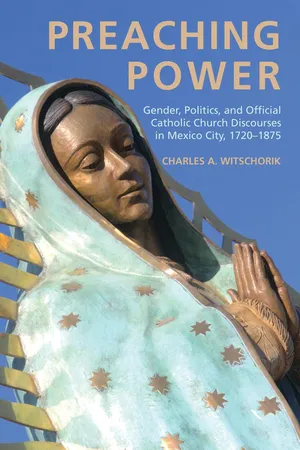
eBook - ePub
Preaching Power
Gender, Politics, and Official Catholic Church Discourses in Mexico City, 1720–1875
- 282 pages
- English
- ePUB (mobile friendly)
- Available on iOS & Android
eBook - ePub
Preaching Power
Gender, Politics, and Official Catholic Church Discourses in Mexico City, 1720–1875
About this book
This book uses a gender perspective to examine sermons and other officially endorsed discourses of the Catholic Church in eighteenth- and nineteenth-century Mexico City. Analyzing the different ways that, over time, gendered images, metaphors, and hagiographical examples were used in sermons and other documents, the book examines how the church negotiated challenges to its cultural and ideological hegemony. Beginning with sermons from the early eighteenth century, the author follows the evolution of church discourses as preachers reveled in Baroque analogies, embraced ideals of the Enlightenment, targeted women's alleged moral vices at times of political crisis, and ultimately turned to notions of women as "the devout sex" in order to combat incipient liberalism. Put another way, liberals after independence were not the only ones to assert a kind of "republican motherhood": preachers countered with a vision of "Catholic motherhood" that had great resonance in Mexico even into the twentieth century.
Information
Topic
Theology & ReligionSubtopic
Christian TheologyChapter 1
Decorating Power
Sermons and the Baroquein Spain and Colonial Mexico
“Overcharged decoration . . . of ritual space . . . sought to impose itself massively . . . on the spectator and to capture in that way his or her will, operating more in the realm of emotional persuasion than of rational knowledge.”55
Referencing the visceral power of Baroque art in the seventeenth- and eighteenth-century Hispanic world, this analysis by a contemporary scholar points to ways in which the Baroque aesthetic employed abundance and excess as a means of imposing meaning on its audiences. Drawing its beholders and listeners in through wonder and adornment, Baroque art sought to win over the will and secure loyalty to the underlying values and power structures that it served. Among the forms in which this Baroque aesthetic manifested itself—for example, architecture, painting, and music—an important but less frequently studied instance was the sermon. Likewise elaborate, mesmerizing and even spectacles in themselves, sermons in the Baroque period in Spain and New Spain served as a way for the Catholic Church, as an arbiter of reigning social norms and power structures, both to celebrate and reinforce its privileged social place.
In order to understand how sermons may contribute to our understanding of the Catholic Church in colonial and early-independent Mexico, this chapter will first examine the context out of which they arose—namely, early modern Roman Catholic preaching in general and Baroque Spanish sermons in particular. Understanding this context will help to illuminate some of the ways in which Baroque sermons in New Spain differed from their peninsular counterparts—especially with regard to the gendered discourses employed within them—and what that may suggest about the state of the institutional Church in New Spain in the first part of the eighteenth century. Later chapters will explore the nature of this difference in greater depth and point to ways in which the Church’s position changed over time in the wake of political and cultural developments later in the eighteenth and early nineteenth centuries.
Early-Modern Catholicism and the Baroque
Common to both Catholic and Protestant Early Modern societies, preaching was frequent and ubiquitous, found not just at mass and church services but also in the contexts of hospitals, outdoor events, religious processions, and autos-de-fe, among others.56 In Catholic and Protestant settings alike, preaching included both a doctrinal component as well as a social dimension reflective of surrounding circumstances.57 However, where Roman Catholic and Protestant preachers parted ways was in the style of preaching emphasized in each movement’s normative statements of reform. While Protestants emphasized the bible and scriptural exegesis in their sermons, Catholic preaching tended to favor reaffirmations of doctrines challenged by reformers, including the authority of the papacy, the cult of the saints, and the centrality of the Eucharist—a trend codified at the Council of Trent (1545–1563) in its decrees on preaching. Nevertheless, while traditional narratives have tended to portray this Catholic response as reactionary—as observable in terms such as Counter-Reformation—more recent scholarship on Trent, beginning with the seminal mid-twentieth-century work of H. Outram Evennett, has shown that neither the council nor the various Roman Catholic reform movements that preceded and followed it were strictly reactionary or focused solely on the past.58 For that reason, other scholars such as John W. O’Malley have suggested various alternate ways of describing Catholic reform movements, including Catholic Reformation and Early Modern Catholicism, among others.59
Still, if the term Counter Reformation is appropriate in any sense for describing early modern Catholicism it is likely in the realm of preaching—an important discursive platform by which the Church sought to combat the gains of Protestantism.60 Nevertheless, Catholic preaching post-Trent was not monolithic—though sharing in common a desire to defend the faith, Catholic sermons embodied a diverse assortment of older and more contemporary forms tailored to the needs of specific situations.61 Officially, the approach mandated by Trent represented a break from earlier times in the sense that it now called for sermons to be given in the context of greater pastoral care on the part of bishops and parish priests—as opposed to the late medieval practice of leaving pastoral concerns largely to religious orders.62 In the words of the Council, bishops and priests were instructed as follows:
[To] feed the people committed to them with wholesome words in proportion to their own and their people’s mental capacity, by teaching them those things that are necessary for all to know in order to be saved and by impressing upon them with briefness and plainness of speech the vices that they must avoid and the virtues that they must cultivate, in order that they may escape eternal punishment and obtain the glory of heaven.63
This emphasis on clear speaking indicated a desire on the part of the council at least implicitly to warn preachers against some of the excesses of medieval preaching, in which extended asides on subtle points of philosophy and theology had tended to obscure more essential moral and spiritual messages.64
Also crucial to the council was the issue of who was to preach.65 Although parish priests and members of religious orders would continue to give sermons, Trent specifically called for bishops to preach whenever possible and to maintain oversight and control of preaching in their respective dioceses.66 Since little mention was made of the types of sermons considered normative, following Trent responsibility for the type of preaching to be encouraged and/or disallowed in particular dioceses largely devolved upon the local bishop.67 Though efforts on the part of some bishops—notably, the archbishop of Milan, Charles Borromeo—resulted in some systematization of Catholic preaching, one of the important legacies of Trent for Catholic preaching was the implicit flexibility it gave for a diversity of styles and genres of sermons to be preached in particular areas according to specific local needs and circumstances.68 Overall, Catholic preaching in the Early Modern period consisted of a diverse, hybrid assortment of many earlier forms, all of which were available to and could be employed by preachers according to the specific needs of the communities in which they preached.69
For the purposes of this study, one important need manifested in the Catholicism of this period found expression in the culture of the Baroque that flowered after Trent.70 Although the council had recommended clarity and economy of style, an even greater priority in many Catholic contexts was the need to guard against defections to Protestantism—a goal often pursued through new artistic and discursive strategies aimed at producing a visceral impact in their audiences, thereby underlining for them the power and majesty of the Church and clarifying what was at stake in either stayi...
Table of contents
- Title page
- Acknowledgments
- Abbreviations
- Introduction: Gender and Official Church Discourses in New Spain and Mexico
- Chapter 1: Decorating Power
- Chapter 2: Manly Virgins and Tender Fathers
- Chapter 3: Reforming Discourses
- Chapter 4: The French Connection
- Chapter 5: Delicate Damsels and Perfidious Rebels
- Chapter 6: Pious Women and New Foundations
- Chapter 7: Gendering Reform
- Conclusion: Gendered Church Discourses Come Full Circle
- Bibliography
Trusted by 375,005 students
Access to over 1.5 million titles for a fair monthly price.
Study more efficiently using our study tools.
Frequently asked questions
Yes, you can cancel anytime from the Subscription tab in your account settings on the Perlego website. Your subscription will stay active until the end of your current billing period. Learn how to cancel your subscription
No, books cannot be downloaded as external files, such as PDFs, for use outside of Perlego. However, you can download books within the Perlego app for offline reading on mobile or tablet. Learn how to download books offline
We are an online textbook subscription service, where you can get access to an entire online library for less than the price of a single book per month. With over 1.5 million books across 990+ topics, we’ve got you covered! Learn about our mission
Look out for the read-aloud symbol on your next book to see if you can listen to it. The read-aloud tool reads text aloud for you, highlighting the text as it is being read. You can pause it, speed it up and slow it down. Learn more about Read Aloud
Yes! You can use the Perlego app on both iOS and Android devices to read anytime, anywhere — even offline. Perfect for commutes or when you’re on the go.
Please note we cannot support devices running on iOS 13 and Android 7 or earlier. Learn more about using the app
Please note we cannot support devices running on iOS 13 and Android 7 or earlier. Learn more about using the app
Yes, you can access Preaching Power by Charles A. Witschorik in PDF and/or ePUB format, as well as other popular books in Theology & Religion & Christian Theology. We have over 1.5 million books available in our catalogue for you to explore.