eBook - ePub
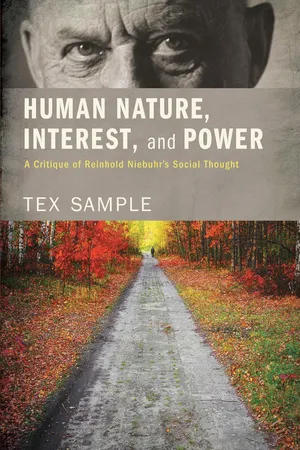
Human Nature, Interest, and Power
A Critique of Reinhold Niebuhr’s Social Thought
- 186 pages
- English
- ePUB (mobile friendly)
- Available on iOS & Android
eBook - ePub
About this book
This book criticizes three basic concepts in Reinhold Niebuhr's social thought: his views of human nature, interest, and power. Attention is directed especially at the way Niebuhr's concepts lack sufficient historicity, obscure social and political dynamics, and, finally, lack adequate descriptive power. An alternative to each of these concepts is offered and used as a way to open up social thought to more complex analysis, more concrete and material uses, and a discussion of implications for alternative direction and action.
Information
Topic
Theology & ReligionSubtopic
Christian Theology1
Human Nature
The Transcendent and Finite Self
At the very heart of Niebuhr’s theology and certainly his political and ethical thought is his view of human nature. That it is a powerful formulation goes without saying, having dominated Christian theological, ethical, and political thought in the United States throughout most of the twentieth century, not to mention its impact on secular thought and in other parts of the world. Niebuhr’s view of the human condition was not original with him; he draws on resources such as Augustine and Kierkegaard, and he also apparently draws a good deal of his inspiration from the work of Emil Brunner.1 Nevertheless, with his concept of human nature and his brilliant analysis of the human condition, Niebuhr addressed central issues facing the nation-state in the middle of the twentieth century; further, he used his views of human nature and analysis of the human condition as weapons against a variety of political positions and postures of the time, which made an indelible and unique imprint.
I should say here just a word about where I’m heading with this chapter. I will challenge Niebuhr’s existentialist view of the self, which he sees as primordial and universal. Against his view, I will contend that the human subject is socially formed, that in its historicity and sociolinguistic settings we find far more divergence in the makeup of the subject and a far more complex dynamic operative in the subjectivities of the self and its intersubjective relationships with others than Niebuhr allows. In other words, it is my intent to challenge Niebuhr’s view of the self at its very core.
The Self as Spirit and Nature
For Niebuhr human nature is a compound or composite of nature and spirit. This composite distinguishes human beings from all other creatures. Niebuhr states it succinctly: “The obvious fact is that man is a child of nature, subject to its vicissitudes, compelled by its necessities, driven by its impulses, and confined within the brevity of the years which nature permits its varied organic forms, allowing them some, but not too much, latitude. The other less obvious fact is that man is a spirit who stands outside of nature, life, himself, his reason and the world.”2
As nature, human beings are limited. Our finitude marks our lives, our physical powers, our thought and reason, and, of course, our very years are limited by death. As nature or creature, Niebuhr includes those characteristics we share with other animals, such as our biological and organic makeup and our genetic inheritance. Our impulses, the urges and surges of our embodied character, factor into our nature as creature. We hunger and thirst, and as social creatures we require each other. We are driven in part by instinct and desire. Through evolution we emerge from simpler forms of biological life, but we are also a race born of family, clan, and tribe, having moved through history into wider communities of cities and nation-states, even civilizations.
Yet, if we are nature, and certainly on Niebuhr’s view we are, we are also spirit, and by our spirit we transcend nature. We are the creature who can make an object of self, who is self-conscious, whose very freedom resides in that capacity to see ourselves, to see our limitations, to anticipate our very deaths and to know that there are limits to all we are, all we do, all we know, and all we can dream. This very self-consciousness is the source of our freedom, our capacity to imagine a different possibility, and the opportunity to decide upon a different path of action. More than this, the spirit is the transcendent unity of the self; it is “the ultimate freedom of the self over its inner divisions. . . . It is, in short, the self standing above its functions and capacities and yet proving its relation to them.”3
Yet, as spirit and nature, humans are characterized by a profound tension between finitude and transcendence, such that an existential anxiety is generated in this tension. Because we are transcendent we can see that we are limited; because we can see we are limited, we know we will die. These characteristics set up an inevitable anxiety from which no one can escape, an anxiety that will characterize human existence throughout all of life in every time and in every place. This anxiety must be distinguished from fear because fear has an object. In fear we are afraid of something. Anxiety, however, has no object; it arises from the self-consciousness of human freedom where one can know the limitations of existence. Thus human freedom is always an anxious freedom.4
It is this anxiety that is the occasion of sin and the source of temptation to sin. It is important to understand that anxiety does not cause sin, but rather is the occasion of sin. It is in this anxiety that one is tempted to escape from existence, an escape that occurs in basically two ways. The first is a flight into self-elevation, into pride or arrogance, an attempt to relieve anxiety by some denial of finitude.5 The subtleties of this are enormous. They can take the form of an arrogance about one’s strength, one’s knowledge or intelligence, one’s sexual prowess or athletic ability, one’s good looks, point of view, business acumen, spiritual awareness, or courage—even arrogance about one’s humility! It is the sin of overreach.
The other direction of escape from anxiety is that of finitude. This is the direction of self-loss, of passivity, of denial of one’s human freedom and capacity. It is the sin of sensuality, the attempt to be nothing more than an animal. It is losing the self in its passions, its impulses, its compulsions, its pleasures, and its irrationalities. It is abandonment of the freedom of the self. It is failure of nerve, the loss of meaning beyond the placation of the energies of the dimension of nature in the self; it is the sin of underreach.6
In both arrogance and sensuality there is a participation of the one in the other—that is, the turn to sensuality is its own kind of arrogance because the self diverts itself from its status before God, a turning away from its vocation and destiny in God. In its flights of self-elevation and arrogance, there is a self-loss by the denial of the finite dimensions of the self, a denial of its creaturely status before God, and hence an underreach. The subtleties of this interpenetration of arrogance and sensuality are immense and when given careful attention open up analytically the genius and, perhaps, the most profound insight of the Niebuhrian position. Certainly, it moves away from the moralizing of pride and sensuality in some simplistic way that ignores the existential dynamics of the self, so understood, with all its complexity and concreteness.7
There is no escape by the self from this existential condition. Niebuhr uses language like “absolute,” “immutable,” “the primordial structure” in discussing the nature of the self.8 He clearly understands that there are always “historically contingent elements” and “new emergents in the human situation”; nevertheless, the “immutable structure” of human nature resides in all cultures and throughout human history. Again, “it belongs to the freedom of man to create new configurations of freedom and necessity,” but this primordial structure remains.9 “There is not much that is absolutely immutable in the structure of human nature except it’s animal basis, man’s freedom to transmute this nature in varying degrees, and the unity of the natural and the spiritual and all the various transmutations and transfigurations of the original ‘nature.’” In the discussions I report in this paragraph Niebuhr is speaking against modern views, which tend to obscure this existential condition by invoking some “laws of nature,” or some “natural” categories understood as “primordial,” or in some incorporation “into a general norm.” But Niebuhr is adamant that human nature itself is immutable; only its particular historic expressions can be changed.10
Furthermore, these dynamics of the self are compounded in social life. It is not only that the collective arrogance of individuals can be conjoined in the idolatries and certitudes of social movements, institutions, societies, and especially nation-states, but also that even the capacities of the self for self-giving and sacrifice—including the ultimate sacrifice of life itself—can serve the most wicked aims and ambitions of human group life.11 Niebuhr states that “the most obvious forms of idolatry” are found in “the life of a tribe or nation” where these “natural historical vitalities” become the center of meaning and value. But idolatry takes more “covert forms” when a penultimate “principle of coherence and meaning” is understood in ultimate terms.12
By way of illustration of Niebuhr’s point, I think of soldiers who will crawl across an open field while under heavy fire and give their lives to grenade a machine gun nest, and yet who do so in behalf of the indefensible imperialistic ambitions of their nation. But we can find endless illustrations of the sacrificial giving of the self to the egoistic aims of human collectives. I think of professionals in think tanks who give unstintingly of their time, who devote themselves fully to the organization’s work, who sacrifice their lives with their families, and who narrow the very richness of their own personalities in pursuit of findings and discourses that serve only the most narrow interests of the corporations or organizations that fund them. Or I think of churches where a few individuals give themselves up selflessly to serve the self-satisfied aims of a misguided congregation in a largely abject dismissal of the gospel of Christ.
Vitality and Form in the Self
As we have seen, a human being is a creature who lives “at the juncture of nature and spirit,” to quote Niebuhr.13 But there is one further twofold distinction required to grasp more fully Niebuhr’s basic understanding of human nature: the role of vitality and form. These “two aspects of creation” can be found in all creatures and “express an exuberant vitality within the limits of certain unities, orders and forms.” Human existence, however, must be distinguished from other creatures because of its participation in creation not o...
Table of contents
- Title Page
- Preface: For the Love of Niebuhr
- Acknowledgments
- Abbreviations
- Chapter 1: Human Nature
- Chapter 2: Niebuhr’s View of Interest
- Chapter 3: Niebuhr’s Concept of Power
- Chapter 4: The Balance of Power in Niebuhr’s Social Thought
- Chapter 5: Internal Power
- Chapter 6: A Narrative Illustration
- Chapter 7: Political Implications
- Bibliography
Trusted by 375,005 students
Access to over 1.5 million titles for a fair monthly price.
Study more efficiently using our study tools.
Frequently asked questions
Yes, you can cancel anytime from the Subscription tab in your account settings on the Perlego website. Your subscription will stay active until the end of your current billing period. Learn how to cancel your subscription
No, books cannot be downloaded as external files, such as PDFs, for use outside of Perlego. However, you can download books within the Perlego app for offline reading on mobile or tablet. Learn how to download books offline
We are an online textbook subscription service, where you can get access to an entire online library for less than the price of a single book per month. With over 1.5 million books across 990+ topics, we’ve got you covered! Learn about our mission
Look out for the read-aloud symbol on your next book to see if you can listen to it. The read-aloud tool reads text aloud for you, highlighting the text as it is being read. You can pause it, speed it up and slow it down. Learn more about Read Aloud
Yes! You can use the Perlego app on both iOS and Android devices to read anytime, anywhere — even offline. Perfect for commutes or when you’re on the go.
Please note we cannot support devices running on iOS 13 and Android 7 or earlier. Learn more about using the app
Please note we cannot support devices running on iOS 13 and Android 7 or earlier. Learn more about using the app
Yes, you can access Human Nature, Interest, and Power by Tex Sample in PDF and/or ePUB format, as well as other popular books in Theology & Religion & Christian Theology. We have over 1.5 million books available in our catalogue for you to explore.