eBook - ePub
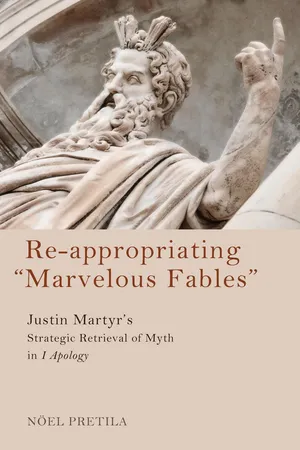
Re-appropriating “Marvelous Fables”
Justin Martyr’s Strategic Retrieval of Myth in 1 Apology
- 184 pages
- English
- ePUB (mobile friendly)
- Available on iOS & Android
eBook - ePub
Re-appropriating “Marvelous Fables”
Justin Martyr’s Strategic Retrieval of Myth in 1 Apology
About this book
Edwin Hatch provided a colorful portrait of the religious world to which Justin Martyr belonged: "The main subject-matter of . . . literary education [amongst the pagans] was the poets. . . . They were read as we read the Bible. They were committed to memory. The minds of men were saturated with them. A quotation from Homer or from a tragic poet was apposite on all occasions and in every kind of society" (The Influence of Greek Ideas on Christianity, 1957). So when some of these pagans converted to Christianity in Justin's day, is it reasonable to assume that they simply "forgot" these mythical narratives in which they had been reared from childhood? Re-appropriating "Marvelous Fables" sets out to argue that this was hardly the case. Rather, Justin in 1 Apology can be seen taking full advantage of this mythical framework that still loomed large in the minds of fledgling Christian believers and students in his care--masterfully re-appropriating this popular form of religious discourse for the purpose of solidifying their newfound faith.
Information
Topic
Theology & ReligionSubtopic
Christian Theology1
Introduction
Justin Martyr’s varied use of Greco-Roman myth within his writings has led to conflicting opinions regarding the apologist’s overall attitude to these primeval stories. As such, scholars have had difficulty reconciling how Justin could allude to these “marvelous fables” in a positive light when throughout his writings he categorically denounced them on the grounds of their diabolical origin and purpose.1 The solutions that have been proffered to resolve this dilemma range from viewing these troublesome allusions as only ostensibly positive in nature to declaring that the contradiction in his approach to myth is the unfortunate result of Justin’s rambling prose.
Thesis and Problem
Unlike previous scholarly assessments of Justin Martyr’s use of Greco-Roman mythology, I will contend that his varied use of myth as seen in 1 Apology reveals a form of pedagogy in which the apologist intentionally incorporated certain aspects of these popular religious narratives and yet was able to declare Christianity’s separation from the ancient tradition. Although Justin perceived in these mythical pre-figurations a wealthy resource of images that could serve the purpose of illuminating Christian dogma in the minds of recent converts still feeling out their newfound faith, his critical assessment of these myths (e.g., that a majority were demonically inspired) begged of his audience to hasten their abandonment of these corrupted pre-figurations in favor of the pure, unadulterated ones found within Moses and the Prophets.
This dynamic form of pedagogy is confirmed by the structural flow of 1 Apology (Table 1.1) itself where Justin’s first sustained treatment of myth (§21–22) is primarily in the vein of ad similia with the apologist’s incorporating myth to illuminate his description of Christ. This is then followed by a section (§23–29) where Justin focused solely upon separation from myth so to signal his readers that they must transfer their trust from the narratives of the ancestral religion to Moses and the Prophets—even if elements within these myths hinted at the eventual arrival of the Logos. This shift begins in chapter 30 where Justin devoted a massive block of material (§30–53) to demonstrate how the anticipation of Christ’s incarnation was most visibly apparent within the writings of Moses and the Prophets. Although mythical allusions are altogether sparse within this section, it is my contention that there exists a typological interaction between the pagan foreshadowings that Justin previously established in the first section (§21–22) with this section (§30–53) thereby demonstrating a subtle form of incorporation of myth at work. Finally, Justin concluded his strategy by employing a decisive separation from myth altogether in chapters 54 through 66. In this last movement, Justin repeated the montage of mythical analogies he established in chapters 21 and 22 but this time went at great lengths to expose the diabolical origin behind these Greco-Roman religious narratives.2
| Table 1.1 Flow of Myth Related to Christology in 1 Apology | |
| chapters | flow of myth |
| § 1- 20 | NONE |
| § 21- 22 | Incorporation & Partial Separation |
| § 23- 29 | Full Separation |
| § 30- 53 | Incorporation & Partial Separation |
| § 54- 66 | Full Separation |
Furthermore, in order to show how Justin’s diverse use of myth reveals a pattern of pedagogy, I am departing from the traditional historiography that assumes Justin wrote 1 Apology for an external pagan audience either pleading for benevolence on behalf of Christians or making a case for educated pagans to convert to Christianity.3 Rather, I am adopting the newer theory that Justin wrote 1 Apology for the purpose of educating an internal Christian audience.4 In this framework, Justin strategically utilized myth as a form of paidea to strengthen the nascent faith of his once mythologizing students so as to arm them with arguments they could then utilize later when confronted by their pagan detractors.5 Although the fully developed theory that 1 Apology was a document primarily meant for internal Christian consumption has been around for more than a decade now, there has been no work to date that explores the didactic possibilities of Justin’s usage of myth when this newly proposed audience is taken into account.
Utilizing myth as a form of paidea was not unique to Justin. His Christian predecessors provided a model to incorporate mythical allusions for the purpose of strengthening the faith of new believers. For instance, Mark Edwards argues that Luke deliberately brought up Paul’s numerous encounters with paganism in Acts of the Apostles (e.g., being mistaken as Zeus in Lystra [Acts 14], his preaching in the Aeropagus [Acts 17]) for the purpose of assuaging the anxiety recent converts naturally began to experience because they had left the ancient religion. By orienting the Pauline theme of Christian supercession as it relates to paganism, Luke exemplified to his internal audience how Christian belief was superior to belief in the pagan gods.6 I will demonstrate in this study that Justin’s use of myth in 1 Apology was driven by a similar impulse to that of the apostolic writer, Luke: to prevent recent Christian converts from reverting back to the ancient religion. He would do so in a much more advanced manner than his predecessor through his extensive as well as dynamic interaction with the wealthy resource of mythical symbols replete in the collective memory of his followers.7
By virtue of reinforcing his new converts of the supremacy of Christian belief over and against the ancient religion they had just freshly renounced, Justin would also go on to surpass Luke’s use of these pagan narratives by laying down a model to his students of how to share their newfound faith in the language and symbols of ancient myth in which their culture was immersed.
Regarding the intent behind the creation of these myths, Justin Martyr’s candor in declaring their demonic origin and purpose cannot be denied. At least once in each of his three extant treatises, Justin explicitly reckoned them as pernicious inventions of demons meant to lead humankind astray from the eventual incarnation of the Logos.8 The following, for example, serves as a worthy representative of such an assessment:
For when [the demons] heard through the prophets that the future coming of Christ was proclaimed and that the impious among human beings were going to be punished by fire, they threw many so-called sons of Zeus into the discussion, considering that they would be able to bring it about that human beings would consider the things said about Christ to be a marvelous fable, and similar to the things said by the poets.9
Refrains similar to the example cited here appear on six different occasions in the 1 Apology alone. Hence, Justin’s constant repetition of the harmful function behind the myths in his initial apology has played no small part in having convinced scholars such as Henry Chadwick to conclude that Justin possessed...
Table of contents
- Title Page
- Foreword
- Preface
- Acknowledgments
- Chapter 1: Introduction
- Chapter 2: Shifting the Paradigm
- Chapter 3: Incorporation of Myth
- Chapter 4: Separation from Myth
- Chapter 5: Other Applications of Poetic Material in Justin
- Chapter 6: Conclusion
- Bibliography
Trusted by 375,005 students
Access to over 1.5 million titles for a fair monthly price.
Study more efficiently using our study tools.
Frequently asked questions
Yes, you can cancel anytime from the Subscription tab in your account settings on the Perlego website. Your subscription will stay active until the end of your current billing period. Learn how to cancel your subscription
No, books cannot be downloaded as external files, such as PDFs, for use outside of Perlego. However, you can download books within the Perlego app for offline reading on mobile or tablet. Learn how to download books offline
We are an online textbook subscription service, where you can get access to an entire online library for less than the price of a single book per month. With over 1.5 million books across 990+ topics, we’ve got you covered! Learn about our mission
Look out for the read-aloud symbol on your next book to see if you can listen to it. The read-aloud tool reads text aloud for you, highlighting the text as it is being read. You can pause it, speed it up and slow it down. Learn more about Read Aloud
Yes! You can use the Perlego app on both iOS and Android devices to read anytime, anywhere — even offline. Perfect for commutes or when you’re on the go.
Please note we cannot support devices running on iOS 13 and Android 7 or earlier. Learn more about using the app
Please note we cannot support devices running on iOS 13 and Android 7 or earlier. Learn more about using the app
Yes, you can access Re-appropriating “Marvelous Fables” by Noël Pretila in PDF and/or ePUB format, as well as other popular books in Theology & Religion & Christian Theology. We have over 1.5 million books available in our catalogue for you to explore.