- 140 pages
- English
- ePUB (mobile friendly)
- Available on iOS & Android
eBook - ePub
About this book
I can't tell you my name.
I can't tell you where I live.
I can't tell you who I work for, or any details about the people with whom I work.
Because where I live, my line of work is not exactly legal.
But if you can pardon the vagueness, I have a story for you.
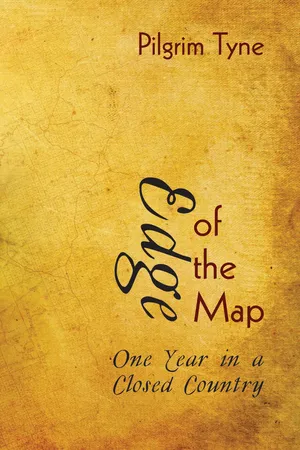
Edge of the Map is a memoir of the calling and adjustment, success and failure of our first year as missionaries to a closed country in the 10/40 window. It tells the story of how my family and I lived out the challenges and blessings of the lives we tried to lay down for Jesus. It is the book I would have wished for, had I known the right questions to ask.
How do I know that I'm called overseas?
How do I move beyond callousness and distraction?
What do I do once I've accepted a call to the nations?
What issues arise after I step into my calling?
How do I go about resolving those issues?
Edge of the Map speaks to these questions in hopes that our journey to a closed country will help nudge the souls of a young, poised generation toward the calling God is whispering over their lives.
Information
Topic
Theology & ReligionSubtopic
Christian Churchpart one
Calling
one
Reconciling Shadows
“Show me where we’re going, Daddy.”
My two-year-old daughter pointed to a giant wall map in the foyer of my father’s church—the kind with a slight grade in its topography, so the mountains seem to come out at you from the wall. My daughter, still grappling with the concept of the earth and its oceans and land masses, stood mesmerized.
“Hmm, let’s see.” I picked her up and we inspected the map more closely together.
My father’s church was not ignorant of the world, and in fact had become more focused on international partnerships with each passing year. This mindset, however, had yet to find its way to the wall map, which depicted North America in its centered, prominent place, and split the other side of the world in half down the middle.
“Well, right now we live here,” I said, pointing to the dead center of the map. “But in a few weeks we’re moving here . . .” I searched the map for our destination, first one half of the fractured biosphere, and then the other. My daughter watched my befuddled finger stroke the air.
I couldn’t find our city on the map because it wasn’t there. In fact, almost our entire country had been erased in this tragically framed picture of the world.
I touched the edge of the map, and then moved my finger a few inches beyond its polished wooden frame.
“Here.”
“It’s not even on the map?”
“Well, it’s not on this map, but it’s there.”
“Are you sure?”
“I’m pretty sure.”
“Ok, Dad.”

Less than one month later I stood on the corner of a densely crowded street, fifty pounds of groceries hanging from my shoulders, my daughter in one arm, a city map in the other, trying unsuccessfully to hail a taxi with my outstretched neck. The dark and the chaos of noise and the deficit of personal space all merged, stifling our capacity for breath. Across the street, a pack of firecrackers burst to life and my daughter trembled at the sound as she clutched my neck. She hid her face from the noise and the smells and the oncoming headlights. I felt my arms stiffening and wondered how long I would be able to stand on that street corner holding her. I felt a deep breath of polluted air passing through my nose and wondered how many years it was shaving from my life. I felt my shoulders sag and wondered, as I had only a few times in my life, whether I had, in fact, made a terrible mistake.
Almost all of the taxis rushed past us already occupied. The ones that weren’t didn’t stop either. I watched them sail by like escape pods that might have been, powerless to rescue myself or my daughter from the stultifying street corner.
Then a taxi slowed as it came around the corner and mercifully pulled up right in front of me. I elbowed my way through the other pedestrians to its passenger side, waited for the current occupant to exit, then locked eyes with the driver.
“Foreign Language University?” I offered.
“Huh?” He furrowed his brow.
I tried one more time in English, but when he clearly didn’t understand, I tried in the local language, doing my best to pronounce the words the way I’d been taught.
The driver’s face wrinkled even further. He said a string of words I couldn’t make out, but by his tone I assumed them to be the rough equivalent of, “What the heck are you trying to say?”
“Please,” I said. “I just need to get back to Foreign Language University.” My body bent under the weight of the bags and my child and the dark night. I begged him, with my face, to understand.
He looked at me, not unkindly, but then he waved us away with the back of his hand and drove up a few meters to another pack of potential occupants—passengers less burdened, who could speak the language, who knew where they were going—a much easier fare.
After failing to adequately communicate my desired destination to four separate taxis drivers, I had the idea to call my contact at the university. When a fifth taxi finally stopped for us, my contact correctly pronounced the name of our school over my newly purchased cell phone. The driver smiled as we climbed in with all our bags.
He asked me a question I couldn’t comprehend.
I just shrugged my heavy shoulders.
He laughed good-naturedly and I tried not to feel like he was making fun of me. My daughter relaxed a little in my lap. At least we were heading home. Sort of home.
I thought if I knew where the school was on the map I could point it out to future taxi drivers, but the map was not in English. When we stopped at a traffic light I held the map up to the driver and used body language and facial expressions to try to elicit the school’s location. He frowned for a moment, then understood, and began to search the map with me. I watched his finger hover above the map, unsure. Finally, he pointed about an inch above where the map cut off.
“Here?” I asked.
He nodded.
“It’s not even on the map?”
The light changed and he looked away from my question to focus on the road.
I let my useless map fall to the floor of the taxi. I shut my eyes to the blur of lights passing outside the window. The lights illuminated faces, and the faces all seemed angry. I rolled up the window to drown out the noise. My trip to the store was supposed to have taken an hour or two. We’d easily been gone six. My daughter had missed dinner. My wife, who didn’t have a cell phone yet, was probably out of her mind with worry. I tried to shut my eyes to all of that, and to look inside for that stillness, that surety, but I couldn’t find it.
For the duration of the ride I tried to relocate my sanity, and I did this by recounting the journey that had brought my family and me to this country. Where had we been, and what had prompted the change? How had we gotten here? When had I ever had time to notice that tender place in my heart, and how could I have been so foolish as to yield to it?
In other words: why did we say yes?

You should know at the outset that I never planned to be a missionary. I’m sure some people do. I never did.
I took a few short-term trips, and I can truthfully call them times of genuine spiritual formation. They introduced me to themes and concepts that became important paths to sojourn. They impacted me, certainly, but not with the kind of force that catalyzes a family to move overseas.
When I was young and missionaries came to our church, it was always apparent to me that they belonged to some other class of heavenly citizen. On two counts, primarily.
First of all, they had an incredible zeal for evangelism. When they talked about the gospel it was as if speaking those words was what they were made by the creator to do. Passion bled from their eyes and sang from their lips, and their bodies visibly shook as they told the story. Quite simply, they loved telling others about Jesus.
Evangelism doesn’t come naturally to me. I do tremble when I share the gospel, but more from nerves than enthusiasm. I get distracted thinking about the magnitude of the moment—pondering how it was ordained by the creator of the universe and whatnot—and I start to lose track of what I’m saying. I leave out important parts of the gospel and repeat inconsequential elements over and over. I start to sweat a lot, wondering if my testimony and presentation is actually distancing others from J...
Table of contents
- Title Page
- Introduction
- Part One: Calling
- Chapter 1: Reconciling Shadows
- Chapter 2: Discontent vs. Apathy
- Chapter 3: Definition
- Chapter 4: Opposition
- Chapter 5: Walking Through a Door
- Part Two: Adjustment
- Chapter 6: A Torch in the Fog
- Chapter 7: Our New Body
- Chapter 8: Successes, and Failures . . . Mostly Failures
- Chapter 9: Unchecked Baggage
- Chapter 10: Slow Walks
- Part Three: Incubation
- Chapter 11: The Trough
- Chapter 12: City Relics
- Chapter 13: The Comfortable Lie
- Chapter 14: Evening Tea
- Chapter 15: Deterioration
- Part 4: Grace
- Chapter 16: Phoenix
- Chapter 17: Resolved
- Acknowledgments
- Bibliography
Trusted by 375,005 students
Access to over 1.5 million titles for a fair monthly price.
Study more efficiently using our study tools.
Frequently asked questions
Yes, you can cancel anytime from the Subscription tab in your account settings on the Perlego website. Your subscription will stay active until the end of your current billing period. Learn how to cancel your subscription
No, books cannot be downloaded as external files, such as PDFs, for use outside of Perlego. However, you can download books within the Perlego app for offline reading on mobile or tablet. Learn how to download books offline
Perlego offers two plans: Essential and Complete
- Essential is ideal for learners and professionals who enjoy exploring a wide range of subjects. Access the Essential Library with 800,000+ trusted titles and best-sellers across business, personal growth, and the humanities. Includes unlimited reading time and Standard Read Aloud voice.
- Complete: Perfect for advanced learners and researchers needing full, unrestricted access. Unlock 1.5M+ books across hundreds of subjects, including academic and specialized titles. The Complete Plan also includes advanced features like Premium Read Aloud and Research Assistant.
We are an online textbook subscription service, where you can get access to an entire online library for less than the price of a single book per month. With over 1.5 million books across 990+ topics, we’ve got you covered! Learn about our mission
Look out for the read-aloud symbol on your next book to see if you can listen to it. The read-aloud tool reads text aloud for you, highlighting the text as it is being read. You can pause it, speed it up and slow it down. Learn more about Read Aloud
Yes! You can use the Perlego app on both iOS and Android devices to read anytime, anywhere — even offline. Perfect for commutes or when you’re on the go.
Please note we cannot support devices running on iOS 13 and Android 7 or earlier. Learn more about using the app
Please note we cannot support devices running on iOS 13 and Android 7 or earlier. Learn more about using the app
Yes, you can access Edge of the Map by Pilgrim Tyne in PDF and/or ePUB format, as well as other popular books in Theology & Religion & Christian Church. We have over 1.5 million books available in our catalogue for you to explore.