- 154 pages
- English
- ePUB (mobile friendly)
- Available on iOS & Android
eBook - ePub
About this book
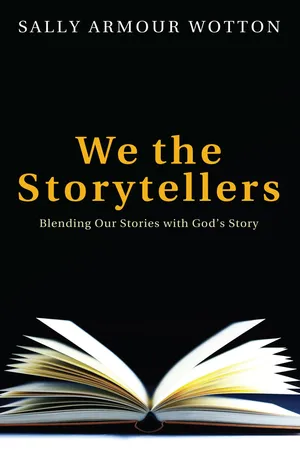
We the Storytellers provides examples and techniques for expressing deeply held beliefs through the oldest form of communication--stories. This book can be used as a resource on narrative theology for preachers, teachers, and storytellers.
Narrative theology is about peeling back the known to discover the unknown. Rather than pronouncing facts, it gives an opportunity for an "ah ha" experience. In a sermon it allows the hearer to grasp an element of truth through fiction or personal story--Jesus's method. And narrative theology is about revealing the relationship between God and God's people. What better way to look at relationships than through stories?
The book is written in two parts. Part 1 asks what is a sacred story and offers a number of possibilities. Part 2 is a workshop on acting, writing, and presentation skills aimed at those who are drawn to expressing themselves through stories.
The stories here are from Sally's own life experiences--the monologues from her imagination. Each story is related to a theme and is humorous, poignant, and human.
We the Storytellers will inspire and equip its readers to develop and perform their own sacred stories.
Information
Topic
Theology & ReligionSubtopic
Christian ChurchPart 1
Our new New Testament Stories
Chapter 1
Sacred Stories
Heal Us and Bring Us Home
Scripture Verses: Psalm 84:3 and Luke 5:17
We are a family with more books than can be found in some libraries, but reading is not only our preferred leisure activity; it is our soothing relief in times of stress. When our son Christopher was young and he scraped his knee or had a bad dream my husband, Ernest, or I read to him from a favorite book, often Winnie the Pooh.
However, one day I had no inclination to read. It was the day before I was to have eye surgery for a detached retina and there was a level of tension in the house that goes with a pending operation. I had been busy keeping busy, not wanting to think about the surgery when I noticed that our eight-year-old son’s concerned questions had ceased. He was gone. I began to look around the apartment for him and my looking turned to searching. I had my hand on the phone to call the neighbors when he stepped out of the large living-room closet. He said,
“Are you packed? I’ve got something important for you to take to the hospital ‘cause you probably won’t be able to read.”
He handed me a cassette tape on which he had recorded our beloved Winnie the Pooh stories—stories that I could “read” in the hospital when my eye was bandaged.
That little tape is still my favorite book and just thinking of it brings me comfort whenever I “scrape my knee.”
Since ancient times stories have been used to teach, preach and heal. The biblical narratives are full of such stories intermingled with our Christian history. These stories are effective because they don’t judge or accuse individuals. They allow us to hear the truth about ourselves and our society through the actions of fictitious but authentic characters. They also affirm our best selves. These are sacred stories. This was Jesus’ method of teaching and healing passed down to him from his Jewish culture.
Each of us has sacred stories that we have heard or experienced and they can heal or inspire us when we most need it. William Bausch, a writer and Roman Catholic theologian, defines sacred story as, “any story that contains an element of mystery and ends in hope.”
The following story of home is, for me, a sacred story.
We were a contented family of three, I thought, when I was 5 years old. I rose early each morning and crawled into my parent’s bed nestling into the warm space between them—taking my place as the center of the universe.
Then, without warning, to me, my parents divorced and my universe crumbled. My mother decided to move from our house in Springfield Illinois to Peoria, Illinois to be near her older sister, Clara, for comfort and support.
When Aunt Clara came to pick us up I grasped the wooden railing of the front porch of my home with all my five-year-old strength crying and howling at the top of my voice. This home was the symbol of my universe and I wasn’t letting it go. It took both of the sisters to wrench me loose and get me into the car. Mom held me in her lap and wiped my tears throughout the eternity of that ride. She assured me that she could be both mother and father for me in our new home and through her love and determination she was.
Mom found an apartment at 171 North Street in Peoria, a hundred and fifty miles south of Chicago and a block and a half from Aunt Clara. 171 North Street became my home for the rest of my childhood and remains the symbol of home to me now.
Our apartment was in Miss Minnie Haley’s early Victorian house. Miss Haley was also early Victorian. She wore rouge and lipstick every day which made her wrinkled face appear pink and white striped and she always bought dresses two sizes too large for her shrunken 85-year-old body believing they were just the right size: “In my day beautiful women were Rubenesque and my size has not changed.” She had more space than income so was willing to have a little girl and her mother share her home. We had a separate apartment, of course, but I pretty much had the run of the house. The rooms had 14-foot high ceilings, marble fireplaces and ornate woodwork around the doors and windows. I loved the pocket doors between the old front and back parlors that slid in and out magically at my touch. But most of all I was fascinated by the newel post at the foot of the stairs. It had a non-functional, gas lamp rising up from it. This “lamp” was a tall brass pole threaded through a cylindrical piece of multi-colored cloisonné and topped with an etched glass shade. Half way up the stairs at the landing was a small ledge in front of a stained glass window—just the right size for me to sit and hold court, gazing down the long flight of stairs at my imaginary subjects and the majestic newel post. I sat in splendor dressed in Mother’s velvet robe and pieces of her costume jewelry. At times I was a Queen (I felt princess was a menial role) or I was a bishop, depending on the daydream of the moment. I had seen bishops when the older kids at church were confirmed and they especially impressed me with their elegant costume and manner of authority.
The brick sidewalk leading up to the ginger bread trimmed front porch was the only pathway on the block that had not been replaced with concrete. The back garden began as a large, groomed lawn but paused at a hedge then continued on the other side as a half block area of trees, underbrush, wild flowers and snails. The other neighborhood children and I thought we were clever to call it the woods. When I grew up I learned it had been called that for generations.
By the time I was eight I had discovered the basement and it became exclusively my space. It was an unfinished basement just waiting for a child to decorate and furnish. There were, of course, high ceilings and the main room had wide planks, lain on the earth, that decades of basement floods had curled. When you walked across this floor, the metal tubs that held the coals for the furnace created a percussion symphony.
The other rooms in the basement had uncovered earth floors; the delicious musty smell permeated the whole space. I got all the cast offs from upstairs to furnish my underground haven; when the linoleum was replaced in our kitchen and when the stair carpet was renewed, I could put the old coverings down on my floor. I arranged garden furniture as a living room area, and leaned an old sink with 2 pipe legs under a wall faucet with a bucket under the drain to become my kitchen. The end of the room had a water heater with a little gas flame—the focus of my inventor’s lab where I worked diligently on the plans for a robot and a flying carpet. The basement was not only my playhouse but also the neighborhood kid’s meeting headquarters and center of fun. As its proprietor I was in charge and discovered a new way to be the center of the universe.
This was pre-Vatican Two and even with only two or three Roman Catholic families the neighborhood was overrun with children. I chose to befriend those who were two to four years younger than I which insured my authority and gave me the benefit of having “siblings” after school and quiet dreaming time in the evenings. In my basement, with my slightly younger followers, I was naturally Chief of Police or leading scientist, school principal or mother.
My friends and I “shopped” for groceries in the woods and had wonderful meals of mulberries and wild rhubarb. I dragged found objects home from the alley to use in my inventor’s lab like interesting bottles, tire rims and the springs from an old car seat. My friend’s parents wouldn’t let such treasures into their homes but my basement playroom was my sanctuary and in it I was queen of the castle.
My aunt and the neighbors said, “Sally should be playing with children her own age, not playing let’s pretend all the time down in that basement. How will she ever grow up?” But I believe the freedom my mother allowed me in my basement and my choice of friends gave me the confidence and leadership skills which as an only child I might not have gained.
When I reached teenaged years I outgrew a playroom, of course, but could still appreciate my basement haven as a retreat where I could dream and occasionally even do homework!
After University I moved to New York City and my mother joined me for only a few months before her death. She brought the piece of cloisonné from the newel post gas lamp with her because we knew the house was slated to be sold and then demolished.
The Christmas after Mother’s death was bleak and lonely. All the decorating, gift-wrapping, eggnog and cheer among my friends just made me feel more alone. The New York I loved suddenly looked gray and withered and felt unresponsive. So, after many years away, I returned to Peoria to spend a few days around New Year’s with old friends. There was a light fall of snow on the ground and after dinner one evening my friends drove me around town to see our childhood haunts. They thought that my old house had been demolished but I wanted to come home one last time. We arrived at 171 North Street after dark to find a cleared space where the house had been. The brick walk that had led up to the front porch was just visible under the thin blanket of snow—an eerie walk that led nowhere. I looked away, sheltering my home in my mind.
The house is gone but my home is indestructible. It is there in my taste for antiquity, and my love of wild spaces in the city, and in the occasional whiff of an earthy, musty scent. It is at the core of that sacred space in me where my independence, sense of freedom and creative imagination live.
Chapter 2
Aging
The Gift of a Lifetime
Scripture Verses: Job 12:12 and 2 Corinthians 4:16 and my favorite, Psalm 92:14
I can no longer stretch the garment of middle age to fit me and so must learn to wear my elder years with dignity.
I would like to think that as we age we gain a bit of wisdom along with the wrinkles, aches and pains. Perhaps gaining that wisdom is our reason for being. One definition of wisdom is the ability to accept differences in one another, difficult changes in our lives and ultim...
Table of contents
- Title Page
- Part One: Our new New Testament Stories
- Chapter 1: Sacred Stories
- Chapter 2: Aging
- Chapter 3: Coming of Age
- Chapter 4: Does Risk, Perseverance and Justice Equal Faith?
- Chapter 5: Fallow Time, Like a Womb, Births Creativity
- Chapter 6: Community
- Chapter 7: Humor
- Chapter 8: Hope, Like Prayer, Makes All Things Well
- Chapter 9: Of the Earth, Not On the Earth
- Part Two: An Actor’s Tools for Life and Liturgy
- Chapter 1: The Body
- Chapter 2: The Voice
- Chapter 3: Our Leadership Style Tells a Story
- Chapter 4: Acting Essentials through Improvisation and Theatre Games
- Chapter 5: Developing a Character
- Chapter 6: The Monologue
- Chapter 7: Silent Eloquence
- Chapter 8: Dramatic Space, Fabric, and Lighting
- Chapter 9: Puppets
- Chapter 10: Public Reading and Memorization
- Chapter 11: Story Writing
- Chapter 12: Brief History of Sacred Drama
- Further Reading
- Synopsis
- Author Biography
Trusted by 375,005 students
Access to over 1.5 million titles for a fair monthly price.
Study more efficiently using our study tools.
Frequently asked questions
Yes, you can cancel anytime from the Subscription tab in your account settings on the Perlego website. Your subscription will stay active until the end of your current billing period. Learn how to cancel your subscription
No, books cannot be downloaded as external files, such as PDFs, for use outside of Perlego. However, you can download books within the Perlego app for offline reading on mobile or tablet. Learn how to download books offline
Perlego offers two plans: Essential and Complete
- Essential is ideal for learners and professionals who enjoy exploring a wide range of subjects. Access the Essential Library with 800,000+ trusted titles and best-sellers across business, personal growth, and the humanities. Includes unlimited reading time and Standard Read Aloud voice.
- Complete: Perfect for advanced learners and researchers needing full, unrestricted access. Unlock 1.5M+ books across hundreds of subjects, including academic and specialized titles. The Complete Plan also includes advanced features like Premium Read Aloud and Research Assistant.
We are an online textbook subscription service, where you can get access to an entire online library for less than the price of a single book per month. With over 1.5 million books across 990+ topics, we’ve got you covered! Learn about our mission
Look out for the read-aloud symbol on your next book to see if you can listen to it. The read-aloud tool reads text aloud for you, highlighting the text as it is being read. You can pause it, speed it up and slow it down. Learn more about Read Aloud
Yes! You can use the Perlego app on both iOS and Android devices to read anytime, anywhere — even offline. Perfect for commutes or when you’re on the go.
Please note we cannot support devices running on iOS 13 and Android 7 or earlier. Learn more about using the app
Please note we cannot support devices running on iOS 13 and Android 7 or earlier. Learn more about using the app
Yes, you can access We the Storytellers by Sally Armour Wotton in PDF and/or ePUB format, as well as other popular books in Theology & Religion & Christian Church. We have over 1.5 million books available in our catalogue for you to explore.