eBook - ePub
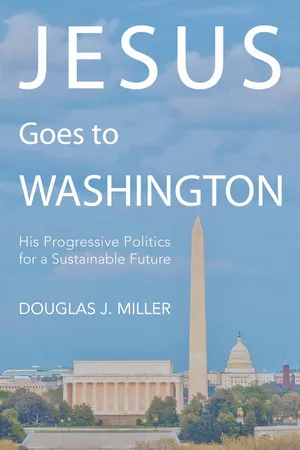
Jesus Goes to Washington
His Progressive Politics for a Sustainable Future
- 226 pages
- English
- ePUB (mobile friendly)
- Available on iOS & Android
eBook - ePub
About this book
This book explores how Christian spirituality and the political ethic of Christianity's founder, Jesus of Nazareth, might contribute to the most looming emergency of our day--ending human misery while reducing the planet's woes. It advances the new ethical paradigm of sustainability that bespeaks the longings of this remarkable Jewish peasant who elbowed his way into a world filled with social misery, shame, and land exploitation. Donning the mantle of a prophet/lawgiver, he disgraced the justifying ethic of the prevailing Roman oligarchies that finds its active counterpart in today's political landscape. He offered a different political path--a Progressive one--that led to respecting Creation and all its inhabitants. Jesus helps us to cherish humane values and he urges us all--Democrats and Republicans, Independents and Greens, religious and nonreligious--to be united in fulfilling them.
Jesus Goes to Washington celebrates the international Earth Charter, the most significant moral document of our generation. Given the urgency of world calamity, the charter implores us to muster every spiritual force at our disposal for immediate action. Being history's most influential moral authority, Jesus provides the needed impetus for achieving a just and sustainable global society.
Information
Topic
Teologia e religioneSubtopic
Teologia cristiana1
Jesus and Ecospiritual Politics
If one person gains spirituality, the whole world gains.
—Gandhi
A theme permeating this work is that human beings are destined to thrive and their flourishing depends on a healthy Planet. This calls for a viable spirituality in which the Universe and others exist apart from their instrumentality or even their being enjoyed, although it includes these to some degree. Indeed, the Cosmos and humans serve something much greater—the Universal or the Infinite, who many call God. In this understanding of spirituality, we exist purely out of gratitude to the Creator, to Earth, and to the Other from whom and for whom we came into being. The biblical writers see God’s glorious “handiwork” and “image” expressed throughout Creation’s stunning marvels and processes—and they stand in awe (Ps 19:1; Rom 1:20.). For many, spirituality is tethered to pondering the dazzling beauty and the unfathomable mysteries of human life and the Universe. Consequently, grateful people mourn when they see Earth and its multitudes suffering due to human arrogance and ignorance; when every affront tarnishes God’s glory. We are in great need of salvation. The urgent call is for a broadened spirituality in which the traditional Christian notion of redemption must expand to include fixing our broken socioeconomic structures and healing our injured Planet.
In Jesus’ symbolic world, derived from his Bible, Land/Earth played a crucial role, being the prerequisite for fulfilling all basic human goods. (In Hebrew, “Earth” and “Land” are interchangeable, so statements about the Land carry implications for the Planet.7) Through the Land, people found their identity. It mediated their economics and politics; it linked them to their past and their future; it brought security and sustenance; it connected them to their God and shaped their religion.8 Land, then, was more than just a commodity. It cultivated vital moral/spiritual meaning that governed community interactions and aspirations, through which all key values—moral and nonmoral—flourished. The Land, as promised by God, would flow with milk and honey, providing for the well-being of all as expressed by the term “shalom” or, broadly, “the common good.” The people saw themselves as citizens of the Land first; they readily spoke of the Land of Israel.
Thus, Israel’s spirituality, rooted in the ground and the peoples’ relationship to it, was an ecospirituality. When Land decisions exploited the people (for example, when farmers were squeezed off their ancestral Lands by the rich), it precipitated a national spiritual crisis that ultimately led to exile (Isa 5:8). To restore Israel meant restoring a just and fair Land policy. Being an agency of moral sanction, all Land/Earth was sacred, holy, and to be acted upon with reverent respect. Given their ties to Earth/Land, humans, too, were considered sacred and to be treated with grandeur (Gen 2:7). Following in this same spiritual tradition, Jesus inaugurated an earthly Kingdom of God that moored human dignity to life-sustaining Land relationships. Christians, as guardians of human worth, are summoned to a spirituality that cannot ignore the Earth in whatever we do. The greening of the Christian Faith and all faiths is surely a most compelling spiritual quest today. Why is this the case?
Imagine turning on the morning news and the anchor blandly reports, “20,000 dead” and then quickly turns to the next story, describing with animated passion and in lurid detail, the marriage break-up of a celebrity couple. The next morning you hear the same, “20,000 dead” and then some other trivial story. And the same is repeated day after day, year in and year out. In reality, this 20,000 figure is the number of people who die every day worldwide due to the ill-health caused by poverty. These are wrenching, miserable, painful, and avoidable deaths.9 Unfortunately, this massive human death count is never a lead story. Caught in a relentless poverty trap, the poor remain voiceless. These desperate are mostly victimized by dominating systems that squeeze them in an ever tightening vice and leave them to eke out a meager day-to-day living. Like the poor, dishonored, and landless in Jesus’ day, they ride the precarious and vicious downward spiral of trying to survive. The numbers are staggering, but the situation is not much better for Earth.
As early as 1972, a group of MIT scholars grimly reported that the modern world would face an ecological crisis, if not a catastrophe, by 2100.10 The researchers advised that “political and moral resolve” were indispensable for reversing the “deteriorating world situation,” but their alert went unheeded for many years.11 More recently, Jim Hansen of NASA’s Goddard Institute for Space Studies has warned, “We have only a short time to address global warming before it runs out of control.”12 The U.N.’s Intergovernmental Panel on Climate Change states that global warming is “unequivocal” and only urgent and immediate global action will stave off its devastating effects on humanity.13 It is now clear that other eco-subsystems—ocean acidity, ozone depletion, soil and water degradation, deforestation, chemical pollution, and exploding population—are reaching or have passed carrying capacity thresholds or tipping-points. Among other disasters, these systemic erosions converge in crop failure, signaling a most critical issue in our day, and one Jesus faced—food production and distribution. Like all crises, this affects mostly the poor, but soon will impact the not-so-poor. To extend our metaphor, Earth, too, is being forced into exile—held in bondage to domination, indifference, and waste. Spiritual people take seriously the overwhelming evidence that the fitness of the environment is worsening, based on a science that is as exact as putting a human on the moon.
The very factors that now feed the Planet’s ailments, as noted in the MIT report, also birthed the circumstances of deteriorating life in Jesus’ day—inequality and selfishness.14 Jesus vigorously addressed these “sins,” providing the moral and spiritual ingredients that shape the solution to our looming troubles. His views of God and Creation, his ideas about the political economy, his notion of justice, and his belief in restoring good governing all represent building blocks for developing a comprehensive and universal spirituality grounded in our relationship to everything in, on, and above Earth. For Christians, Jesus provides “the way”; but what is the path he compels us to walk?
Our Spiritual Journey Walks the Path of Sustainability
Politically speaking, America today lies battered and bruised by divisiveness and cynicism, enmeshed in a nasty ongoing war of words. Read the current political best sellers; listen to the babble on talk radio; or watch the acrimonious debates on our most popular “news” channels and see how woefully divided we are. We struggle over which political ideas ought to reign and which are flawed. Battle lines have been drawn between competing value systems, and Christians, caught in the war zone, are likewise deeply split. Although the clash generates political noise, the undertone is ultimately spiritual—a “spiritual warfare,” as some call it—between the many visible and hidden powers that influence our choices and shape our destiny. Gaining a measure of victory rests in a time-tested spirituality that bears witness to transcendent humane values.
The quest for a deeper spirituality has been called the most significant megatrend in our day.15 Interest in the spiritual life of Jesus skyrocketed Deepak Chopra’s The Third Jesus to a number one best seller. But what is spirituality? Why is it so important? And what does this most spiritual person, Jesus Christ, really teach us about a transcendent life, not just in a collection of his short sayings taken in isolation, but within the context of his everyday interactions with downtrodden Galileans? And how might his recollected truths break the trance that renders people so hard of hearing and so short of seeing?
Spirituality is about closeness to and dependency on God, yet a lifelong up and down quest. It begins when we first realize that because of fears, false hopes, and misnamed pleasures, we live distant from our God-determined destiny. Our soul has been captivated by and held captive to a larger world in exile—burdened with delusion, disillusion, and destruction—and so far from home. We grapple for transcendence and hope, for more than just everyday rawness, ravage, and revenge; we long for a transformed self, a better world, and renewed Earth—the ingredients of hope. The glory of a more Evangelical Christianity has been its insistence upon restoring a personal relationship with God through Jesus Christ—a relationship severed by Adam’s calamitous pride and aggrandizing selfishness. Yet, Evangelicalism often ignores the truth that our oneness with God means bonding with all Creation; that neglecting and despoiling any part of it degrades spirituality.
The familiar psalm 23 expresses it comprehensively and most beautifully: “The Lord makes me lie down in green pastures; leads me beside still waters; restores my soul; leads me in the right paths.” Today, the right soulful path to viable pastures and untroubled waters means traveling a moral path of sustainability for Earth and all its inhabitants. What does Jesus bring to this quest?
Jesus imparts five truths that elevate our closeness to God and births a new understanding of spirituality. First, Mark begins his gospel by describing Jesus’ mission as “the way,” a designation so suitable that the early Christians adopted it to name their movement (Mark 1:1–3; Acts 9:2). He teaches that spirituality is a journey to unite us with a loving nurturing God expressed by a family metaphor, “Father” or Parent.16 Second, for Jesus, spirituality is not an otherworldly or escapist path. It always finds its “home” (oikos or eco) traversing Earth, and thus, its path is an ecospiritual one. I...
Table of contents
- Title Page
- Acknowledgments
- Introduction
- Chapter 1: Jesus and Ecospiritual Politics
- Chapter 2: His God Who Sustains
- Chapter 3: His Progressive Politics
- Chapter 4: Conservative Opposition
- Chapter 5: Holiness as Political Compassion
- Chapter 6: Welcoming and Affirmative Action
- Chapter 7: Prayer and a Living Wage
- Chapter 8: Sustainability vs. Destitution
- Chapter 9: Ecospiritual Insight and Judicial Activism
- Chapter 10: Sustaining a Healthy World
- Chapter 11: Sustainability Is International
- Chapter 12: What Would Jesus Do in Washington?
- Appendix 1: The Earth Charter
- Appendix 2: Reconciling Past and Present
- Appendix 3: Jesus Speaks at Different Moral/Spiritual Levels
- Bibliography
Trusted by 375,005 students
Access to over 1.5 million titles for a fair monthly price.
Study more efficiently using our study tools.
Frequently asked questions
Yes, you can cancel anytime from the Subscription tab in your account settings on the Perlego website. Your subscription will stay active until the end of your current billing period. Learn how to cancel your subscription
No, books cannot be downloaded as external files, such as PDFs, for use outside of Perlego. However, you can download books within the Perlego app for offline reading on mobile or tablet. Learn how to download books offline
We are an online textbook subscription service, where you can get access to an entire online library for less than the price of a single book per month. With over 1.5 million books across 990+ topics, we’ve got you covered! Learn about our mission
Look out for the read-aloud symbol on your next book to see if you can listen to it. The read-aloud tool reads text aloud for you, highlighting the text as it is being read. You can pause it, speed it up and slow it down. Learn more about Read Aloud
Yes! You can use the Perlego app on both iOS and Android devices to read anytime, anywhere — even offline. Perfect for commutes or when you’re on the go.
Please note we cannot support devices running on iOS 13 and Android 7 or earlier. Learn more about using the app
Please note we cannot support devices running on iOS 13 and Android 7 or earlier. Learn more about using the app
Yes, you can access Jesus Goes to Washington by Douglas J. Miller in PDF and/or ePUB format, as well as other popular books in Teologia e religione & Teologia cristiana. We have over 1.5 million books available in our catalogue for you to explore.