- 150 pages
- English
- ePUB (mobile friendly)
- Available on iOS & Android
eBook - ePub
About this book
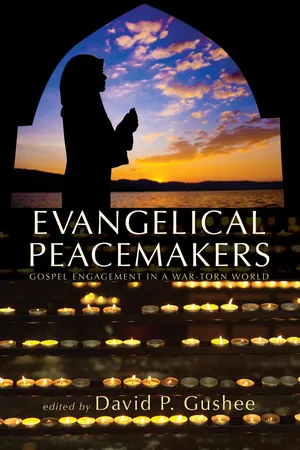
This book contains fifteen essays originally presented at a conference on evangelical Christianity and global peacemaking held at Georgetown University in September 2012, together with a critical analysis of the collection by the editor, David P. Gushee. The essays fall into two categories: the first four essays primarily engage theoretical issues in the ethics of war and peace, considering pacifism, just war, and just peacemaking approaches, all in contemporary US context. The other eleven essays offer glimpses into current evangelical peacemaking efforts being undertaken by individuals, congregations, parachurch organizations, and global evangelical bodies. The collection as a whole gives considerable attention to Christian-Muslim relations and offers a number of extraordinary accounts of evangelical peacemaking with Muslims and efforts to engage Islam as a living religious tradition. The concluding essay suggests that while evangelical peace and war thinking cannot escape the paradoxes and challenges that have always bedeviled Christian theorizing about war, contemporary evangelical peacemaking efforts reflect substantial progress in implementing the radical love of Jesus Christ in some of the most challenging contexts and conflicts in our world today.
Information
Topic
Theology & ReligionSubtopic
Christian Denominations1
The U.S. Warfare State and Evangelical Peacemaking
Introduction
I will try to do three things in this opening chapter: offer an accurate critical assessment of contemporary United States foreign and military policy; offer an accurate critical assessment of contemporary evangelical engagement with U.S. foreign and military policy; and suggest some ways forward for evangelicals. I will state my claims primarily in the form of propositions, each of which could be and hopefully will be debated.
The U.S. Warfare State
The leaders of the federal government of the United States in the past twelve years have proven unable or unwilling to pass anything approaching a balanced budget. (Sometimes they can’t pass any budget at all.) As annual deficits and cumulative debts mount, concern about our dramatic fiscal irresponsibility has moved to the center of political debate, with legitimate fears of a coming fiscal collapse as retiring baby boomer social security and health costs kick in. Zbigniew Brzezinski has recently argued that the ineffectiveness of our legislative process in addressing this basic task of governance contributes to a weakening respect for the United States abroad, itself an important foreign policy concern.1
And yet, amidst these fiscal problems, our $775 billion annual defense budget,2 not to mention our tens of billions of dollars spent on intelligence and other national security expenses, is treated as sacrosanct. Budget-cutters, especially on the Republican side, do not train their sights on the defense budget as they seek to address our flood of red ink, but instead focus on dramatic cuts in the safety net for the poor.
According to former Reagan budget director David Stockman, our $775 billion defense budget is nearly twice as large in inflation-adjusted dollars as the defense budget of Dwight Eisenhower for 1961, during the Cold War.3 Our fiscal year 2011 defense budget was five times greater than that of China, our nearest competition for this dubious honor; constituted over 40 percent of the world’s entire military spending; and was larger than the cumulative budget of the next fourteen nations in the top fifteen.4 All of this occurs at a time when our infrastructure is crumbling, our schools are sliding, and one-sixth of our population cannot find or has stopped looking for full-time work.5
The Republican David Stockman suggests that no plausible national defense goals today justify this level of defense spending. He rightly points out that “we have no advanced industrial state enemies” akin to the USSR of Cold War days. He argues that what in fact supports a budget of this size is an ideology of “neoconservative imperialism” and an attempt to function as a “global policeman” even after the world has “fired” us from this role.6
Andrew Bacevich argues in several important recent books that the direction of U.S. foreign and military policy is slipping from democratic control.7 It is instead dominated by a cohort of active and retired military, intelligence, law enforcement, corporate, lobbyist, academic, and political elites whose power in Washington is sufficiently impressive as to foreclose serious reconsideration of what Bacevich calls the “Washington Rules.” The elites enforcing these rules consistently drive us to policies of permanent war, a staggeringly large global military presence, and regular global interventionism. This analysis stands in striking continuity with the warnings offered by President Eisenhower about the “military-industrial complex” fifty years ago.
U.S. foreign and military policy received scant attention in the 2012 presidential campaign, despite Governor Romney’s efforts to position himself as more hawkish than President Obama, for example, in relation to Israel. But this had little effect, because President Obama has learned the lesson of prior Democratic presidents (and candidates) that no Democrat can afford to seem “soft on defense” or “weak” in foreign policy—that is, that no one dare break with the “Washington Rules.” Thus only fringe politicians such as Ron Paul ever propose fundamental questions about the nature of our foreign and military policy.
While our taste for large boots-on-the-ground military interventions appears finally to have waned after the bloody and bankrupting off-budget wars in Iraq and Afghanistan, our special forces, covert, and technological intervention abroad—and the massive secret national security establishment that supports them—has heightened. Our nation has not had a serious debate about the centralization of presidential authority involved in this recent shift, including the legitimacy of presidential authority to order long-distance drone strikes—in countries that want such strikes, and in countries that don’t want them.
The United States remains a nation traumatized by 9/11 and its terror attacks. We are easily manipulated into military and covert engagements in the name of post-9/11 national security.
One of the greatest tragedies of the last decade has been the extraordinary burden borne by the small cast of paid (e.g., “volunteer”) soldiers who have been killed or traumatized by our recent wars. We honor them with sentimental displays at airports and ballparks, but seem to have no serious answer for mental health problems that now take twenty-five veteran’s lives by suicide for every one soldier now dying on the battlefield.8 And we will be paying their pensions and medical expenses for the next seventy years.
In a trenchant turn of phrase, David Stockman suggests that we have developed into a “warfare state”9 whose military-spending excesses are one major factor contributing to economic decline and imminent fiscal emergency. I believe that David Stockman is correct.
Evangelicals and Peace/War
The Christian, and not just evangelical, voice in U.S. foreign policy debates seems entirely marginalized, more so than at any time I have lived through or studied. There is no contemporary Christian leader, scholar, denomination, or movement whose views on U.S. foreign and military policies seems to matter to either party or its leaders.
Just war theory does not seem to be functioning in any significant or constructive way. In academia, its use seems to have become an empty intellectual exercise divorced from any persuasive power to guide either state policy or Christian practice. The outcome of just war theory reasoning seems tightly linked to the prior ideological or temperamental makeup of the just war theorist.
On the right, anti-Muslim and neo-Crusade thinking has resurfaced in both popular and academic circles, Christian and otherwise. This problem has obviously been exacerbated by the trauma of 9/11 and other acts of Islamist terrorism as well as the stresses of multiple U.S. military engagements in primarily Muslim lands.
Pacifism remains popular in elite academic and popular (progressive) circles. But it has little to offer to public discussion other than occasionally trenchant analyses of obvious excesses or wrongs in U.S. foreign and military policy. And most academic pacifism is untethered to actual Christian communities that practice either nonviolence or any other form of radical Christian discipleship.
Just peacemaking theory offers a profound strengthening of the last resort criterion of just war theory, as well as highlighting realistic conflict resolution possibilities through creative state and NGO diplomacy and grassroots citizen advocacy and action.10 It is currently the most relevant of all existing Christian peacemaking theories/strategies but it would not be accurate to say that it has gained wide influence in U.S. foreign policy circles.
A longstanding coalition strategy within the center-left of evangelicalism has attempted to overcome differences between pacifists and just warriors by emphasizing areas of agreement and shared commitment to just peacemaking. This has protected friendships and produced strategic gains at times, but I wonder if it has weakened the concreteness, realism, and relevance of evangelical peacemaking efforts, and perhaps obscured the legitimate, principled differences between pacifists and those who believe Christians can sometimes support the use of force.
Some Ways Forward for Evangelical Peacemakers
We need to join the conversation about U.S. foreign and military policy. That includes studying U.S. foreign policy goals, our current military presence around the world, our alliance commitments, existing and planned weapons systems, and finally how all of that is reflected in the U.S. defense budget. We also need to become aware of the various political, civic, and economic forces that limit needed budget cuts in defense even when foreign policy and governmental leaders believe those cuts are actually needed. This is a formidable research agenda calling for the emergence of a new generation of ethics specialists in this area.
We need eventually to offer our own proposals, or join with those of others, for what kind of foreign policy, use of military force, and size and shape of defense budget that we could support. But this would require a willingness on our part to accept a legitimate national right of self-defense and use of lethal force under certain specified conditions. It would also involve consideration once again of the morality of maintaining military forces and weapons of sufficient scope to deter aggressors. In other words, we have to decide whether there is such a thing as “national security” that can find a place within a Christian approach, and if so, how a legitimate national security is best garnered and pro...
Table of contents
- Title Page
- Contributors
- Preface and Acknowledgments
- Chapter 1: The U.S. Warfare State and Evangelical Peacemaking
- Chapter 2: War, Terror, and Peace
- Chapter 3: Just War Theory
- Chapter 4: Learn and Teach the Practices that Make for Peace
- Chapter 5: The World EvangelicalAlliance and Christ’s Call to Peacemaking
- Chapter 6: The Peace Witness of the Fellowship of Reconciliation
- Chapter 7: Christian Peacemaking and Witness with Muslims
- Chapter 8: U.S. Foreign Policy and the Muslim World
- Chapter 9: Christian-Muslim Conflict Zones and Possibilities for Peace
- Chapter 10: How Personal Forgiveness Created a Platform for Global Peacemaking
- Chapter 11: A Holy Land We Hold in Trust
- Chapter 12: Pastors and Peacemaking in a Glocalized World
- Chapter 13: Loving People Like Jesus Does
- Chapter 14: Where We Have Been—and Where We Go From Here
- Chapter 15: Evangelicals for Peace
- Chapter 16: Evangelical Peacemakers
- Bibliography
Trusted by 375,005 students
Access to over 1.5 million titles for a fair monthly price.
Study more efficiently using our study tools.
Frequently asked questions
Yes, you can cancel anytime from the Subscription tab in your account settings on the Perlego website. Your subscription will stay active until the end of your current billing period. Learn how to cancel your subscription
No, books cannot be downloaded as external files, such as PDFs, for use outside of Perlego. However, you can download books within the Perlego app for offline reading on mobile or tablet. Learn how to download books offline
Perlego offers two plans: Essential and Complete
- Essential is ideal for learners and professionals who enjoy exploring a wide range of subjects. Access the Essential Library with 800,000+ trusted titles and best-sellers across business, personal growth, and the humanities. Includes unlimited reading time and Standard Read Aloud voice.
- Complete: Perfect for advanced learners and researchers needing full, unrestricted access. Unlock 1.5M+ books across hundreds of subjects, including academic and specialized titles. The Complete Plan also includes advanced features like Premium Read Aloud and Research Assistant.
We are an online textbook subscription service, where you can get access to an entire online library for less than the price of a single book per month. With over 1.5 million books across 990+ topics, we’ve got you covered! Learn about our mission
Look out for the read-aloud symbol on your next book to see if you can listen to it. The read-aloud tool reads text aloud for you, highlighting the text as it is being read. You can pause it, speed it up and slow it down. Learn more about Read Aloud
Yes! You can use the Perlego app on both iOS and Android devices to read anytime, anywhere — even offline. Perfect for commutes or when you’re on the go.
Please note we cannot support devices running on iOS 13 and Android 7 or earlier. Learn more about using the app
Please note we cannot support devices running on iOS 13 and Android 7 or earlier. Learn more about using the app
Yes, you can access Evangelical Peacemakers by David P. Gushee, Gushee in PDF and/or ePUB format, as well as other popular books in Theology & Religion & Christian Denominations. We have over 1.5 million books available in our catalogue for you to explore.