- 210 pages
- English
- ePUB (mobile friendly)
- Available on iOS & Android
eBook - ePub
About this book
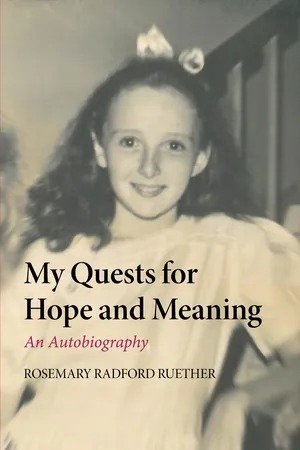
This book is an autobiography tracing Rosemary Radford Ruether's intellectual development and writing career. Ruether examines the influence of her mother and family on her development and particularly her interactions with the Roman Catholic religious tradition. She delves into her exploration of interfaith relations with Judaism and Islam as well. Her educational formation at Scripps College and the importance of historical theology is also a major emphasis. Mental illness has also affected Ruether's nuclear family in the person of her son, and she details the family's struggle with this issue. Finally in this intellectual autobiography, Ruether explores her long concern and involvement with ecology, feminism, and the quest for a spirituality and practice for a livable planet.
Information
Topic
Theology & ReligionSubtopic
Religious Biographies1
Growing Up in Matricentric Enclaves
I grew up in series of matricentric enclaves led by intelligent, articulate, and self-confident women. This reality has something to do with my assumption, for as long as I can remember, that I was an autonomous person and could do whatever I wanted. Both my mother’s family and that of my father were clearly patriarchal, although not oppressively so. But these patterns seemed far away, not impinging on my immediate world. For me, as a child, my male ancestors were present in swords, in combat ribbons and photos hanging the wall, but they were dead or away at war. The immediate references of my world were my mother, my aunt Mary, who came to live with us and help my mother manage after my father died when I was twelve, and my two older sisters, Bequita and Manette.
I realized many years later that my experience of my family, and particularly of my mother, was significantly different from that of my older sister Bequita. In 1992 I wrote an article titled “A Wise Woman: Mothered by One Touched by Wisdom’s Spirit”1 on my mother, in which I spoke of my feelings of being unconditionally affirmed by my mother. When I was a child she and I used to play a game at night in bed about what I should do when I grew up. Mother would canvas various professions (teacher, lawyer, doctor, etc.). I realized later that she never mentioned wife and mother. She herself and several of her best friends married late, in their thirties and even forties, after having jobs and interesting travel. She met my father in her early twenties on a boat coming from Europe, but they married only seven years later. She assumed that I would eventually marry, but only after college and travel. (She herself went to Elmira for college from 1912 to 1916.) Marriage and children did not seem to define the center who she thought I should be.
My sister Bequita, born in 1932, was four years older than I, and (I realized much later) experienced my mother very differently from the way I did. My father was much more of a presence in the family in her childhood. She was nine when he left for Europe in World War II, while I was only four. She was a pretty, vivacious teenager when our family lived in Athens, Greece, in 1947 and 1948, and attracted boyfriends, particularly American sailors posted there. When we returned to our family home in Washington DC after my father’s death, with my mother shouldering the task of raising the three of us alone, she saw my sister Bequita as a “handful” and feared she would “run off” with an inappropriate male. Thus my sister experienced my mother as distrusting her, fearful that she would misbehave. I as the baby, and more a student than a dater in high school and college, experienced more unconditional trust from my mother. Fears about our developing sexuality was a major problem for my mother, a fear focused on my sister Bequita. When my sister read my article on my mother in 1993, she said to me, “That wasn’t my experience of mother. I experienced her as mistrusting me, and that was a very painful part of my life.”
This difference of our position in the family led to a poignant moment in the later relationship between myself, my sister Bequita, and my mother. Bequita married into a military family shortly after finishing college in 1954. She quickly produced three sons and adopted a fairly conservative view of her role as full-time wife and mother. When I married in 1957 in the last year of college, had a baby when I graduated from college, and determined that I would combine graduate studies with marriage and motherhood, my sister wrote me a polemical letter rebuking me for not devoting myself to full-time domestic life. She was then living with my mother in La Jolla with her children, while her husband was away at war. If I had received this letter, the two of us would probably have been deeply alienated for some years. But I never got this letter. My mother, realizing what my sister was writing, hid the letter in her desk. Did she tell my sister she would mail it and then not do so? I don’t know.
I found the letter only when my mother died in 1978, twenty years later. I came across it cleaning my mother’s desk while clearing her house. I smiled when I discovered it, trying to imagine the dynamic going on between Bequita and my mother. I did not tell my sister I found it. No need to remind her of this moment in our past. By this time her life and our relationship had greatly changed. Her boys by then were grown, her husband retired from the military and soon dead. She had broken away from subservience and had done an MA in biblical studies, taking her place in a network of progressive Catholic nuns as a teacher and spiritual director in her own right. We had become intellectual colleagues and friends.
Childhood in Washington DC: 1936–1952
For me, then, my family was much more of a matricentric enclave than it was for my older sisters. There I moved as youngest daughter enjoying a sense of affirmation in a world governed by my mother, who seemed to assume that whatever I wanted to do would be good. My father, who I remember as very kindly toward me, teaching me to be the map reader on a trip to his family enclave in Virginia when I was ten, was only briefly present in my life. Absent during the war, he returned for a year in 1945–46, only to leave soon thereafter to become head engineer for the American Mission for Aid to Greece. There he was in charge of restoring the railroad system and clearing the Corinth Canal trashed by Nazis as they left the country in 1945. My sisters, my mother, and I joined him there in 1947–48. But Manette and Bequita went off to France and Switzerland to school, accompanied by my mother. I was left alone with my father when he suddenly took ill and died in October 1948. My sisters remained in school that year, while my mother and I returned home to Washington.
Thus our family home returned to being what it had been for most of my childhood: a realm governed by my mother, now with the added presence of my aunt Mary, who moved in with us. Aunt Mary was a social worker and had a job in a Mormon orphanage. My mother also sought employment to pay our bills. She brushed up her accounting and secretarial skills from premarital days and got a job with a real estate agent a few doors from our home on 1524 31st street in Georgetown, Washington DC. Thus my two mothers carried the load of family life through their work and home management. At the end of that school year my sisters returned from Europe. We were then a female community of five. Bequita, then eighteen, became the “boy” in the family, hanging out the windows of our three-story townhouse to install the storm windows and doing other such housekeeping feats beyond capacity of the other four of us.
Manette had been sent to Sweetbriar College in Virginia where Southern belles arrived with their own horses (my father’s choice; she hated it), and had spent a year in Montpelier University in the south of France, becoming fluent in French. Back home, she signed up at American University to study political science. She followed the diplomatic bent of the family, returning to Europe with the State Department for several years after finishing college, before moving to the San Francisco area where she found employment with the State of California. She never married. In later life she indulged her bent for water, boats, and music by buying and living in a houseboat in Sausalito, California, surrounded by a catamaran sailboat, a rowboat, and several kayaks, and playing music with local groups on several instruments. She did an MA in French, writing her thesis on Jacques Cousteau and Antonie de Saint Exupery.
Meanwhile (in 1948) I returned to the Catholic grade school, Dunblane Hall, where I had studied before we left for Athens, and then went on to their high school, Immaculata. This too was a matricentric enclave in a patriarchal world, an all-female world of nuns and girls. Although male clerics were in exclusive control of the realm of priests, they appeared only as distant figures in chasubles with their backs to us when we filed into the chapel for Mass. I don’t remember ever talking to one of them during my whole Catholic schooling. Nuns were in charge of all aspects of our school, as principal, teachers, and sometimes playmates who took their turns at bat in baseball and joined us on sleds during snowy days.
Even the liturgical highlight of our school year was exclusively female. This was May Day celebrated on or near May 1 each year. Several weeks were devoted to preparing for this event. Hours of time out from classes were given to practicing the songs and procession. Each grade-school class wore a different-colored sash over white dresses and carried matching flowers. A leading student in the eighth grade was selected to crown Mary Queen of the May. Our large, tree-lined campus was the scene of a winding march of students from all grades that culminated in assembling around Mary’s statue as she was crowned with a flowery chaplet, while we all sang “Oh Mary, we crown thee with flowers today: Queen of the Angels, Queen of the May.” Mary was our goddess in this drama; Christ, God the Father, or priests nowhere to be seen.
Our sisters (the nuns) were affirmative of females. They even hinted that girls were better than boys; perhaps smarter students, certainly better at keeping our shirts tucked in. I remember “my nuns” as good teachers who gave me the writing skills that would hold me in good stead for my future academic career. When I went in for debating and won the title as top debater for the District of Colombia on the topic of the American Constitution and its amendments, the nuns were there in the front row cheering and enveloping me in the ample folds of their habits in a big hug. Years later I received an invitation to the “motherhouse” (in Indiana) of the Sisters of Providence who ran our school. They had turned their land into an ecojustice center devoted to concerns for the proper care for the earth. They wanted me to speak on the subject. There I discovered my former third- and fourth-grade teacher, Sister Grace, now restored to her original name, who was retired. I realized with a start that when she was my beloved teacher, she was only in her early twenties. At that time she seemed ageless.
La Jolla, California: 1952–1957
In 1952 my mother got a chance to escape the dark world of the Radford house in Georgetown and return to her native California. Helen Marston Beardsley came to visit us in Washington. She and mother had met each other at San Diego High School around 1910 and were lifelong friends. Helen was the daughter of George Marston, San Diego city founder. Marston came to San Diego in 1870 at the age of twenty and founded Marstons, which became the leading dry goods department store in that city. He became deeply interested in city planning and contributed funds and land for the building of Balboa Park, the cultural and recreational center for San Diego still today.
Helen, his youngest daughter, was born in 1892. She became committed to civil rights and peace, and founded the San Diego chapter of the Women’s International League for Peace and Freedom (WILPF) in 1923 and the San Diego chapter of the American Civil Liberties Union (ACLU) in 1933. She worked in the settlement movement in New York and Chicago and was a friend and colleague of Jane Addams. She also taught in progressive schools in San Diego, particularly concerning herself with rights of the Mexican population. She was part of a delegation of the ACLU and WILPF that went to Imperial Valley, California, to enforce a federal injunction that gave the farmworkers the right to assemble. Although driven out of town by a growers union, she returned several times to Imperial Valley to support the farmworkers union’s efforts. Helen was an active Socialist in the 1930s and the secretary of the local Socialist party.2
Helen had built herself a small house in La Jolla, California, in the 30s, which was available since she was then married and living in Pasadena. She invited my mother to occupy it until my mother could buy a house of her own. My mother was delighted and quickly set ...
Table of contents
- Title Page
- Foreword
- Acknowledgments
- Introduction
- Chapter 1: Growing Up in Matricentric Enclaves
- Chapter 2: Catholicism
- Chapter 3: The Warring Children of Abraham
- Chapter 4: Explorations in Religion and Atheism
- Chapter 5: Crises of the Mental Health System
- Chapter 6: Ecology, Feminism, and Spirituality for a Livable Planet
- Bibliography
Trusted by 375,005 students
Access to over 1.5 million titles for a fair monthly price.
Study more efficiently using our study tools.
Frequently asked questions
Yes, you can cancel anytime from the Subscription tab in your account settings on the Perlego website. Your subscription will stay active until the end of your current billing period. Learn how to cancel your subscription
No, books cannot be downloaded as external files, such as PDFs, for use outside of Perlego. However, you can download books within the Perlego app for offline reading on mobile or tablet. Learn how to download books offline
We are an online textbook subscription service, where you can get access to an entire online library for less than the price of a single book per month. With over 1.5 million books across 990+ topics, we’ve got you covered! Learn about our mission
Look out for the read-aloud symbol on your next book to see if you can listen to it. The read-aloud tool reads text aloud for you, highlighting the text as it is being read. You can pause it, speed it up and slow it down. Learn more about Read Aloud
Yes! You can use the Perlego app on both iOS and Android devices to read anytime, anywhere — even offline. Perfect for commutes or when you’re on the go.
Please note we cannot support devices running on iOS 13 and Android 7 or earlier. Learn more about using the app
Please note we cannot support devices running on iOS 13 and Android 7 or earlier. Learn more about using the app
Yes, you can access My Quests for Hope and Meaning by Rosemary Radford Ruether in PDF and/or ePUB format, as well as other popular books in Theology & Religion & Religious Biographies. We have over 1.5 million books available in our catalogue for you to explore.