eBook - ePub
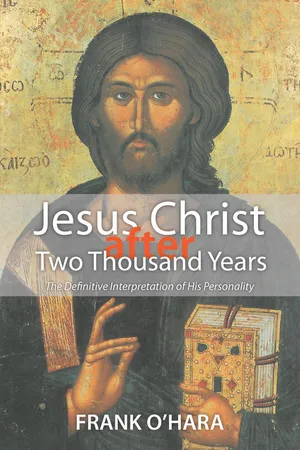
Jesus Christ after Two Thousand Years
The Definitive Interpretation of His Personality
- 150 pages
- English
- ePUB (mobile friendly)
- Available on iOS & Android
eBook - ePub
About this book
This work proposes the model of translation for the incarnation. According to this model, in Jesus Christ the eternal Word of God was translated into human flesh and form. Thus in Jesus Christ the invisible became visible, the inaudible became audible, the intangible became tangible, and the impalpable became palpable (cf. I John 1:1-4). This translation is brought about inasmuch as the heart of Jesus is the heart of the Word-made-flesh because it is the heart-of-the-Word made flesh. All the sentiments of the Word towards his Father, towards the Holy Spirit, and towards the whole of creation find expression in the human heart of Jesus Christ. The very being of the Word is thus expressed for us in the humanity of Jesus. That humanity is taken up into and hypostatically united to the Word of God through the medium of Word-consciousness, namely the consciousness in the human mind of Jesus of being the Word expressed in human form.
Information
Topic
Theology & ReligionSubtopic
Christian Church1
The Word Was Made Flesh
The classic place in the New Testament for the doctrine of the incarnation is John 1:14: “The Word was made flesh, he lived among us” (Greek: “pitched his tent among us”). Here the author of the Fourth Gospel states that the Logos or Word who was in the beginning with God (John 1:1) has become flesh and has come to live amongst us. The Gospel according to John is the one place in the New Testament where there is a clear statement of the incarnation of a pre-existent being. The Evangelist goes on to speak of Jesus Christ as the only Son, who is nearest to the Father’s heart, and who has made himself known, that is, became God’s “exegete,” his translator or interpreter (Greek: exegesato, John 1:18).1
I suggest here that when the Word was made flesh, the eternal Word of God was translated into human form in Jesus Christ, so that Jesus not only became the translator or interpreter of the Father, as John 1:18 says, but was also the translation of the Father’s Word into human form.
In order to give substance to this statement, I take the first four verses of the First Letter of John, which read as follows:
Something which has existed since the beginning,
that we have heard,
and we have seen with our own eyes;
that we have watched
and touched with our hands:
the Word, who is life—
that is our subject.
That life was made visible:
we saw it and we are giving our testimony,
telling you of the eternal life
which was with the Father and has been made visible to us.
What we have seen and heard
we are telling you
so that you too may be in union with us,
as we are in union
with the Father
and with his Son Jesus Christ.
We are writing this to you to make your own joy complete.
(1 John 1:1–4; my emphases)
Here the author is speaking of the life of God made visible, so that it can be seen and heard and touched by human beings. He identifies that life with the Word or Logos. But from John, chapter 1 we know that this Word is personal, and has become flesh in Jesus Christ (“The Word was with God,” John 1:1, and “The Word was made flesh,” John 1:14). These four verses of 1 John 1:1–4 reveal that in Jesus Christ the invisible became visible, the inaudible became audible and the intangible became tangible. Relying on statements of the early Fathers of the church, notably Ignatius of Antioch and Irenaeus, I add that through Christ the impalpable became palpable. Thus, we can link incarnation with redemption in that through the suffering and death of Christ we get to know who and what he is.
These various aspects of the incarnation are expounded in subsequent chapters of this book. Here, I wish simply to indicate how they are rooted in the New Testament.2
Before moving on, however, I should note one passage of the Epistle to the Philippians that has been widely considered to denote the pre-existence of Jesus Christ. Here Paul writes:
His state was divine,
yet he did not cling
to his equality with God
but emptied himself
to assume the condition of a slave,
and became as men are;
and being as all men are,
he was humbler yet,
even to accepting death,
death on a cross.
But God raised him high
and gave him the name
which is above all other namesT
so that all beings
in the heavens, on earth and in the underworld,
should bend the knee at the name of Jesus
and that every tongue should acclaim
Jesus Christ as Lord,
to the glory of God the Father.
(Phil 2: 6–11)
Not all scholars view this passage as a denotation of the pre-existence of Jesus Christ. In The New Jerome Biblical Commentary, Brendan Byrne, SJ considers that this passage states that Christ “[as] the Godlike one ‘took on’ the human condition ‘from outside’ as it were.”3 A different opinion is expressed by James Dunn, who considers that this passage does not denote pre-existence but...
Table of contents
- Title Page
- Preface
- Abbreviations
- Introduction
- Chapter 1: The Word Was Made Flesh
- Chapter 2: The Invisible Becomes Visible
- Chapter 3: The Inaudible Becomes Audible
- Chapter 4: The Intangible Becomes Tangible
- Chapter 5: The Impalpable Becomes Palpable
- Chapter 6: Cor Iesu Christi, Cor Verbi Incarnati, quia Cor Verbi Incarnatum
- Chapter 7: Technical Aspects of Translation Christology
- Chapter 8: Translations as the Communication of Meaning
- Chapter 9: Finitum Capax Infiniti (Martin Luther)
- Chapter 10: Finitum non Capax Infiniti (John Calvin)
- Chapter 11: Religious Aspects of Translation Christology
- Chapter 12: God Revealed by Jesus Christ
- Chapter 13: God Revealed in Jesus Christ
- Chapter 14: God Revealed Through Jesus Christ
- Chapter 15: The Incarnation Realized in Fact
- Chapter 16: The Incarnation Fulfilled in History
- Chapter 17: A Note on Aristotelian and Scholastic Concepts
- Chapter 18: The Impassibility of God
- Chapter 19: The Resurrection of Jesus Christ
- Chapter 20: Toward a Modern Theory of the Holy Trinity
- Bibliography
Trusted by 375,005 students
Access to over 1.5 million titles for a fair monthly price.
Study more efficiently using our study tools.
Frequently asked questions
Yes, you can cancel anytime from the Subscription tab in your account settings on the Perlego website. Your subscription will stay active until the end of your current billing period. Learn how to cancel your subscription
No, books cannot be downloaded as external files, such as PDFs, for use outside of Perlego. However, you can download books within the Perlego app for offline reading on mobile or tablet. Learn how to download books offline
We are an online textbook subscription service, where you can get access to an entire online library for less than the price of a single book per month. With over 1.5 million books across 990+ topics, we’ve got you covered! Learn about our mission
Look out for the read-aloud symbol on your next book to see if you can listen to it. The read-aloud tool reads text aloud for you, highlighting the text as it is being read. You can pause it, speed it up and slow it down. Learn more about Read Aloud
Yes! You can use the Perlego app on both iOS and Android devices to read anytime, anywhere — even offline. Perfect for commutes or when you’re on the go.
Please note we cannot support devices running on iOS 13 and Android 7 or earlier. Learn more about using the app
Please note we cannot support devices running on iOS 13 and Android 7 or earlier. Learn more about using the app
Yes, you can access Jesus Christ after Two Thousand Years by Frank O’Hara in PDF and/or ePUB format, as well as other popular books in Theology & Religion & Christian Church. We have over 1.5 million books available in our catalogue for you to explore.