- 110 pages
- English
- ePUB (mobile friendly)
- Available on iOS & Android
eBook - ePub
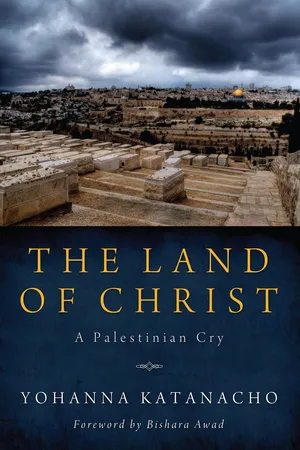
About this book
Palestinians and Israeli Jews live in one land, yet as two distinct communities, each of which claims ownership of the same territory. How are we to understand the divine promise pertaining to the land? Did God promise the land exclusively to the Jewish people? Do the Palestinians have a right to live in the land, or does God want them to leave?
After affirming important Palestinian Evangelical concerns, The Land of Christ challenges the argument that God gave the land to Israel. Yohanna Katanacho asks: (1) What are the borders of the land? (2) Who is Israel? (3) How did God give Israel the land? Through careful biblical exegesis, the book responds to these questions, exposing the superficiality of many slogans and claims. Then the book presents an alternative biblical theology of the land.
However, the theology of the land in this book is intimately associated with the context in Israel/Palestine. The Palestinian Kairos Document is the most accepted representative of the current Palestinian context and theology. The book unpacks this document and extrapolates on its theology of the land. Finally, the author does not leave the reader without hope. Katanacho portrays Hagar as a symbol of hope and considers the Korahite Psalms from the perspective of refugees.
Information
Topic
Theology & ReligionSubtopic
Christian Churchone
The Context
All theology is contextual. We look at a text from a particular point of view, a particular interest, and highlight some aspects of the text. It is important, then, to study theology in community, interacting with and learning from one another, for individuals cannot escape the peril of creating a canon within a canon. Each interpretation tends toward a particular angle of the truth.
Furthermore, it is important to study theology with humility, to be willing to listen to and learn from one another. Humility and community are especially important when it comes to the “theology of the land” and the theological ways in which we perceive the modern state of Israel.
Disagreements may be very personal and emotional and may influence the way Palestinians and Israelis, Christian Zionists and covenant theologians relate to one another. A theological assertion such as “God gave the land to Israel” has not only theological, but also military, economic, and political implications. In this book, I will address this assertion from my perspective as an evangelical Palestinian Arab Christian. First, though, an explanation of my background is important for the reader to understand the context of my presentation and interpretation of biblical texts.
Evangelical Christian
For the sake of simplicity, I use the term “evangelical” to refer to people in Israel/Palestine who are followers of Jesus Christ, affirm the need for personal conversion, and accept the authority of the Bible. Good theology is embedded in a personal relationship with God, so I must begin with my own conversion story and acknowledgement of the authority of the Bible, as one living in a culture of hatred and a land torn by conflict.
I was born in Jerusalem, in June 1967, during the Arab–Israeli war known as the “Six-Day War.” Due to the curfew imposed on East Jerusalem, my mother could not leave the hospital. However, my father risked his life to bring us home and despite the bomb that exploded next to the entrance of our home, tragically killing our neighbor, we arrived home safely. This is how my life began, and ever since, I have lived with conflict and wars motivated by politics and religion.
I grew up in Jerusalem, a city full of religious people—Jews, Muslims, and Christians—who often walk along the same streets, distinguishable by their dress. It is common to see the robe and turban of a Muslim sheikh, the long dress and head scarf of a Muslim woman, the black coat and hat of an Orthodox Jewish man, and the modest dress and head covering of an Orthodox Jewish woman. There are priests and nuns of various religious orders and others, both religious and secular, who come from all over the world. My family is part of this diversity.
My mother is an Armenian Catholic. Her parents fled from Armenia to seek refuge in Jerusalem in 1915, having lost many relatives in massacres rooted in hatred and religious persecution. Although my mother wanted to become a nun, she fell in love with my father, a Roman Catholic Palestinian Arab. He and most of his family lost their homes in Ramle (near Tel Aviv) during the 1948 war and sought refuge in Jerusalem. Although both of my parents suffered the loss and hardship of war and persecution, I never saw hatred in them toward anyone. My parents taught me well; however, I refused the teachings of the church. As a teenager I was an atheist and actively led a student group promoting atheism at Bethlehem University (in the West Bank). My studies in chemistry, biology, and philosophy reinforced my atheistic beliefs, and the philosophy of atheism was realized practically in my life; I lived as though God did not exist. I was influenced by the immorality of my friends and by my desire to live free of religion and ethics. I also participated in many ungodly activities that I am now ashamed to mention. However, much to my surprise, God intervened in my life with his grace.
Early one morning in 1986, I awoke to the sound of the church bells of Jerusalem. It was 3:00 a.m. I opened my eyes and felt a strange sensation like air penetrating my body! And then, I could not move. My hands, feet, and neck seemed paralyzed and I was not even able to shout. For a moment I thought I was dead, but as I tried to understand what was happening to me, I failed to find a logical explanation. After struggling to free myself for almost two hours, I cried out to God saying, “O Lord, if this is you, free me and I promise I will search for you.” After this short prayer, I found I could move again. My whole worldview had collapsed in just one night. Now, how could I continue to actively support atheism at Bethlehem University? How could I explain what had happened to me? I got up, drank some water, and went back to bed. Later, I was afraid to say that God did not exist. I was even afraid to walk in dark places because my mysterious supernatural encounter had happened in the dark. In short, I was puzzled and needed answers, so I started searching for God.
In 1987, I began to study the Bible, but I was disturbed by what I discovered. I argued, “How can someone live on earth for fifty or sixty years and then be cast into hell by God for eternity? This is unfair.” During this period, I was invited to attend a special “revival meeting” at the Alliance Church in Jerusalem, and consequently, I decided to follow Jesus Christ. I felt that God was speaking to me and asking me to give him my heart. I answered saying, “Lord, I don’t have a problem giving you my heart, but I do have a problem giving you my mind.” I knew that I was a sinner and that I needed to be saved, but I was not completely convinced of the justice of Christianity. However, I decided to take a step of faith; I told the Lord that I would give him my heart, but that I had to trust him to convince me intellectually.
During the same period of time, I had three dreams. In the first dream, I saw myself walking down a path full of ugly faces on both sides. I was following a man I did not know, holding onto his long cloak while many terrifying faces surrounded me. In the second dream, I was in a transparent glass box surrounded by the same ugly and terrifying faces, but the box prevented them from touching or hurting me. In the third and final dream, I was on the same path as in the first dream, with the same ugly faces, but this time I was not following the man wearing the cloak. Instead, he was holding me in his arms, and whenever I opened my eyes in my dream, I saw his face and this brought peace and tranquility to my heart. When I woke up God spoke to my heart, and the first thought that struck me was, “this is the difference between works and grace. If you want to follow me by your own efforts you will lose me, because you cannot keep holding onto my cloak by your own strength. If you are in Christ (in the box), then I will carry you.” This is grace. These dreams were a turning point in my life. God became so personal to me. He won my heart and my mind and I accepted Jesus Christ as my Savior and Lord, knowing that he died on the cross in my place.
From that moment, I started experiencing significant changes in my life. This inner transformation touched not only my intellect, but also my behavior. I stopped many of my bad habits, such as smoking, gambling, and cursing, but unfortunately, I also lost many of my friends who did not approve of my new lifestyle. However, a few of my friends did accept the Lord. I started reading my Bible daily, and by the grace of God, learned about his just love. I decided to give him all of my life and started a Bible study at Bethlehem University where I used to promote atheism. The Bible shaped my understanding of God and my role in life. However, there were still difficult challenges ahead of me, for the Bible commanded me to love my enemies! If I accepted the authority of the Bible, then I should obey its commandment to love. The Bible says:
You have heard that it was said, “Love your neighbor and hate your enemy.” But I tell you: Love your enemies and pray for those who persecute you, that you may be sons of your Father in heaven. He causes his sun to rise on the evil and the good, and sends rain on the righteous and the unrighteous. If you love those who love you, what reward will you get? Are not even the tax collectors doing that? And if you greet only your brothers, what are you doing more than others? Do not even pagans do that? Be perfect, therefore, as your heavenly Father is perfect. (Matt 5:43–48 NIV)
Loving My Enemy
It was nearly midnight when I closed up the office of the Alliance Church in Jerusalem, stuffed the stack of pamphlets I had just finished photocopying inside my jacket, and began an uneasy walk home. In the late 1980s, under a new Israeli law, if an Israeli soldier called out to a Palestinian and the Palestinian did not respond, the soldier could consider that person a political fanatic and shoot him. During that time, many Palestinians distributed political flyers challenging the authority of the Israeli government. As I neared the Damascus Gate, I saw three Israeli soldiers standing in the shadows, watching me. One soldier lifted a hand and crooked his finger commanding me to approach them. There was no one else in sight, and as I approached the soldiers, my heart pounded and I began to pray. Without thinking, I rapidly unzipped my jacket, and just as quickly found three machine guns aimed at my head!
I stared at the soldiers. I had seen many soldiers who looked just like these men, mocking the students at Bethlehem University, forcing them to stay indoors during a sudden curfew that could last for weeks, allowing no possibility to work, buy food, or get medical attention. I looked at them and raised my hand to my chest. “I have a heart, here, that loves you,” I told them. For a moment, the three soldiers stared at me, shocked. I was shocked, too! Slowly, they lowered their guns and we began to talk together. After twenty minutes, one soldier told me, “I wish that all Palestinians were like you.” “No”, I replied. “I wish that you were like me.”
That incident helped me to reflect on how Christ had changed me. Only two years earlier, Christ’s command in the Sermon on the Mount to love your enemies seemed impossible to me. And yet, there it was—unambiguous and unchanging. For me, love was an active decision, counter to the culture in which I lived—a culture where hatred of the other abounded, fuelled by the circumstances of daily life, the media, attitudes—all contributing to the alienation of both Israeli Jews and Palestinian Arabs. To overcome this alienation and hatred, I needed a profound change.
At first I tried, but failed, in my attempts to feel love. Israeli soldiers would stop Palestinians daily, at random, and ask for their identification cards, sometimes detaining them for hours. These experiences fueled my fear and anger. As I confessed my inability to love to God, I realized something significant. The radical love of Christ is not an emotion, but a decision. I decided to show love, however reluctantly, by sharing the gospel message with the soldiers on the street.
With new resolve, I began to carry tracts written in Hebrew and English with a quotation from Isaiah 53, and the words “Real Love” printed across the top. Every time a soldier stopped me, I handed him both my ID card and a tract. Because the quote came from the Hebrew Scriptures, the soldiers usually asked me about it before letting me go. After several months of this, I suddenly realized that my feelings toward the soldiers had changed. I was surprised. It was a process that I had been unaware of, but my former feelings were gone. I would pass the same way and see the same soldiers as before, but now I found myself praying, “Lord, let them stop me so I can share with them the love of Christ.”
Opposition served as a reminder to me that I needed to decide daily whether or not I would choose to love. Sin distorts your mind and you can easily revert to the ways of human nature and respond with hate when treated badly. But really, our “love muscles” grow stronger as we obey God, and after some time we become more patient. We have more strength to love. Our hearts grow bigger, and we learn how to involve prayer in our love.
A recent incident challenged me again to demonstrate the love of God. I was invited to present an academic lecture at Lund University in Sweden. In the group of speakers were Muslims, Jews, and Christians, including several Jewish professors from Israeli universities. We visited a mosque, a church, and a synagogue. At the synagogue, I put on a skull cap and listened to three religious Jewish speakers, two men and one woman. For almost forty minutes they listed only negative aspects of Palestinians and spoke of how Palestinians persecute and torture Jews. Many statements were simply wrong. None of the speakers knew that there was a Palestinian in the audience, and when they concluded their lecture, invited questions and comments. I stood up and said, “I am a Palestinian Christian. I empathize with your pain, even though I have different convictions, and I am sorry that you had to go through so much pain. I just want to tell you that I love you.” Then I sat down.
The speakers were confused and did not know how to respond. Later, one of the Jewish Israeli professors told me, “I am amazed by love in Christianity.” I replied that love is also found in the Hebrew Scriptures. He responded saying, “But it is central in your faith.” For me, this kind of love is not an excuse to abandon justice, but is a motive to pursue it with all of my heart. In fact, this is my reason for writing this book: to promote a biblical view of land that is rooted in biblical love, faithful to the Bible, and that seeks justice for both Palestinians and Israelis. Thus in the next chapter, I will interact with many brothers and sisters in Christ who continue to affirm that the current state of Israel is the fulfillment of prophecies.
two
Three Important Questions
Palestinians and Israeli Jews live today in one land, yet they live as two distinct communities, each of which claims ownership of the same territory. How are we to understand the divine promise pertaining to the land? Did God promise the land exclusively to the Jewish people? Do the Palestinians have a right to live in the land or does God want them to leave?
Some claim that the Jewish people have a divinely endorsed, perpetual right of ownership to the land, while others claim that the promises referring to the land have been fulfilled in the New Testament.1 Where is Christ in this debate? In this present time, does the land belong to Israel or to Christ?
Let us consider the theological argument that God gave the...
Table of contents
- Title Page
- Foreword
- Preface
- Acknowledgments
- Chapter 1: The Context
- Chapter 2: Three Important Questions
- Chapter 3: The Land
- Chapter 4: The Kairos Theology
- Chapter 5: A Message of Hope
- Addendum: The Palestinian Kairos Document
- Bibliography
Trusted by 375,005 students
Access to over 1.5 million titles for a fair monthly price.
Study more efficiently using our study tools.
Frequently asked questions
Yes, you can cancel anytime from the Subscription tab in your account settings on the Perlego website. Your subscription will stay active until the end of your current billing period. Learn how to cancel your subscription
No, books cannot be downloaded as external files, such as PDFs, for use outside of Perlego. However, you can download books within the Perlego app for offline reading on mobile or tablet. Learn how to download books offline
Perlego offers two plans: Essential and Complete
- Essential is ideal for learners and professionals who enjoy exploring a wide range of subjects. Access the Essential Library with 800,000+ trusted titles and best-sellers across business, personal growth, and the humanities. Includes unlimited reading time and Standard Read Aloud voice.
- Complete: Perfect for advanced learners and researchers needing full, unrestricted access. Unlock 1.5M+ books across hundreds of subjects, including academic and specialized titles. The Complete Plan also includes advanced features like Premium Read Aloud and Research Assistant.
We are an online textbook subscription service, where you can get access to an entire online library for less than the price of a single book per month. With over 1.5 million books across 990+ topics, we’ve got you covered! Learn about our mission
Look out for the read-aloud symbol on your next book to see if you can listen to it. The read-aloud tool reads text aloud for you, highlighting the text as it is being read. You can pause it, speed it up and slow it down. Learn more about Read Aloud
Yes! You can use the Perlego app on both iOS and Android devices to read anytime, anywhere — even offline. Perfect for commutes or when you’re on the go.
Please note we cannot support devices running on iOS 13 and Android 7 or earlier. Learn more about using the app
Please note we cannot support devices running on iOS 13 and Android 7 or earlier. Learn more about using the app
Yes, you can access The Land of Christ by Yohanna Katanacho in PDF and/or ePUB format, as well as other popular books in Theology & Religion & Christian Church. We have over 1.5 million books available in our catalogue for you to explore.