eBook - ePub
Isaiah and Imperial Context
The Book of Isaiah in the Times of Empire
- 262 pages
- English
- ePUB (mobile friendly)
- Available on iOS & Android
eBook - ePub
Isaiah and Imperial Context
The Book of Isaiah in the Times of Empire
About this book
Interpreting Isaiah requires attention to empire. The matrix of the book of Isaiah was the imperial contexts of Assyria, Babylon, and Persia. The community of faith in these eras needed a prophetic vision for life. Not only is the book of Isaiah crafted in light of empire, but current readers cannot help but approach Isaiah in light of imperial realities today. As a neglected area of research, Isaiah and Imperial Context probes how empire can illumine Isaiah through essays that utilize archaeology, history, literary approaches, post-colonialism, and feminism within the various sections of Isaiah. The contributors are Andrew T. Abernethy, Mark G. Brett, Tim Bulkeley, John Goldingay, Christopher B. Hays, Joy Hooker, Malcolm Mac MacDonald, Judith E. McKinlay, Tim Meadowcroft, Lena-Sofia Tiemeyer, and David Ussishkin.
Information
Topic
Theology & ReligionSubtopic
Biblical Commentary1
Sennacherib’s Campaign to Judah
The Events at Lachish and Jerusalem
A. The Assyrian Campaign
Lachish and Jerusalem were the most important cities which were militarily challenged by Sennacherib during his campaign to Judah in 701 B.C.E. The events that transpired in these cities are documented in the historical chronicles, and their material remains have systematically been studied by archaeologists. In the case of both cities an analysis of the archaeological data helps in interpreting the written sources and in understanding better the events of 701 B.C.E.
In 705 B.C.E. Sennacherib ascended to the throne of Assyria, which at that time was the largest and most powerful kingdom in the Near East. The young king was soon faced with a revolt organized by Hezekiah king of Judah. An alliance against Assyria was formed between Judah, Egypt and the Philistine cities in the Coastal Plain, possibly with Babylonian support. Sennacherib met the challenge. In 701 B.C.E. he marched to Phoenicia, Philistia, and Judah, and succeeded in reestablishing Assyrian supremacy in those regions (see map in Fig. 1).
Based on the detailed information in the Old Testament and the
Assyrian records it seems that the main course of the campaign can be reconstructed in different ways. The following reconstruction seems to us the most plausible. Sennacherib and his powerful army marched on foot from Nineveh, the capital of Assyria to the Phoenician cities situated along the Mediterranean coast (see map in Fig. 1). Sennacherib received there the tribute of various vassal kings and continued his advance southwards to Philistia. He then defeated in open battle a large Egyptian expeditionary force, and reestablished Assyrian rule in Philistia.
Assyrian records it seems that the main course of the campaign can be reconstructed in different ways. The following reconstruction seems to us the most plausible. Sennacherib and his powerful army marched on foot from Nineveh, the capital of Assyria to the Phoenician cities situated along the Mediterranean coast (see map in Fig. 1). Sennacherib received there the tribute of various vassal kings and continued his advance southwards to Philistia. He then defeated in open battle a large Egyptian expeditionary force, and reestablished Assyrian rule in Philistia.

Fig. 1. The ancient Near East at the end of the eighth century B.C.E.
At this point Sennacherib turned against Judah and its ruler Hezekiah (see map in Fig. 2). It is clear that upon arriving in Judah, Sennacherib’s attention was focused primarily on the city of Lachish rather than on the capital Jerusalem. Lachish was the most formidable fortress city in Judah, and its conquest and destruction were the paramount task facing Sennacherib when he came to crush the military powers of Hezekiah. In fact, the conquest of Lachish was of singular importance and a great Assyrian military achievement as indicated by the Lachish reliefs (see below).
The Old Testament informs us that Sennacherib encamped at Lachish and established his headquarters there during his campaign in Judah (2 Kgs 18:14, 17; Isa 36:2; 2 Chr 32:9). He conquered and destroyed forty-six Judean cities, and from Lachish he sent a task force to challenge Hezekiah in Jerusalem. Eventually, as related in both the Old Testament and the Assyrian annals, Jerusalem was spared, and Hezekiah, who came to terms with Sennacherib, continued to rule Judah as an Assyrian vassal, and paid heavy tribute to the Assyrian king.
A detailed account of the Assyrian campaign in Judah is given in the biblical texts, focusing on the events in Jerusalem (2 Kgs 18–19; Isa 36–37; 2 Chr 32). It should be noted that the prophet Isaiah played a significant moral and political role in solving this acute crisis, the most difficult one during the reign of Hezekiah.
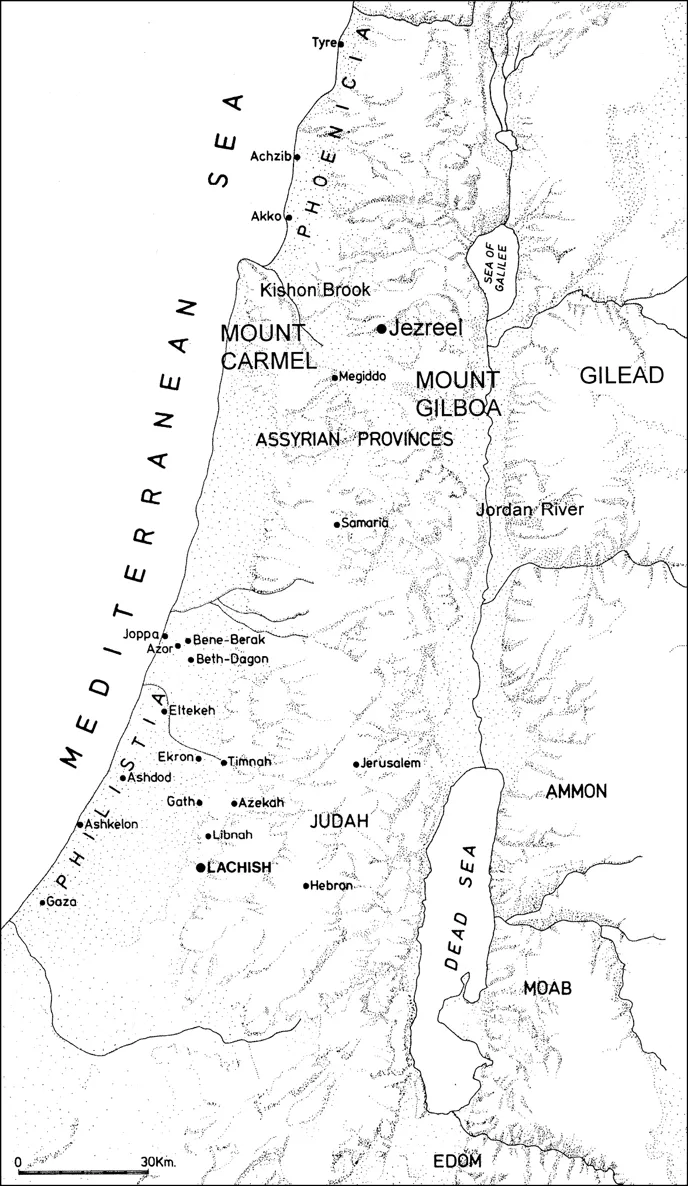
Fig. 2. The Land of Israel at the end of the eighth century B.C.E.
B. Biblical Lachish: The Judean Fortress city
Turning to Tel Lachish, the site of the biblical city, we see that it is one of the largest and most prominent mounds in southern Israel (Fig. 3). The mound is nearly rectangular, its flat summit covering about eighteen acres. The slopes of the mound are very steep due to the massive fortifications of the ancient city constructed here.

Fig. 3. Tel Lachish, the site of biblical Lachish, from the north.
Extensive excavations were carried out at Lachish by three expeditions. The first excavations were conducted on a large scale by a British expedition, directed by James Starkey, between 1932 and 1938. The excavation came to end in 1938 when Starkey was murdered by Arab bandits. The excavation reports were later published by his assistant, Olga Tufnell.1 In 1966 and 1968 Yohanan Aharoni conducted a small excavation, limited in scope and scale, in the Solar Shrine of the Persian period (Fig. 4 no. 11).2 Finally, systematic, long-term and large-scale excavations were directed by me on behalf of the Institute of Archaeology of Tel Aviv University between 1972 and 1993.3
Lachish was continuously settled between the Chalcolithic period in the fourth millennium and the Hellenistic period in the third century B.C.E.4 Our concern here, however, is the city of Levels IV and III, dated to the ninth and eighth centuries B.C.E. respectively.
At the beginning of the ninth century B.C.E. one of the kings of Judah constructed here a formidable fortress city, turning Lachish into the most important city in Judah after Jerusalem. With the lack of inscriptions it is not known who is the king who built the city and at what date. The fortress city continued to serve as the main royal fortress of the kings of Judah until its destruction by Sennacherib in 701 B.C.E. In archaeological terminology this fortress city is divided into two successive strata, labeled Level IV and Level III.
The plan in Fig. 4 shows the outlines of the fortress city, and the illustration in Fig. 5 portrays a reconstruction of Lachish from the west on the eve of Sennacherib’s conquest in 701 B.C.E.

Fig. 4. Plan of Tel Lachish: (1) Outer city-gate; (2) Inner city-gate; (3) Outer revetment; (4) Main city-wall; (5) Judean palace-fort complex; (6) Area S—the main excavation trench; (7) The Great Shaft; (8) The well; (9) Assyrian siege-ramp; (10) The counter-ramp; (11) Acropolis Temple; (12) Solar Shrine; (13) Fosse Temple.

Fig. 5. Reconstruction of Lachish on the eve of Sennacherib’s siege, from west; prepared by Judith Dekel from a sketch by H. H. McWilliams in 1933, supplemented by newly excavated data.
The nearly rectangular fortress city was protected by two city-walls —an outer revetment surrounding the site at mid-slope (Fig. 4 no. 3), and the main city-wall, extending along the upper periphery of the site (Fig. 4 no. 4). The massive outer revetment was uncovered in its entirety by the British expedition. Only its lower part, built of stones, was preserved. It probably served mainly to support a rampart or glacis, which in turn reached the bottom of the main city-wall. The main city-wall was built of mud-brick on stone foundations. It was a massive wall. Being more than 6 m or about 20 ft thick, its top provided sufficient, spacious room for the defenders to stand and fight.
A roadway led from the south-west corner of the site to the gate. The city-gate complex included in fact two gates: the outer gate (Fig. 4 no. 1), connected to the outer revetment, and the inner gate (Fig. 4 no. 2), connected to the main city-wall, and an open, spacious courtyard between the two gat...
Table of contents
- Title Page
- Illustrations
- Contributors
- Preface
- Chapter 1: Sennacherib’s Campaign to Judah
- Chapter 2: Eating, Assyrian Imperialism, and God’s Kingdom in Isaiah
- Chapter 3: Isaiah as Colonized Poet
- Chapter 4: Living in the Empire
- Chapter 5: The Usefulness of a Daughter
- Chapter 6: Zion as Theological Symbol in Isaiah
- Chapter 7: Imperial Influence on the Language and Content of Isaiah 40–55
- Chapter 8: Transforming Word and Empire
- Chapter 9: Isaiah 56–66
- Chapter 10: Imperial Imagination in Isaiah 56–66
- Chapter 11: Redeeming the Earth
- Chapter 12: Responses
- Bibliography
Trusted by 375,005 students
Access to over 1.5 million titles for a fair monthly price.
Study more efficiently using our study tools.
Frequently asked questions
Yes, you can cancel anytime from the Subscription tab in your account settings on the Perlego website. Your subscription will stay active until the end of your current billing period. Learn how to cancel your subscription
No, books cannot be downloaded as external files, such as PDFs, for use outside of Perlego. However, you can download books within the Perlego app for offline reading on mobile or tablet. Learn how to download books offline
Perlego offers two plans: Essential and Complete
- Essential is ideal for learners and professionals who enjoy exploring a wide range of subjects. Access the Essential Library with 800,000+ trusted titles and best-sellers across business, personal growth, and the humanities. Includes unlimited reading time and Standard Read Aloud voice.
- Complete: Perfect for advanced learners and researchers needing full, unrestricted access. Unlock 1.5M+ books across hundreds of subjects, including academic and specialized titles. The Complete Plan also includes advanced features like Premium Read Aloud and Research Assistant.
We are an online textbook subscription service, where you can get access to an entire online library for less than the price of a single book per month. With over 1.5 million books across 990+ topics, we’ve got you covered! Learn about our mission
Look out for the read-aloud symbol on your next book to see if you can listen to it. The read-aloud tool reads text aloud for you, highlighting the text as it is being read. You can pause it, speed it up and slow it down. Learn more about Read Aloud
Yes! You can use the Perlego app on both iOS and Android devices to read anytime, anywhere — even offline. Perfect for commutes or when you’re on the go.
Please note we cannot support devices running on iOS 13 and Android 7 or earlier. Learn more about using the app
Please note we cannot support devices running on iOS 13 and Android 7 or earlier. Learn more about using the app
Yes, you can access Isaiah and Imperial Context by Andrew Abernethy,Mark G. Brett,Tim Bulkeley,Tim Meadowcroft, Abernethy, Brett in PDF and/or ePUB format, as well as other popular books in Theology & Religion & Biblical Commentary. We have over 1.5 million books available in our catalogue for you to explore.