- 410 pages
- English
- ePUB (mobile friendly)
- Available on iOS & Android
eBook - ePub
About this book
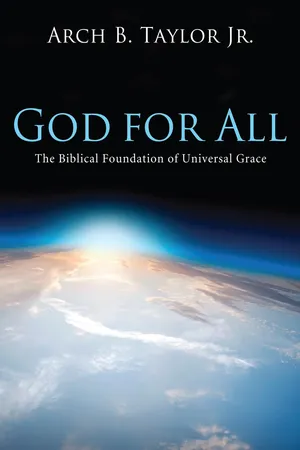
"God our Savior desires everyone to be saved" (1Tim 2:4). Does God get what God wants? "Yes, but--" depending on how we read the Bible.
The Bible is universal: One God, Sovereign Creator of everything, especially humanity in God's image, God's partner to manage creation. Science and evolution say humanity evolved, gradually acquiring superior capabilities. We have yet to transcend animal nature and acknowledge oneness of creation under God.
Humans exploited our semi-divine status, becoming alienated. God chose Israelites/Jews for blessing and reconciling humanity. They exploited chosenness, so God sent the Jew Jesus to reveal God's gracious concern for all people. Roman political and Jewish religious power killed Jesus, but he appeared resurrected to his disciples, who proclaimed him Savior.
God gave another Jew, Paul, a vision of Jesus resurrected and appointed him to proclaim God's reconciliation to Gentiles. Paul taught that through the faithfulness of Jesus, Gentiles too become God's people and share Israel's blessings without becoming Jews. All who experience reconciliation share Jesus's partnership with God. "We toil and struggle, because we have our hope set on the living God, who is the Savior of all people, especially of those who believe" (1 Tim 4:10).
Information
1
My Spiritual Pilgrimage
I was among the more conservative students at seminary, for my family upbringing and Southern Presbyterian origins naturally inclined me in that direction. If I had been presented with the idea that salvation was possible outside the Christian faith at that early time I would have dismissed it at once. Not until I was about to close my career as a missionary in Japan and return home for retirement did I finally admit to myself that I had, really, reached the point at which I could no longer equivocate; I had to speak openly of my belief that for me the God revealed in Scripture and supremely in Jesus Christ was the Savior of all people. As I expressed it to myself, finally I “came out of the closet” on that question. Yet as I reflected on my life and experience, I could identify certain people and events that left a deep impression on me even from early days that finally bore fruit in my change of mind.
1. Benjamin B. Warfield
At Louisville Presbyterian Theological Seminary in 1942 to 1945 I came under influence from my teacher of church history and apologetics, Dr. Andrew K. Rule. Dr. Rule had come to the U.S. from his native New Zealand to study with Dr. Benjamin B. Warfield of Princeton Seminary. Under Dr. Rule’s guidance I purchased and read nearly all of Warfield’s writings. Yet the first and most impressive was the little book, The Plan of Salvation.7 Through the years I read the book several times, writing comments in the margin. As I reflect on my spiritual pilgrimage, I credit Warfield with giving me a good start, by means of The Plan of Salvation.
From the Reformed theological position stemming from John Calvin, Warfield placed utmost emphasis upon the sovereignty and initiative of God, rather than upon anything that humans can do to gain salvation. Starting from the assumption that all humans are lost sinners, Warfield explained his view of how God goes about saving them. Warfield says God deals with humans as individuals, what he calls “particular evangelicalism.” He notes that there are some theologians who teach that humans must contribute something to their own salvation—that although God desires the salvation of all, and Christ died for the sins of all, each one must respond to God’s offer of salvation by accepting it, by believing the message, by confessing sin, and requesting forgiveness. If a person refuses to respond in this way, he or she can, in effect, frustrate God’s desire. On the other hand, if the person does respond positively, that act of response is what effectively accomplishes salvation, for without it the person would not have been saved. Warfield brands this doctrine “autosoterism”—saving one’s self. He dismisses it as an affront to the sovereignty of God.
According to Warfield, righteousness is the defining characteristic of the divine nature, and the righteousness of God determines salvation or damnation. Only by God’s righteous decree can anyone be saved, and since it is obvious (he wrote) that not everybody is saved, it must be because they were not included in God’s decree. In short, God really and truly predestines some to be saved and some to be lost. No matter how urgently people, such as Warfield and my professor Dr. Rule, stressed the goodness and love of God and expressed this “double predestination” in as moderate terms as possible, I could not escape the sense of revulsion most people feel at hearing it.
Warfield was only expounding a section of the Westminster Confession of Faith (WCF), a foundational statement of Christian doctrine held by major Presbyterian churches. WCF Chapter III “Of God’s Eternal Decrees” speaks of those who “are predestinated unto eternal life and others foreordained to everlasting death.” God’s dealing with the latter is described in WCF Chapter V paragraph 6 “Of Providence” in part as follows:
As for those wicked and ungodly men whom God, as a righteous judge, for former sins, doth blind and harden, from them he not only withholdeth his grace, whereby they might have been enlightened in their understandings, and wrought upon in their hearts; … whereby it cometh to pass that they harden themselves, even under those means which God useth for the softening of others.8
In 1903 the General Assembly of the Presbyterian Church (USA)—“Northern”—aiming to ease the consciences of those repelled by this and other similar statements, approved a Declarative Statement that included the following:
. . . concerning those who perish, the doctrine of God’s eternal decree is held in harmony with the doctrine that God desires not the death of any sinner, but has provided in Christ a salvation sufficient for all, adapted to all, and freely offered in the gospel to all; that men are fully responsible for their treatment of God’s gracious offer; that his decree hinders no man from accepting that offer; and that no man is condemned except on the ground of his sin.9
The Declarative Statement allows Presbyterians to be what Warfield called “autosoterists” with a clear conscience and without honestly acknowledging any “affront” to God. In my day the church never made it an issue in ordination, and I was happy not to have to face the question myself. But I could never evade the nagging of those texts that spoke in terms of God’s love for the world, God’s concern for all. The first time I read Warfield’s book, on a page where he discussed this question of God’s righteous decrees I wrote: “Double predestination and universalism can both be supported by scriptural texts. Each position expresses one of the opposite logical extremes of supernatural evangelicalism. I reject both as extremes.”
Concerning universal salvation, Warfield wrote, “There is no reason why a Calvinist might not be a universalist in the most express meaning of that term, holding that each and every human soul shall be saved; and in point of fact some Calvinists (forgetful of Scripture here) have been universalists in this most express meaning of the term.”10 Resting strongly on these words of Warfield, I join the ranks of those Calvinists who have become universalists. I have done so, not as Warfield would charge by being “forgetful of Scripture,” but precisely because I take seriously the universal texts within Scripture itself.
2. Catherine and Peter Marshall
During my second and third years in seminary I served as student pastor of the Presbyterian Church in Charlestown, Indiana. The women of the church asked me to lead a study of Ephesians based on a guide titled The Mystery of the Ages by Catherine and Peter Marshall. Recalling that experience, I can’t be sure how much the women learned, but I received a deep impression of the scope of God’s eternal purpose as I followed the Marshalls’ leading.
In their introduction, the authors alluded to the ongoing World War Two. They proposed that Ephesians could guide Christians as we anticipated reconstructing world order when peace again prevailed. They offered Ephesians 1:10 as the key to God’s purpose to which we Christians should devote ourselves: “That in the dispensation of the fullness of times [God] might gather together in one all things in Christ, both which are in heaven, and which are on earth, even in him” (King James Version). The Marshalls gave three lines of evidence to support this view that God would eventually overcome all divisions by gathering together all things and people in Christ.
1. Death is the greatest force dividing people. God has overcome death by his “mighty power, which he wrought in Christ, when he raised him from the dead” (Ephesians 1:20 KJV). Resurrection, then, is the first ground of the ultimate unity of all things in Christ.
2. Sin is the next divisive power, which separates us from God. By the forgiveness of sins through Christ, God has brought us to new life and reconciliation with God (Ephesians 2:1–10).
3. Divisions among people, most poignantly demonstrated by division between Jews and Gentiles, has been overcome by the cross of Christ, who broke down the wall of partition and made “one new humanity” (Ephesians 2:11–22).
In my sense of call to mission service and my early years in Japan, I followed the Marshalls’ concept that this unity of humankind would be accomplished “through the Church”—eventually by God’s plan all people would become Christians. I shared the Marshalls’ supersessionist view, that God rejected the Jews and that Christians had superseded or replaced them. Henceforth the Church must be the locus for the oneness of humankind. In the course of my pilgrimage I have come to believe that God’s universal plan of reconciling all people is broader than the Christian church, though I am committed to the church in which I was born and nurtured, and I continue to witness and serve through and in the church as well as by other means. Nevertheless, Catherine and Peter Marshall gave me the vision of God’s eternal plan of total reconciliation, which has now become my universalism.
3. The equality of women and men
I took an important step toward universalism by acknowledging the equal...
Table of contents
- God for All
- Abbreviations
- Introduction
- Chapter 1: My Spiritual Pilgrimage
- Chapter 2: The Beginnings of Monotheism
- Part One: The Universal Matrix
- Chapter 3: God and the Creation of Humanity
- Chapter 4: The Creator and Humans in Relationship
- Chapter 5: Biblical Creation, Evolution, and Brain Science
- Chapter 6: The Spread of Population and Sin
- Chapter 7: The Covenant with Abram
- Part Two: Abraham to the Settlement of Canaan
- Chapter 8: Children of Abraham—Exclusion and Assimilation
- Chapter 9: Moses, the Name, and the Exodus
- Chapter 10: Moses and the Sinai Covenant
- Chapter 11: Covenant as Gift and Obligation
- Chapter 12: From Sinai to Canaan
- Chapter 13: The Conquest and Settlement of Canaan
- Part Three: The Monarchy from Beginning to End
- Chapter 14: Like Other Nations: David’s Monarchy
- Chapter 15: Like Other Nations: Solomon’s Shadows
- Chapter 16: The People of YHWH Like Other Nations
- Chapter 17: The Covenant as Family Relation
- Chapter 18: The Prophets and the End of the State
- Part Four: From Exile to the Time of Jesus
- Chapter 19: Exile: Re-imagining God and Humanity
- Chapter 20: Return, Rebuild, Retrench
- Chapter 21: Roman Palestine in the Time of Jesus
- Part Five: Jesus of Nazareth
- Chapter 22: Introduction to Jesus and the Gospels
- Chapter 23: The Call of Jesus
- Chapter 24: Jesus’s Ministry as Healer and Exorcist
- Chapter 25: Jesus and the Oneness of God
- Chapter 26: Jesus Challenges the Domination System
- Chapter 27: Who Did Jesus Say that He Was?
- Part Six: Paul, Apostle to the Gentiles
- Chapter 28: In Quest of Saul/Paul
- Chapter 29: The Death of Saul and Birth of Paul
- Chapter 30: Paul’s New Understanding of God
- Chapter 31: Universal Grace in Romans
- Chapter 32: Paul and the Oneness of God
- Part Seven: After Jesus and Paul
- Chapter 33: The Jesus Movement’s Breakout
- Chapter 34: Jesus of Nazareth in God’s Plan
- Chapter 35: Humanity in God’s Plan—1
- Chapter 36: Humanity in God’s Plan—2
- Afterword
- Appendix A
- Appendix B
- Bibliography
Trusted by 375,005 students
Access to over 1.5 million titles for a fair monthly price.
Study more efficiently using our study tools.
Frequently asked questions
Yes, you can cancel anytime from the Subscription tab in your account settings on the Perlego website. Your subscription will stay active until the end of your current billing period. Learn how to cancel your subscription
No, books cannot be downloaded as external files, such as PDFs, for use outside of Perlego. However, you can download books within the Perlego app for offline reading on mobile or tablet. Learn how to download books offline
We are an online textbook subscription service, where you can get access to an entire online library for less than the price of a single book per month. With over 1.5 million books across 990+ topics, we’ve got you covered! Learn about our mission
Look out for the read-aloud symbol on your next book to see if you can listen to it. The read-aloud tool reads text aloud for you, highlighting the text as it is being read. You can pause it, speed it up and slow it down. Learn more about Read Aloud
Yes! You can use the Perlego app on both iOS and Android devices to read anytime, anywhere — even offline. Perfect for commutes or when you’re on the go.
Please note we cannot support devices running on iOS 13 and Android 7 or earlier. Learn more about using the app
Please note we cannot support devices running on iOS 13 and Android 7 or earlier. Learn more about using the app
Yes, you can access God for All by Arch B. Taylor Jr. in PDF and/or ePUB format, as well as other popular books in Theology & Religion & Biblical Criticism & Interpretation. We have over 1.5 million books available in our catalogue for you to explore.