eBook - ePub
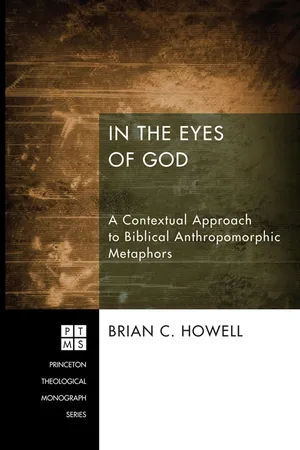
In the Eyes of God
A Contextual Approach to Biblical Anthropomorphic Metaphors
- 308 pages
- English
- ePUB (mobile friendly)
- Available on iOS & Android
eBook - ePub
About this book
Throughout the Bible, divine interaction with humanity is portrayed in almost embarrassingly human terms. He sees, hears, thinks, feels, runs, rides chariots, laughs, wields weapons, gives birth, and even repents. Many of these expressions, taken at face value, seem to run afoul of much classical theology, including divine simplicity, transcendence, omniscience, omnipotence, omnipresence, and especially immutability.
Traditionally, these texts have been seen as "accommodations" to human intellectual and moral limitations. That is, they were deemed as giving God a more approachable feel, but not as representing any "real" part of his character, being, or interaction with humanity. For example, references to God seeing or hearing are not deemed to represent real acts, as God already knows everything.
However, this view is largely based on an Aristotelian conception of metaphors as rhetorical devices, not vehicles that carry any truth content. Since the 1970s, the understanding of how metaphors convey meaning has taken great strides. These advances can help unlock how divine action--often inadvertently flattened under theological presuppositions--functions within a text.
This book aims to explore the biblical metaphor of divine sight and how current understandings of metaphorical function can enrich our reading of the text and its theology.
Information
Topic
Theology & ReligionSubtopic
Biblical Commentary1
Approaching Biblical Anthropomorphic Language
Does He who planted the ear not hear? Or the one who formed the eye, not see?
—Ps 94:9
According to Brevard Childs, “no modern theological issue which presently challenges the church is in more need of serious theological reflection from both biblical, historical, and dogmatic theology than the identity of God whom we worship.”1 This issue is also an ancient one, as we find in the Old Testament. For example, Daniel rebukes the king for honoring false, inanimate “gods,” over the God of life. He says, “You have praised the gods of silver and gold, of bronze, iron, wood and stone, which do not see, hear or understand. But the God in whose hand are your life-breath and your ways, you have not glorified”2 (Dan 5:23b). Hence, God’s ability to see, hear, and understand His creation is portrayed as a distinguishing, if not defining, attribute of His identity.
However, this verse, like so many others, speaks of God in a manner that has been viewed as problematic through its history of interpretation—in anthropomorphic terms. Robert Culver defines these: “In theology it means to represent God under the figure of human form and parts—hands, ears, eyes, etc. There is also anthropopathism, or representing God as having human passions (emotions) such as pain, fear, hate, mercy, etc., and anthropopoiesis, ascribing human actions to God.”3 It is the issue of interpreting these terms, replete through Old and New Testament descriptions of the deity, which fuels even modern debates such as that of Open or Freewill Theism.4 Most studies dealing with this issue focus on the iconological representation5 of God or on the depiction of God as a human,6 but rarely is this last topic—God’s actions7—the explicit focus.
Commonly known as “The Problem of Religious Language,” or, “The Problem of Naming God,” the conundrums these expressions create for interpreters lie between the arenas of linguistics, epistemology, and theology. In terms of linguistics, the issue lies in the capacity for language as medium to communicate the correct information about God. Are terms for humans and God used in the same sense, totally differently, or something in between? We must understand in what sense human language can be applied to a transcendent God. We seek here to determine the meaning of such language and how it might augment our picture of the biblical God.
Once we determine the sense in which our descriptions of God are to be taken, we are then faced with the question of how we can know what we say is true of God. As Frederick Ferré says, “THE FUNDAMENTAL PROBLEM for users of theological language, as seen by one theological tradition, is the avoidance, on the one hand, of anthropomorphism and, on the other, of agnosticism.”8 If we speak of a divine being in terms originating from our own sphere of life, we risk looking down the well at the proverbial mirror. Conversely, God, as Creator, has traditionally9 been viewed as transcending His creation, and hence, it is difficult to understand how human (created) language can apply to Him. That is, we must establish a basis upon which we can claim our assertions of God are veridical. Even if we determine the sense in which they are to be taken, how do we know that they even apply accurately to God?
Finally, questions are raised when a biblical reference to God seems to contradict our theological systems.10 Do we rule the statement out of order as a vestige of earlier, more naive stages of the Bible’s development? Is it simply a “manner of speaking” which requires theologically-informed interpretation to keep it in line? For example, Frederick Ferré distinguishes between anthropomorphism and vulgar anthropomorphism (anthropocentrism).11 He says of the former, “It is, however, not vulgar anthropomorphism, attributing obscene or unworthy traits to the divine. On the contrary, it is precisely by the selection of specific traits acknowledged as eminently worthy that (logically) believers may eliminate the unworthy in connection with the Most High. Without some such positive criterion, as we have seen, anything goes.”12 But how is one to develop such a criterion of which traits are “eminently” worthy?
Previously considered a clear medium of knowledge, an examination of language itself has shown that it has both sense and reference (G. Frege), as well as gathering its meaning within particular language games (L. Wittgenstein). Hence, to further establish the nature of this issue and our underlying stances towards it, we too must take a look at how language conveys meaning, its basis for making truth claims about God, and the theological issues involved in the divine-human relationship, if we are able to understand what anthropomorphic language can indicate for us. In the next section, we shall examine the major approaches to the problem of speaking of God in human language, noting the questions which inherently arise. Following this, we shall examine the basis upon which religious language can refer to the divine, and in the final section, we examine how Old Testament theology informs our approach to speaking of the divine.
Approaches to Divine Description
Thomas Aquinas lays out the three main historical approaches to describing the divine in human terms: the equivocal, univocal, and analogous. Not necessarily mutually exclusive, theologians have drawn from all of them in attempting to speak of God. In the following section, we will give a short description of each approach, noting the difficulties that arise with each approach. We will also look at an attempt to bridge these difficulties through partial-univocity, and finally, the more recent developments in metaphor theory and various theorists’ attempts to use it to fill in the gaps within the via analogia.
Equivocation
This approach was adopted by such theologians as John Damascene (674–749), Meister Eckhart (1260–1327) the German mystic preacher, the Jewish theologian Moses Maimonides (1135–1204), and Søren Kierkegaard (1813–55). It is often driven by a theology known as apophaticism, which Denys Turner describes,
It follows from the unknowability of God that there is very little that can be said about God: or rather, since most theistic religions actually have a great number of things to say about God, what follows from the unknowability of God is that we can have very little idea of what all these things said of God mean. And, strictly speaking, that is what “apophaticism” asserts, as one can tell from its Greek etymology: apophasis, is a Greek neologism for the breakdown of speech, which, in face of the unknowability of God, falls infinitely short of the mark.13
Turner further notes, “‘Apophaticism’ is the same as what the Latin tradition of Christianity called the via negativa, ‘the negative way.’”14 This is opposed to cataphatic approach, which uses much speech, from many areas of life, to describe God. As Pseudo-Dionysius, a Christian mystic writing in the fifth or sixth century, said,
What has actually to be said about the Cause of everything is this. Since it is the Cause of all beings, we should posit and ascribe to it all the affirmations we make in regard to beings, and, more appropriately, we should negate all these affirmations, since it surpasses all being. Now we should not conclude that the negations are simply the opposites of the affirmations, but rather that the cause of all is considerably prior to this, beyond privations, beyond every denial, beyond every assertion.15
Notably, “This passage directly contradicts a passage from Aristotle, who used identical terminology to argue that negations are the opposites of affirmations (On Interpretation 17a 31–33). Here at the outset and again at its conclusion (MT 5 1048B 16–21), the treatise refutes the impression that negations can capture the transcendent Cause of all.”16 Rather, he likens this process to, “sculptors who set out to carve a statue. They remove every obstacle to the pure view of the hidden image, and simply by this act of clearing aside they show up the beauty which is hidden.”17 This assumes a particular order, “not all negations concerning God are equally appropriate; the attributes to be negated are arranged in an ascending order of decreasing incongruity, first considering and negating the lowest or most obviously false statements about God and then moving up to deny those that may seem more congruous. Thus the fi...
Table of contents
- Title Page
- Acknowledgments
- Chapter 1: Approaching Biblical Anthropomorphic Language
- Chapter 2: Approaching Divine Metaphors
- Chapter 3: Theomorphism
- Chapter 4: Seeing Good and Evil—Genesis 1–3
- Chapter 5: God, the Sons of God, and the Man of God
- Chapter 6: A View to Judgment
- Chapter 7: Status and Blessing in the Sight of God
- Chapter 8: A Second Look at Sodom
- Chapter 9: The Mountain with a View
- Chapter 10: Conclusion
- Appendix A: Exegesis of Genesis 16:13–14
- Appendix B: The Righteousness of Lot
- Appendix C: Testing
- Bibliography
Trusted by 375,005 students
Access to over 1.5 million titles for a fair monthly price.
Study more efficiently using our study tools.
Frequently asked questions
Yes, you can cancel anytime from the Subscription tab in your account settings on the Perlego website. Your subscription will stay active until the end of your current billing period. Learn how to cancel your subscription
No, books cannot be downloaded as external files, such as PDFs, for use outside of Perlego. However, you can download books within the Perlego app for offline reading on mobile or tablet. Learn how to download books offline
We are an online textbook subscription service, where you can get access to an entire online library for less than the price of a single book per month. With over 1.5 million books across 990+ topics, we’ve got you covered! Learn about our mission
Look out for the read-aloud symbol on your next book to see if you can listen to it. The read-aloud tool reads text aloud for you, highlighting the text as it is being read. You can pause it, speed it up and slow it down. Learn more about Read Aloud
Yes! You can use the Perlego app on both iOS and Android devices to read anytime, anywhere — even offline. Perfect for commutes or when you’re on the go.
Please note we cannot support devices running on iOS 13 and Android 7 or earlier. Learn more about using the app
Please note we cannot support devices running on iOS 13 and Android 7 or earlier. Learn more about using the app
Yes, you can access In the Eyes of God by Brian C. Howell in PDF and/or ePUB format, as well as other popular books in Theology & Religion & Biblical Commentary. We have over 1.5 million books available in our catalogue for you to explore.