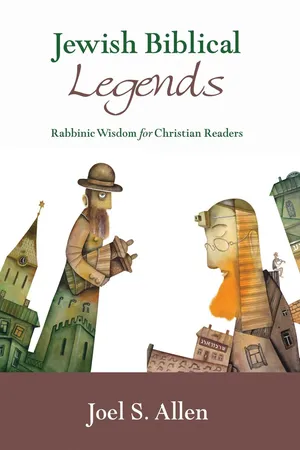
- 188 pages
- English
- ePUB (mobile friendly)
- Available on iOS & Android
eBook - ePub
About this book
This book introduces Christian readers of the Bible to the otherworldly way in which the rabbis of ancient times interpreted sacred texts. You will discover how the rabbis sought to keep their congregations engaged by telling tales, parables about the Bible. Sometimes they made up whole new background stories that do not appear in Scripture but shed light on it. They were gifted storytellers, and sometimes--almost like Doc in Back to the Future--crazy but brilliant inventers. And like Marty McFly, we can climb into this literary DeLorean and speed back to a time when sages saw things in Scripture that we could never see. Their interpretive insights were based upon immense knowledge of what we call the Old Testament. This knowledge they employed to keep the congregations engaged and informed. They may end up doing the same for us if we listen to what they have to teach us.
Information
Topic
Teologia e religioneSubtopic
Studi biblici1
The Work of Creation
The Limitations of Human Knowledge
“In the beginning . . .” (Gen 1:1).
The rabbis were concerned about fanciful philosophical speculation, which was popular in their day; flights into imagination tended toward foolish and harmful notions. These speculations were motivated, in their opinion, by pride and an unwillingness to embrace divine boundaries appropriate for the natural limitations of human knowledge. They also believed that the Scriptures were resplendent with glorious significations that go far beyond obvious grammatical meaning. Modern interpreters of Scripture are naturally suspect of these deeper mysteries; we prefer to interpret on the historical critical level alone. For us, the first question is always, “What did this text mean to the original hearers?” which is the primarily locus of meaning the text bears.26
Rabbis enjoyed much greater freedom, and the schools of midrashic study encouraged interpreters to find deeper and deeper shades of meaning in texts following some general guidelines they called middoth. The historical critical meaning of Scripture had very little interest to rabbis. So in sum, rabbis sought to suppress excessive philosophical speculation yet were enthused about a kind of midrash (biblical interpretation) that strikes moderns as quite speculative.
This tension comes into play in their interpretation of the first verse of Scripture. The Hebrew Bible begins with the word bereshit so the first letter of the Hebrew Bible is the letter “b” (or bet in Hebrew). A bet has this shape: ב. Please take a moment to examine the shape of the bet. To understand their interpretation it is also important to know that Hebrew is read from right-to-left rather than from left-to-right. That means that the open part of the bet is facing forward, not backward. Could there be any significance to the fact that the very first letter of the Holy Scripture takes this particular shape? Of course, for the rabbis the answer is a resounding Yes! The shape of the bet is intended to limit excessive philosophical speculation and to focus our attention on creation itself. These are their words.
Why was the world created using the letter ב. Just how the bet is closed on the sides and open to the front, so it isn’t permitted to investigate what is above, what is below and what is before and what is behind. But from the day the world was created and thereafter (it is permitted).27
Rabbis were primarily concerned here, more than likely, to limit the kind of neo-Platonic speculation that gave rise to heretical groups and ideas that today go by the title “gnostics” or “Gnosticism.” Gnostics were a loose association of “Christian” folk whose beliefs orthodox Christians claimed to be perverse and heretical. For the gnostics, the true God is not the Hebrew god who created this world full of suffering as it is. No, the true God is the God of Jesus, and the God of Jesus is a more spiritual and much higher deity than the low-level deity proclaimed by Moses. The gnostic God is a God of pure spirit who had nothing to do with the creation of this world nor any interest in it; he was only interested in spiritual things. This deity sought to deliver humans from their enslavement not in Egypt but from their bondage to the capricious semi-deity of Moses. This was to be achieved through secret knowledge or gnosis given by the Christ, which provides secret access to the upper ethereal realms.
Whether this particular heresy is in view or not (and it very likely is), rabbis were concerned to limit the dangers of such speculative belief-systems, and they started by noting the shape of the first letter of the holy text. Nothing happens in Scripture haphazardly or accidentally; those of true sagacity serve by discerning deeper meanings of sacred writ.
The shape of the bet indicates certain limitations of human knowledge and provides direction for our spiritual inquiry. We should not inquire about what came before the creation of the world, what is above the creation, and what is below creation. Our focus must be on the created world and our inquiry must end when the world ends (where the arms of the bet end). There is no point speculating about the world to come other than what is based in Scripture. Rabbis thought a lot about the coming world—they called it haOlam haba’—but this speculation must be limited to midrashic biblical interpretation.
Not only would gnostics be guilty here of excessive speculation concerning the future, but within Judaism itself there existed apocalyptic groups (from which Christianity sprang), which worried the rabbis as well. For instance, in the Apocalypse of Abraham Abraham is envisioned to be swept into heaven by an angel named Yahoel where Abraham sees deep into the future and provides details about the end of all things.
Rabbis found this kind of literature troublesome and untethered to any biblical foundation. The letter bet, shaped as it is, provides a clue about the limitations of human knowledge and theological inquiry; our focus must be on this created world and the time of its existence. That should keep us occupied enough. Rabbis believed that their work was to be primarily focused on what they called the halakah, which is based on the Hebrew verb “to walk.” Halakah is a legal work that intended to take what the Scriptures say (especially the 613 laws of the Torah) and spell out exactly how the godly are to walk through this life. The Talmud is essentially a commentary on an earlier collection of laws called the Mishnah. It is a very complicated collection of rabbinic legal opinions, but the point of all of it is to discern how to “walk” through this world in a way that gives honor to their good and loving Creator. Excessive speculations, enthralling though they might be, distract the community from its primary task.
The dangers of excessive philosophical speculation are echoed in Col 2:8: “See to it that no one takes you captive through hollow and deceptive philosophy, which depends on human tradition and the elemental spiritual forces of this world rather than on Christ” (NIV). Early Christian writers like Irenaeus and Origin also expressed great concern about accommodating human philosophy too much as it gave rise to heresies.28 We must remember that what is in view here is not scientific inquiry but a kind of philosophical and apocalyptic speculation that lacks the controls of rationality and common-sense. While this kind of free-wheeling world-creation might dazzle the eyes and enthrall the imagination, the rabbis here call their disciples to live in the real world where decisions must be made about mundane things like eating dinner and plowing fields. The bet is a reminder to focus the energies of life in things of mundane yet practical value. What we need, rabbis believe, is not spiritual ecstasy and high-flying mind-bogglement. Rabbis sought to apply their genius to the present world and the Torah (which they often described as being almost the same thing—the world) and find contentment there. There we can speculate within bet’s boundaries and find delights enough.
Created Out of Nothing?
“Now the earth was formless and empty and darkness covered the surface of the deep” (Gen 1:2).
The words in Hebrew translated above “formless and empty” (in Hebrew tohu va-vohu) could also be translated “waste and void.” The text seems to indicate that the material from which God created the world was inferior and faulty.29 The reason Gen 1:1–2 posed such a challenge to the rabbis is because of the intellectual challenge presented by the gnostics. For gnostics, the fact that the creator fashioned the world out of inferior construction materials (tohu va vohu) explains all the sufferings of the life. They claimed that the creator must be either malicious or weak and ignorant. If God didn’t realize the pain caused by creating such an inferior world of degraded products then God is a fool. If God intentionally chose to create using the tohu and the vohu then God is malicious. Either way, the gnostics believed that the Hebrew Scriptures provided ample reason to reject the creator of this world and so worship the gnostic deity of pure spirit.
R. Eleazar responds by quoting a passage in Ecclesiasticus (or Sirach—abbreviated Sir), which encourages a humility that limits its own range of inquiry to questions of Jewish law and refrains from philosophical speculation. Sir 3:21–22 (NRSV) says: “Neither seek what is too difficult for you, nor investigate what is beyond your power. Reflect upon what you have been commanded, for what is hidden is not your concern.30” Eleazar illustrates Ben Sira’s limitation of inquiry—and thus the critique of gnostic speculation—with the following parable.
This is like a king who built a palace on top of piles of feces, sewers, and garbage dumps. Everyone who came along would say, “This palace was built on poop piles, sewage and garbage!” They wouldn’t necessarily devalue the property, would they? That’s the way it is when someone comes along and says, “The world was constructed on tohu va vohu!” They aren’t necessarily likely to devalue the creation, are they?31
R. Eleasar’s parable supposes, for the sake of the argument, that God did create the world out of or on top of pre-existent worthless matter. The rabbis would prefer to interpret the text so as to make creation ex nihilo its true meaning.32 But the Rabbis knew that the Hebrew could naturally be read so that the tohu va vohu was at least c...
Table of contents
- Title Page
- Foreword
- Acknowledgments
- Introduction
- Chapter 1: The Work of Creation
- Chapter 2: The Serpent and Sin
- Chapter 3: The World after Sin
- Chapter 4: Abraham, Our Father
- Chapter 5: Jacob and Esau
- Chapter 6: Israel in Egypt
- Chapter 7: The Plundering of Egypt
- Chapter 8: At the Sea and Beyond
- Chapter 9: Moses, Torah, and Sinai
- Chapter 10: The Ethics of the Fathers
- Glossary
- Bibliography
Trusted by 375,005 students
Access to over 1.5 million titles for a fair monthly price.
Study more efficiently using our study tools.
Frequently asked questions
Yes, you can cancel anytime from the Subscription tab in your account settings on the Perlego website. Your subscription will stay active until the end of your current billing period. Learn how to cancel your subscription
No, books cannot be downloaded as external files, such as PDFs, for use outside of Perlego. However, you can download books within the Perlego app for offline reading on mobile or tablet. Learn how to download books offline
Perlego offers two plans: Essential and Complete
- Essential is ideal for learners and professionals who enjoy exploring a wide range of subjects. Access the Essential Library with 800,000+ trusted titles and best-sellers across business, personal growth, and the humanities. Includes unlimited reading time and Standard Read Aloud voice.
- Complete: Perfect for advanced learners and researchers needing full, unrestricted access. Unlock 1.5M+ books across hundreds of subjects, including academic and specialized titles. The Complete Plan also includes advanced features like Premium Read Aloud and Research Assistant.
We are an online textbook subscription service, where you can get access to an entire online library for less than the price of a single book per month. With over 1.5 million books across 990+ topics, we’ve got you covered! Learn about our mission
Look out for the read-aloud symbol on your next book to see if you can listen to it. The read-aloud tool reads text aloud for you, highlighting the text as it is being read. You can pause it, speed it up and slow it down. Learn more about Read Aloud
Yes! You can use the Perlego app on both iOS and Android devices to read anytime, anywhere — even offline. Perfect for commutes or when you’re on the go.
Please note we cannot support devices running on iOS 13 and Android 7 or earlier. Learn more about using the app
Please note we cannot support devices running on iOS 13 and Android 7 or earlier. Learn more about using the app
Yes, you can access Jewish Biblical Legends by Joel S. Allen in PDF and/or ePUB format, as well as other popular books in Teologia e religione & Studi biblici. We have over 1.5 million books available in our catalogue for you to explore.