eBook - ePub
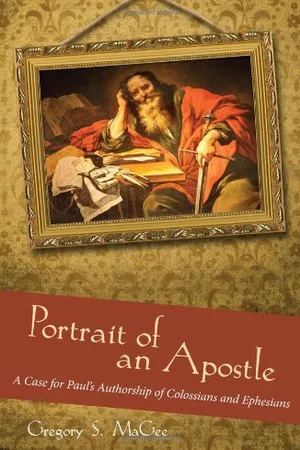
Portrait of an Apostle
A Case for Paul’s Authorship of Colossians and Ephesians
- 212 pages
- English
- ePUB (mobile friendly)
- Available on iOS & Android
eBook - ePub
About this book
In Portrait of an Apostle Greg MaGee explores the claim that Colossians and Ephesians are works of forgery that use Paul's authoritative status to gain a hearing. This hypothesis is so often restated in recent scholarship that it is arguably the default position in the field, even though the theory is relatively untested. MaGee argues that such a view does not stand up to close scrutiny. Unsuccessful attempts to imitate Paul usually flounder in their portrayals of Paul, as is evident with the pseudepigraphal Epistle to the Laodiceans and 3 Corinthians. Such is not the case with Colossians and Ephesians. This book attempts to demonstrate that interpretations based on the assumption of Paul's authorship of Colossians and Ephesians are consistently superior to interpretations positing that an admirer of Paul wrote the letters.
Information
1
The Emergence of the Exalted Apostle Theory
An Untested Theory
This book challenges the popular theory that in Colossians and Ephesians a well-meaning imitator, perhaps as part of an informal “school of Paul,” attempts to speak using Paul’s authoritative voice. This is a hypothesis that is so often restated in recent scholarship that it is arguably the default position in the field, even though the theory is relatively untested. The widely held judgment is that Paul is portrayed as an exalted, idealized apostle and prisoner in Colossians and Ephesians. Intrinsic to this position is that Paul himself did not write Colossians and Ephesians, at least not in their canonical forms. Rather, according to this view, admirers of Paul adopted a stereotyped picture of Paul in order to speak with his perceived authority in current settings. This theory, which in this book will be referred to as the “Exalted Apostle Theory,” has been propagated in a variety of studies in recent decades.
J. Christiaan Beker, for instance, points to the “exalted view of Paul” and his “heroic status” in Colossians, while in Ephesians Paul is “a figure whose authority and stature have increased enormously over time” since Paul’s death.1 According to Martinus de Boer, the persona of Paul in both Colossians and Ephesians arises out of “a developing legend of Paul.”2 David Meade contends that the Paul in Ephesians has been presented as “an archetypical figure,”3 and Andrew Lincoln sees Eph 3:1–13 as “a device” used in order to “boost claims for the authority of the apostle’s teachings for a later time.”4 According to Leander Keck, Paul “strikes an Olympian pose” in Ephesians.5 For Colossians, Eduard Lohse provides this assessment: “[T]he concern is only with Paul’s office, and no indication exists of a mention of the rest of the apostles, neither Peter nor the Twelve. Paul is, as the Apostle to the nations, the one and only Apostle.”6 Charles Nielsen contends that the author of Colossians is “elevating the status of Paul to astonishing heights.”7 These excerpts are representative of a perspective that has been gaining a foothold in modern studies on Colossians and Ephesians.
This book seeks to answer the claim that Colossians and Ephesians present an elevated image of Paul and employ this image to buttress the letters’ authority. It will be proposed that such a view does not stand up to close scrutiny. Instead, Colossians and Ephesians reflect Paul’s own understanding of his apostolic identity and ministry in a way that is consistent with the earlier letters that bear his name.
The test of any viable theory of authorship for these letters lies in the credibility of the interpretations it yields for the letters. This monograph seeks to show that interpretations based on the assumption of Paul’s authorship of Colossians and Ephesians are consistently superior to interpretations positing that an admirer of Paul wrote the letters. The book thus reflects the method of historical interpretation, accompanied by an analysis of the literary relationship between works (specifically, identifying or ruling out literary dependence).
This study will look at how texts correlate with other texts that preceded them. Selected works are divided into three distinct categories. The first group consists of Paul’s undisputed letters, which are Romans, 1 and 2 Corinthians, Galatians, Philippians, 1 Thessalonians, Philemon. Certain letters universally recognized as being written in Paul’s name but after the time of Paul constitute the second group. The two pseudepigraphal works Epistle to the Laodiceans (Ep. Lao.) and Third Corinthians (3 Cor.) are examples of letters from early Christianity that draw on Paul’s perceived authoritative status and allot a significant percentage of the material to relaying a credible identity for Paul. The incorporation of Paul’s identity in these letters is thus comparable to what proponents of the Exalted Apostle Theory allege for Colossians and Ephesians. The third category is comprised of the letters in question, Colossians and Ephesians. The approach of this study is to use the first group to establish Paul’s understanding of his ministry and then to compare and contrast how the second and third groups adopt or reflect the themes and language of the letters from the first group.8
The focal point of investigation lies in the sections of discourse in which Paul’s self-understanding as a minister is put forward. A successful pseudepigrapher would need to speak convincingly as Paul in those sections in order to gain a hearing in the rest of the letter. As a result, unsuccessful attempts to imitate Paul usually flounder here, as in the case of the pseudepigraphal Epistle to the Laodiceans and 3 Corinthians. Passages describing Paul’s ministry and calling in Colossians and Ephesians, on the other hand, stand up to rigorous scrutiny and reflect the creative and authoritative mind of Paul himself.
Comparisons among letters in the three different categories will involve attention to connections in themes, language, and context. Thematically, the complex interplay between Paul’s authority and suffering in the undisputed letters will be analyzed, along with the formative influence of the Old Testament and Paul’s Damascus experience on his sense of calling. Then, letters from the second and third categories will be examined to see whether they conform to the complex overall picture of Paul’s apostleship as found in the undisputed letters. For language, w...
Table of contents
- Title page
- Chapter 1: The Emergence of the Exalted Apostle Theory
- Chapter 2: Paul’s Identity in the Undisputed Letters
- Chapter 3: Imitation of Paul in the Epistle to the Laodiceans and 3 Corinthians
- Chapter 4: Paul’s Identity in Colossians
- Chapter 5: Paul’s Identity in Ephesians
- Chapter 6: A Better Way
- Bibliography
Trusted by 375,005 students
Access to over 1.5 million titles for a fair monthly price.
Study more efficiently using our study tools.
Frequently asked questions
Yes, you can cancel anytime from the Subscription tab in your account settings on the Perlego website. Your subscription will stay active until the end of your current billing period. Learn how to cancel your subscription
No, books cannot be downloaded as external files, such as PDFs, for use outside of Perlego. However, you can download books within the Perlego app for offline reading on mobile or tablet. Learn how to download books offline
We are an online textbook subscription service, where you can get access to an entire online library for less than the price of a single book per month. With over 1.5 million books across 990+ topics, we’ve got you covered! Learn about our mission
Look out for the read-aloud symbol on your next book to see if you can listen to it. The read-aloud tool reads text aloud for you, highlighting the text as it is being read. You can pause it, speed it up and slow it down. Learn more about Read Aloud
Yes! You can use the Perlego app on both iOS and Android devices to read anytime, anywhere — even offline. Perfect for commutes or when you’re on the go.
Please note we cannot support devices running on iOS 13 and Android 7 or earlier. Learn more about using the app
Please note we cannot support devices running on iOS 13 and Android 7 or earlier. Learn more about using the app
Yes, you can access Portrait of an Apostle by Gregory S. MaGee in PDF and/or ePUB format, as well as other popular books in Theology & Religion & Biblical Criticism & Interpretation. We have over 1.5 million books available in our catalogue for you to explore.