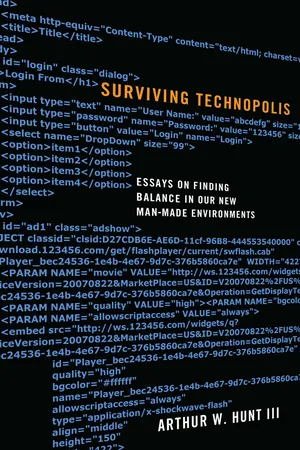
eBook - ePub
Surviving Technopolis
Essays on Finding Balance in Our New Man-Made Environments
- 128 pages
- English
- ePUB (mobile friendly)
- Available on iOS & Android
eBook - ePub
About this book
Technopolis has no end in view other than bigger, faster, newer, and more. While giving us many material benefits--at least in the short run--in its wake are spiritual loss, alienation, and devastation. These essays not only evaluate Technopolis, but also seek wisdom to cope with our new human-made environments. Positively stated, they offer suggestions on how to bring us back into balance. Some of our best wisdom in analyzing Technopolis can be found in the voices of the Christian humanists. Unlike Enlightenment humanism, which tends to be human-centered, Christian humanism is concerned with the role of humankind within God's created order. G. K. Chesterton, T. S. Eliot, J. R. R. Tolkien, and C. S. Lewis represent this tradition. They, and others like them, understood that technological progress with no clear telos obscures what Eliot called "the permanent things." Surviving Technopolis means restoring the things closest to us--those old identity-forming institutions of home, church, and community.
Information
Topic
PhilosophySubtopic
Ethics & Moral Philosophy1
Remembering Marshall McLuhan
The Probes of the Media Guru Are Still Relevant for Us Today
Unlike previous environmental changes, the electric media constitute a total near instantaneous transformation of culture, values, and attitudes.
—Marshall McLuhan1
Shortly after publishing Understanding Media in 1964, Marshall McLuhan appeared before a New York audience and casually predicted the invention of the iPhone headset: “There might come a day when we [will] . . . all have portable computers, about the size of a hearing aid, to help us mesh our personal experience with the experience of the great wired brain of the outer world.”2 The great wired world of which he spoke came to be more commonly referred to as the global village, a term he coined, and by which he meant electronic interdependence. McLuhan anticipated that all electronic media, taken together, would restructure the world as we know it. Information would flow instantaneously from one situation to another, from every quarter of the earth, so that the globe would become a small village-like affair. In this new environment, whatever happens to anybody happens to everybody.3 He saw it as the externalization of the human subconscious on a global scale, and it was coming together in his lifetime. He said soon the “new society will be one mythic integration, a resonating world akin to the old tribal echo chamber where magic will live again; a world of ESP.”4 The year 2011 marked the media guru’s one-hundredth birthday. Had he not died in 1980, he no doubt would be on Oprah today saying, “I told you this was coming.”
McLuhan believed the only way to survive a world predicated on constant change was to stand back and scrutinize its patterns. His methodology was a matter of seeing, and he compared what he was doing to Edgar Allen Poe’s “A Descent into the Maelstrom.” In Poe’s story a sailor is caught in the tentacles of a swirling vortex. While pondering his fate, the sailor notices how some objects remained at the surface and were not affected by the current. The sailor secures himself to a barrel, abandons his boat, and saves himself from drowning.
Like the sailor in Poe’s story we also must learn to stand outside the remarkable forces that swirl around us and ponder their effects. Only then can we keep ourselves from being sucked down into an electronic vortex. McLuhan liked to call his observations “probes”—announcements and predictions about pattern change that often went unnoticed by society at large—unnoticed because moderns tend to embrace all technological change without thinking very hard about its unintended consequences. Those who are already familiar with McLuhan are still deciphering the profundity of these probes. Others are amazed at how he shrewdly anticipated the arrival of the global village. McLuhan’s probes are just important today as they were when he first pronounced them—more important really—because our attention spans have not gotten any longer.
Marshall McLuhan, What Were You Doin’?
McLuhan was born into a Protestant family but converted to Catholicism as a young man. He would have been content to have been born during the Middle Ages, but providence placed him in the twentieth century where he became an astute observer of change. He earned his PhD from the University of Cambridge, fashioning himself as a literary scholar. The rejection of his religious heritage (he was raised Baptist) was due in part to his disappointment with what he thought Protestant culture had produced. He was influenced early-on by Old World Catholic G. K. Chesterton whose sharp pen criticized the Protestant tendency to embrace all things new in the name of “progress.” By the time he reached Cambridge he confessed to his mother that everything that was “especially hateful and devilish and inhuman about the conditions and strains of modern industrial society is not only Protestant in origin, but their boast (!) to have originated it.”5 McLuhan was appalled at American utilitarianism. “The Americans serve ‘service,’” he wrote to his mother. “Like the rest of the world they have smothered man and men and set up the means as the end.”6
Although Canadian born, his first teaching positions were in America where he soon realized that his students were more influenced by advertising, comic books, and movies than anything he might offer in the way of Dickens or Hawthorne. The divide between his world and theirs astonished him, so he took it upon himself to infuse popular culture into the subjects he taught, the goal being to make his students grasp the type of influence he thought the commercial world was exerting over them.
Not everyone saw what McLuhan saw. After the publishing of The Gutenberg Galaxy in 1962, and Understanding Media two years later, he threw down a public gauntlet saying electronic communication would undo the old print society. Heads started to turn. His meteoric rise was due in part to his uncanny ability to deliver mouth-dropping one-liners. He said things like Blondie was emasculating Dagwood in front of Cookie and Alexander—proof the American male had been reduced to a shell.7 He told Playboy magazine in 1969 that the day of political democracy was over. He said peculiar things like, “The Finn cycle of tribal institutions can return in the electric age, but if again, then let’s make it a wake or awake or both.”8 (This particular quotation alludes to James Joyce’s Finnegans Wake, a work McLuhan embraced as paralleling his own understanding of human communication and its cyclical view of history.) Statements like these made him a charlatan to some and a genius to others. Henry Gibson of Laugh-In looked into the television camera and asked, “Marshall McLuhan, what are you doin’?”
Early in his career McLuhan was unafraid to make moral pronouncements, but as his star shot above the cultural horizon he was more reluctant to comment on the “goodness” or “badness” of what he was talking about. Anyone who reads The Mechanical Bride (1951) can sense a certain animosity toward the ravishing power of industrialism and its chief agent, modern advertising. Interestingly, he would not let his own children watch more than one hour of television per week.9 One of his biographers says that his study of media was almost an act of revenge for what it was doing to his family, to him, and the world.10 As a result, he developed a personae that made him appear to be above the cultural convulsions that were occurring with the new media. Hence he became a self-proclaimed observer, detached from his subject. He had learned from James Joyce that oracles are not supposed to take sides.11
In reviewing Understanding Media Harold Rosenberg remarked, “In his latest mood, he [McLuhan] regards most of what is going on today as highly desirable, all of it meaningful.”12 In his interview with Playboy McLuhan said that until he had written The Mechanical Bride, he had adopted an “extremely moralistic approach to all environmental technology,”13 and then added that he was not “advocating anything.” “I am merely probing and predicting trends. Even if I opposed them or thought them disastrous, I couldn’t stop them, so why waste my time lamenting?”14
Since McLuhan was underscoring the importance of the new electronic media, television gladly embraced him. He rubbed shoulders with the corporate world, advising businesses on the media they sought to harness. But perhaps more than anything, his popularity was due to the fact he was offering answers—even if they were off-the-wall answers—during turbulent times when political assassinations, campus riots, and a sexual revolution were making headlines. Journalists elevated him to the status of a sage, calling him everything from “media guru” to “oracle of the electronic age.” More recently, Wired Magazine made him its “patron saint.”
McLuhan was boldly unconventional.15 He never really made “scientific claims” about anything. He preferred to toss his probes like grenades. He did not persuade his audience; he ...
Table of contents
- Title Page
- Foreword
- Acknowledgments
- Introduction
- Chapter 1: Remembering Marshall McLuhan
- Chapter 2: Neil Postman and the Evangelicals
- Chapter 3: The Image Versus the Word—Old Story, New Twist
- Chapter 4: Why I Am Not Going to Teach Public Speaking Online
- Chapter 5: Progress
- Chapter 6: What’s a Person to Do?
- Chapter 7: Oikos
- Chapter 8: Back to the Shire
- Permissions and Credits
- Bibliography
Trusted by 375,005 students
Access to over 1.5 million titles for a fair monthly price.
Study more efficiently using our study tools.
Frequently asked questions
Yes, you can cancel anytime from the Subscription tab in your account settings on the Perlego website. Your subscription will stay active until the end of your current billing period. Learn how to cancel your subscription
No, books cannot be downloaded as external files, such as PDFs, for use outside of Perlego. However, you can download books within the Perlego app for offline reading on mobile or tablet. Learn how to download books offline
Perlego offers two plans: Essential and Complete
- Essential is ideal for learners and professionals who enjoy exploring a wide range of subjects. Access the Essential Library with 800,000+ trusted titles and best-sellers across business, personal growth, and the humanities. Includes unlimited reading time and Standard Read Aloud voice.
- Complete: Perfect for advanced learners and researchers needing full, unrestricted access. Unlock 1.5M+ books across hundreds of subjects, including academic and specialized titles. The Complete Plan also includes advanced features like Premium Read Aloud and Research Assistant.
We are an online textbook subscription service, where you can get access to an entire online library for less than the price of a single book per month. With over 1.5 million books across 990+ topics, we’ve got you covered! Learn about our mission
Look out for the read-aloud symbol on your next book to see if you can listen to it. The read-aloud tool reads text aloud for you, highlighting the text as it is being read. You can pause it, speed it up and slow it down. Learn more about Read Aloud
Yes! You can use the Perlego app on both iOS and Android devices to read anytime, anywhere — even offline. Perfect for commutes or when you’re on the go.
Please note we cannot support devices running on iOS 13 and Android 7 or earlier. Learn more about using the app
Please note we cannot support devices running on iOS 13 and Android 7 or earlier. Learn more about using the app
Yes, you can access Surviving Technopolis by Arthur W. Hunt III in PDF and/or ePUB format, as well as other popular books in Philosophy & Ethics & Moral Philosophy. We have over 1.5 million books available in our catalogue for you to explore.