eBook - ePub
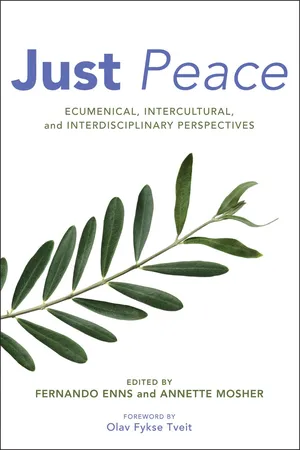
Just Peace
Ecumenical, Intercultural, and Interdisciplinary Perspectives
- 226 pages
- English
- ePUB (mobile friendly)
- Available on iOS & Android
eBook - ePub
Just Peace
Ecumenical, Intercultural, and Interdisciplinary Perspectives
About this book
Christian theology and ethics have wrestled with the challenge to apply Jesus's central message of nonviolence to the injustices of this world. Is it not right to defend the persecuted by using violence? Is it unjust if the oppressed defend themselves--if necessary by the use of violence--in order to liberate themselves and to create a more just society? Can we leave the doctrine of the just war behind and shift all our attention toward the way of a just peace?
In 2011 the World Council of Churches brought to a close the Decade to Overcome Violence, to which the churches committed themselves at the beginning of the century. Just peace has evolved as the new ecumenical paradigm for contemporary Christian ethics. Just peace signals a realistic vision of holistic peace, with justice, which in the concept of shalom is central in the Hebrew Bible as well as in the gospel message of the New Testament.
This paradigm needs further elaboration. VU University gathered peacebuilding practitioners and experts from different parts of the world (Africa, Latin America, North America, Asia, and Europe) and from different disciplines (anthropology, psychology, social sciences, law, and theology)--voices from across generations and Christian traditions--to promote discussion about the different dimensions of building peace with justice.
Information
Topic
Theology & ReligionSubtopic
Christian ChurchPart One
Developing Theologies of Just Peace in Light of Violence and Injustice
1
Towards an Ecumenical Theology of Just Peace
“Glory to God and Peace on Earth!”
Glory to God—and Peace on Earth!”3 This was the biblical motto of the recent International Ecumenical Peace Convocation (IEPC) of the World Council of Churches (WCC). It is most appropriate to begin any theological and ethical reflection on peace and justice (“Peace on Earth”) by the doxology “Glory to God!”
One thousand participants from more than one hundred nations gathered on the campus of the University of the West Indies (Mona) in Kingston, Jamaica, during the week of 17–25 May 2011. As a truly ecumenical gathering, representing churches from all traditions, including the Roman Catholic Church and some Pentecostal communities, we confessed our common understanding: “We understand peace and peacemaking as an indispensable part of our common faith. Peace is inextricably related to the love, justice and freedom that God has granted to all human beings through Christ and the work of the Holy Spirit as a gift and vocation. It constitutes a pattern of life that reflects human participation in God’s love for the world.”4 To accept the gift (or grace) of peace as a common vocation of the church worldwide and as a central expression of our common faith in the triune God is a milestone in a long ecumenical journey.5
This global peace convocation marked the culmination of the ecumenical “Decade to Overcome Violence: Churches Seeking Reconciliation and Peace. 2001–2010,” which was decided upon by the VIII Assembly of the WCC in Harare/Zimbabwe in 1998. One of the goals of that decade was to “move peace-building from the periphery to the centre of the life and witness of the church.”6 For the past ten years churches throughout the world—often with partners from other religions and from the secular realm—have been determinedly engaged in investigating and exploring possibilities for violence prevention, nonviolent methods of conflict resolution, civil forms of conflict management, training of civilian peacemakers, and active work for reconciliation after recourse to violence. Universities and seminaries have contributed their insights from research and think tanks. All these activities have often been summed up as “developing cultures of peace.”7
And yet, we are not satisfied. How could we be? There is such an extensive field of injustices as ongoing obstacles for peace. The peace convocation tried to identify the wide range of direct/personal violence, indirect/structural violence, as well as cultural forms of violence.
Peace in the Community8
Violence in our communities has many ugly faces. We have listened to the voices of struggle within communities and neighborhoods in one of the most violent capitols of the world—Kingston. Young people are killed on the streets every single night. We have met courageous people who are inventing new steps towards community building by creating safe spaces. For example, theatre plays are initiated with children, which allows them to express their sorrows and joys. Together, churches now clearly see that “peace education must move to the centre of every curriculum in schools, seminaries and universities.”9 This education is “a profoundly spiritual formation of character that involves family, church, and society . . . Peace education promotes active nonviolence as an unequalled power for change that is practiced and valued in different traditions and cultures.”10
Peace in Economic Relations11
We have listened again to the witnesses of dehumanizing poverty—in Zimbabwe, for example. The churches’ message from Kingston is clear: “The global economy . . . provides many examples of structural violence that victimizes not through the direct use of weapons or physical force but by passive acceptance of widespread poverty, trade disparities and inequality among classes and nations.”12 The Bible—in contrast—signals a vision of life with “abundance for all,” and therefore the churches are starting to advocate for alternative “economies of life”13 that are inclusive, respecting everyone’s dignity and allowing fair participation for all. As Jürgen Moltmann pointed out so clearly during our conference in Amsterdam: “The alternative to poverty is not property; the alternative to poverty and property is community, and the spirit of community is solidarity and mutual help.”14
Peace with the Environment15
The representatives from the Pacific region informed us about how seriously climate change calls their very existence into question: some are starting to leave their homes because their islands are flooded. We have listened to the voices from Fukushima, Japan, who described their anger and fear. They reminded us of the atomic hell of Hiroshima.16 “To care for God’s precious gift of creation and to strive for ecological justice are key principles of just peace,”17 the Convocation affirmed (cf. Genesis 2:4b–9). We noticed, that “the environmental crisis is profoundly an ethical and spiritual crisis of humanity . . . Natural resources and common goods such as water must be shared in a just and sustainable manner.”18
Peace among Peoples19
“We witness with concern and compassion the struggle for freedom, justice, and human rights of the people in many Arab countries . . . Our love for the peoples of Israel and Palestine convinces us that the continued occupation damages both peoples.”20 With a common voice the churches acknowledge: “History, especially in the witness of the historic peace churches, reminds us of the fact that violence is contrary to the will of God and can never resolve conflicts. It is for this reason that we are moving beyond the doctrine of just war towards a commitment to Just Peace.”21 But we are just beginning to see that this requires moving from exclusive concepts of national security to an understanding of safety for all. All of us continue to struggle with how innocent people can be protected from injustice, war, and violence since we are convinced of our “responsibility to protect” them.22 “The Way of Just Peace is fundamentally different from the concept of ‘jus...
Table of contents
- Title Page
- Foreword
- Introduction
- Part One: Developing Theologies of Just Peace in Light of Violence and Injustice
- Chapter 1: Towards an Ecumenical Theology of Just Peace
- Chapter 2: On A Culture of Life in the Dangers of This Time
- Chapter 3: Just Peace and the Unity of the Church
- Chapter 4: Theology and theosis after the Gulag
- Part Two: In the Midst of War, Violence, and Lies—Creating Space for Peace
- Chapter 5: Genocide, ‘Responsible Outsiders,’ and the Truth
- Chapter 6: On the Necessity of Daydreaming
- Chapter 7: Creating Space for Peace
- Chapter 8: Christian Peacemaker Teams
- Part Three: Truth, Forgiveness, and Reconciliation—Restoring Justice
- Chapter 9: Peace Needs Justice
- Chapter 10: Reading for Reconciliation
- Chapter 11: Transcending the Dictates of Prosecutorial Justice
- Chapter 12: Justice and Peace within Restorative Justice
- Chapter 13: Forgiveness in the Face of Tragedy
- Contributors
Trusted by 375,005 students
Access to over 1.5 million titles for a fair monthly price.
Study more efficiently using our study tools.
Frequently asked questions
Yes, you can cancel anytime from the Subscription tab in your account settings on the Perlego website. Your subscription will stay active until the end of your current billing period. Learn how to cancel your subscription
No, books cannot be downloaded as external files, such as PDFs, for use outside of Perlego. However, you can download books within the Perlego app for offline reading on mobile or tablet. Learn how to download books offline
Perlego offers two plans: Essential and Complete
- Essential is ideal for learners and professionals who enjoy exploring a wide range of subjects. Access the Essential Library with 800,000+ trusted titles and best-sellers across business, personal growth, and the humanities. Includes unlimited reading time and Standard Read Aloud voice.
- Complete: Perfect for advanced learners and researchers needing full, unrestricted access. Unlock 1.5M+ books across hundreds of subjects, including academic and specialized titles. The Complete Plan also includes advanced features like Premium Read Aloud and Research Assistant.
We are an online textbook subscription service, where you can get access to an entire online library for less than the price of a single book per month. With over 1.5 million books across 990+ topics, we’ve got you covered! Learn about our mission
Look out for the read-aloud symbol on your next book to see if you can listen to it. The read-aloud tool reads text aloud for you, highlighting the text as it is being read. You can pause it, speed it up and slow it down. Learn more about Read Aloud
Yes! You can use the Perlego app on both iOS and Android devices to read anytime, anywhere — even offline. Perfect for commutes or when you’re on the go.
Please note we cannot support devices running on iOS 13 and Android 7 or earlier. Learn more about using the app
Please note we cannot support devices running on iOS 13 and Android 7 or earlier. Learn more about using the app
Yes, you can access Just Peace by Fernando Enns,Annette Mosher, Enns, Mosher in PDF and/or ePUB format, as well as other popular books in Theology & Religion & Christian Church. We have over 1.5 million books available in our catalogue for you to explore.