- 150 pages
- English
- ePUB (mobile friendly)
- Available on iOS & Android
eBook - ePub
About this book
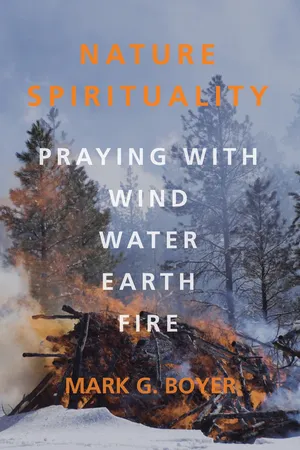
The presence of the Divine is everywhere. That is both a comfort and a challenge. We are consoled to know that God is with us, but being human we need a sign, something to touch, see, hear, taste, smell. We need something of the ordinary to name the non-touchable, invisible, unable-to-be-heard, tasteless, odorless God's presence with us. So, we employ metaphors, figures of speech which literally denote one kind of object in place of another, to suggest a likeness or analogy. In this book, the metaphors used for God come out of the Bible; they are the four elements of nature for the Greeks: wind, water, earth, and fire. Wind is a metaphor for God's Spirit. Water refers to God as the source of life. Earth, from which we are created, bears God's fingerprints and footprints. And fire reminds us of the God who purifies and draws all creation to himself. This nature spirituality book consists of four chapters--wind, water, earth, fire--each of which contains twenty, four-part exercises of prayer: a few verses from Scripture, a reflection, a journal exercise, and a concluding prayer.
Information
Topic
Teología y religiónSubtopic
Estudios bíblicos
Wind
The Spirit is like the wind that blows wherever it wants to.You can hear the wind, but you don’t know where it comes from or where it is going.
—John 3:8
A Mighty Wind
Scripture: On the day of Pentecost all the Lord’s followers were together in one place. Suddenly there was a noise from heaven like the sound of a mighty wind! It filled the house where they were meeting (Acts 2:1–2).
Reflection: The Hebrew word for wind, “ruah,” is translated into Greek as “pneuma.” There is no adequate single word in English to render either of these words. In their own languages they are layered in meaning, sometimes referring to the movement of air, breath, or spirit. However, common to all the meanings assigned to “ruah” and “pneuma” is the divine dynamic activity by which God accomplishes what the Mighty One desires. This is the creative or giving-birth dimension of God.
The author of the Acts of the Apostles portrays God giving birth to the church through the wind. Jesus’ followers are huddled together in a womb-like room. God takes control of them, filling them with the breath of enthusiasm and putting words in their mouths that they would never have dreamed of saying. They leave the security of their place of gestation and begin preaching the message of the risen Christ throughout the world. The mighty wind of God gives birth to the church.
God’s use of wind to give birth is nothing new. The Genesis story-teller says that in the beginning, when God created the heavens and the earth, “The earth was barren, with no form of life; it was under a roaring ocean covered with darkness. But the Spirit of God was moving over the water” (1:2). Some Bibles say that “a mighty wind was moving over the water.” The barren earth is like a woman’s womb ready to give birth to life. God gives birth to everything through the mighty wind. The movement of the air, breath, makes everything alive. It is the Spirit that fecundates, animates, all of creation.
The creative wind of God appears again after the great flood. The Book of Genesis says: “God did not forget about Noah and the animals with him in the boat. So God made a wind blow, and the water started going down” (8:1). The wind dries the earth, Noah and the animals emerge from the ark, and a new creation begins. The Spirit of God has breathed life everywhere. God has given birth once again.
The wind or breath or spirit of God continues to give birth to life. The warm winds melt the snows and uncover the earth every year as creation is born anew. The control of breathing is taught to pregnant women in preparation for the birth of their children. God is a mighty wind in our lives—blowing us from one career to another, generating new ideas in our minds, filling us every second of every day with the breath of life—accomplishing what God desires.
Journal: In what ways has God been a mighty wind in your life? How have you been re-created? In what ways do you perceive God filling the church with a mighty wind today?
Prayer: Creating God, in your wisdom you have made the earth full of your creatures, which you fill with the breath of life. Send forth your Spirit to renew the face of the earth and to guide me in the ways of your Son, Jesus Christ, who is Lord for ever and ever. Amen.

Breath of Life
Scripture: The LORD God took a handful of soil and made a man. God breathed life into the man, and the man started breathing. . . . The LORD God made him fall into a deep sleep, and he took out one of the man’s ribs. Then after closing the man’s side, the LORD made a woman out of the rib (Genesis 2:7, 21–22).
Reflection: In the second story of creation, which is older than the first, God resembles a potter, sitting at the wheel, throwing clay into all types of shapes and forms. Once the clay is molded, however, God breathes on it, and it comes alive. God blows into it the breath of life, the spirit that animates it, the wind that distinguishes it from that which is dead. Once a clay figurine begins to breathe, it continues to inhale and exhale, feasting on God’s Spirit, until it returns to the soil from which it was made.
Long before machines were invented to measure heartbeats and brain waves ancient cultures used breath to determine whether or not a person was still alive. A feather from the down of a fowl would be placed under the nose of an unconscious person. If the feather moved, the individual was declared to be full of spirit. If the tuft stayed in place, the breath of life had departed, and the person was dead. Since there is some moisture exhaled in the process of respiration, a mirror or other glass often was placed under an incognizant person’s nose. If a fog appeared on the glass, the individual was alive. If there were no fog, death had stolen the breath of life from him or her.
The author of John’s Gospel applies the Genesis metaphor of God breathing life into God’s clay figures to Jesus in two ways. The author of the Fourth Gospel states: “The disciples were afraid . . . , and . . . they locked themselves in a room. Suddenly, Jesus appeared in the middle of the group. He greeted them and showed them his hands and his side. When the disciples saw the Lord, they became very happy. After Jesus had greeted them again, he said, ‘I am sending you just as the Father has sent me.’ Then he breathed on them and said, ‘Receive the Holy Spirit’” (John 20:19–22).
First, Jesus is alive. He is full of the breath of life, the Spirit of God. He has been raised from the dead by God, who did for Jesus what God did for the first man and woman he had created: God breathed life into him. Second, Jesus breathes life into his followers, who are dead in fear and all huddled together behind locked doors. Jesus’ breath is so violent that it blows open the doors and sends the disciples into the world to continue his work. They, like him, are filled with the very life of God, the Holy Spirit.
Every inhalation, every exhalation recalls the memory of God blowing breath into creation and of God re-creating in and through the resurrection of Jesus Christ. The windy Spirit of God animates all of our days and nights.
Journal: When have you been dead and God has breathed new life into you? In what ways has the Spirit animated you?
Prayer: Living God, you not only fill me with life, but you re-create me in the image of Jesus. I join everything that breathes in praising you through Christ, whom you raised from the dead and lives for ever and ever. Amen.
•
No Breath
Scripture: For forty days the rain poured down without stopping. And the water became deeper and deeper, until the boat started floating high above the ground. The LORD destroyed everything that breathed. Nothing was left alive except Noah and the others in the boat (Genesis 7:17, 22–23).
Reflection: The God of the Book of Genesis who first breathes the breath of life into all of the Holy One’s clay figurines also takes it away with the great flood. The spirit that animates God’s creation is washed away. Only the patriarch Noah, his family, and the creatures he has captured in the boat remain filled with the wind of life.
Without breath, people are like statutes waiting to be carved from a marble block. Breathing spirit-air makes persons like God. However, when they cease to live like God, their breath is removed. When sin has scared the earth, God sends the flood which turns clay figurines into mud. They no longer have distinctive shapes; they no longer have the breath of life in them.
Having the breath of life within is how we tell the difference between the true God and false gods. Idols do not breathe. They are sculptures of stone, wood, or metal, imprisoned in their temples. The real God cannot be contained in a temple or imaged in a statue. The real God is spirit. And God makes people out of what the Holy One is.
In the Hebrew Bible, Noah becomes a new first human, a pattern that will be repeated over and over again until it reaches a crescendo...
Table of contents
- Title Page
- Introduction
- Chapter 1: Wind
- Chapter 2: Water
- Chapter 3: Earth
- Chapter 4: Fire
Trusted by 375,005 students
Access to over 1.5 million titles for a fair monthly price.
Study more efficiently using our study tools.
Frequently asked questions
Yes, you can cancel anytime from the Subscription tab in your account settings on the Perlego website. Your subscription will stay active until the end of your current billing period. Learn how to cancel your subscription
No, books cannot be downloaded as external files, such as PDFs, for use outside of Perlego. However, you can download books within the Perlego app for offline reading on mobile or tablet. Learn how to download books offline
We are an online textbook subscription service, where you can get access to an entire online library for less than the price of a single book per month. With over 1.5 million books across 990+ topics, we’ve got you covered! Learn about our mission
Look out for the read-aloud symbol on your next book to see if you can listen to it. The read-aloud tool reads text aloud for you, highlighting the text as it is being read. You can pause it, speed it up and slow it down. Learn more about Read Aloud
Yes! You can use the Perlego app on both iOS and Android devices to read anytime, anywhere — even offline. Perfect for commutes or when you’re on the go.
Please note we cannot support devices running on iOS 13 and Android 7 or earlier. Learn more about using the app
Please note we cannot support devices running on iOS 13 and Android 7 or earlier. Learn more about using the app
Yes, you can access Nature Spirituality by Mark G. Boyer in PDF and/or ePUB format, as well as other popular books in Teología y religión & Estudios bíblicos. We have over 1.5 million books available in our catalogue for you to explore.