- 164 pages
- English
- ePUB (mobile friendly)
- Available on iOS & Android
eBook - ePub
About this book
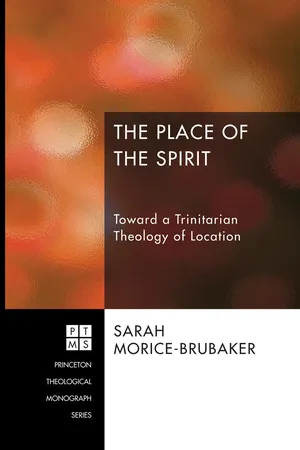
Is there any way to talk theologically about the Trinity and place? What might the "placedness" of creation have to do with God's triunity? In The Place of the Spirit, Sarah Morice-Brubaker considers how anxieties about place have influenced Trinitarian theology--both what it is asked to do and the language in which it is expressed.
When one is nervous about collapsing God into created horizons, she suggests, one is apt to come up with a model of trinity that refuses place. Distance becomes a primary way of situating the divine persons in relation to each other. Conversely, those theologians who wish to avoid a too-remote God likewise recruit Trinitarian language to suit that purpose. They, too, give that language a placial gloss, expressing triunity in terms of coinherence and mutual indwelling.
And yet, suggests Morice-Brubaker, the question, "What is place, and how can one talk about God and place?" is underdetermined within much contemporary Trinitarian thought. Thankfully, this question has received full-on attention in other areas of ethics, philosophy, and systematic theology. This book calls for Trinitarian thought to avail itself of those insights and offers some ways in which it may do so.
Information
Topic
Theology & ReligionSubtopic
Christian Church1
Placing the Question
Trinity and . . . Place?
Is there any theologically appropriate way to talk about trinity and place?
Is there any way to talk about the trinity’s location, while yet making all the qualifications, hedges, and provisions necessary to preserve a sense of God’s otherness? Or does one who so much as whispers “location” and “trinity” in the same theological thought thereby risk committing idolatry?
This question drives the present dissertation. From one angle, the currency of the question is a function of this inquiry’s particular North American academic, early twenty-first-century context. Place is a current theological (and philosophical, and sociological) topic, in the academy and in the dominant culture. Over two decades entirely new ways of being placed (e.g., in online environments) have been synthesized. In many fields—philosophy, sociology, geography, cultural studies—there is a growing consensus that “location” has to do with much more than just material, geometric extension. More broadly, at least in the more privileged cultural pockets of first-world economies, one finds as well a persistent nostalgia for location—understood to mean rootedness, a tie to the local, “a sense of place.” Under the auspices of place, one’s belonging, one’s identity in relation to one’s surroundings, is at issue; there to be negotiated, and in fact already in the process of being negotiated.
But to raise the question of trinity and place, in my experience, typically evokes a different reaction. Whether one’s interlocutors are theologians or theologically invested non-specialists, the issue of immediate concern seems to be of God’s limit, scale, and ultimacy. Is it not a creaturely reality, to be placed? Doesn’t placed-ness coincide exactly with delimitation and contingency? This happens both in spite of, and because of, the habitual comfort with which most of us likely talk about God’s “bigness,” God’s “height,” God’s maximal extension and infinite capacity, the vastness of God’s scale, and other metaphors suggesting a kind of placing or spacing. The metaphor of expansiveness, when applied to divinity, usually carries with it an implied intensifier, a comparison: God is vaster than anything else and cannot be contained by anything. Thus, where bigness and expansiveness seem to add to divinity, the category of place seems—often, practically uncritically—to contract it. There is a felt danger in trying to place God, a fear that a placed deity is necessarily conditioned, and thus smaller than what is needed. Too, it seems to imply that there are areas where God’s power does not extend—an exterior to God into which God cannot reach or intervene, but which press in on God from all sides. Such a deity is a thing or an artifact, even, at best a candidate for a polytheistic pantheon. It manifestly lacks the ineffability and mystery of threeness-in-oneness.
This worry is both understandable and, in the history of Christian theological reflection, well attested. But it will not do, I think, to let the explicit treatment of place drop out of trinitarian reflection, for several reasons. First, inasmuch as trinitarian theology supposes some kind of threeness attending God’s very identity, notions of place will inevitably have a way of sneaking in. Triunity invites one to consider plurality and singularity, the distinction between the two, and how far that distinction extends. How could triunity fail to stir inquiries into, for example, how the three persons are arranged in relation to one another? Or whether they are all together somewhere, and whether God’s one-ness consists in being located thus? Although they might seem unsophisticated once they are made explicit, such questions really cannot help but be raised, any more than one can avoid raising questions that sound temporal and tensed (in discussion of the order of processions, for example). Even if one gives an answer that disavows or explicitly refuses place—saying that the relationships between Father, Son, and Spirit are prior to place and exceed placial categories, that the three are not delimited quantities in the normal sense of limit, and that place in fact derives from them rather than the other way around—one has already made a theological claim about place and trinity. I believe it is best to do so systematically and explicitly.
Which leads to the second reason that I believe this is a worthwhile inquiry. Two living thinkers—Jürgen Moltmann and Jean-Luc Marion—use place and triunity in structurally similar ways but to divergent ends. This is a startling pairing, to say the least. Moltmann and Marion, after all, do not form an obvious pairing as representatives of a shared theological vision. Early in his career Moltmann garnered criticism for his indebtedness to Hegel; Marion could hardly be more allergic to Hegel. Readers likely know Moltmann as a theologian of history—and in recent years, motivated by ecological concern, of space. Marion, by contrast, is a cartographer of Being, and of ontotheology. He traces its boundaries and speculates about its exterior. Moltmann is Protestant; Marion is Catholic. Trinitarian thought suffuses Moltmann’s work over four decades, in both his early trilogy (Theology of Hope, The Crucified God, and The Church in the Power of the Spirit) and his later six-volume “Systematic Contributions” series. By contrast, Marion discusses Father, Son, and Spirit in the three volumes under consideration here (God Without Being, Prolegomena to Charity, and Idol and Distance), but this by no means exhausts his body of philosophical work on, for example, Descartes. It is possible to engage Marion’s thought without proceeding through the entryway of trinitarian discourse. It is not possible to do so with Moltmann’s.
Whence the similarity? In the broadest terms, each writer approaches certain set domains—history, space, Being—with a goal of getting a remote God back into them, or freeing God from them. Not, of course, that they believe God to be either remote or trapped, but they are concerned that incautious theology may suggest as much. Both Moltmann and Marion criticize predominant understandings of God based on problematic implications for God’s relationship to a certain horizon. And for both Moltmann and Marion, place (or space) serves as a figure for horizons generally. Place—to the extent that it is made explicit at all—signals a domain already loaded with its own operations, possibilities, latencies, and conditions of presence. The proper application of trinitarian thought, therefore, will show how God relates to domains. This assumption is at work for Moltmann, and, in very different ways, for Marion.
But is this an appropriate way to envision place? Moreover, is it an appropriate end toward which to direct trinitarian thought? The present dissertation makes a case for conceiving the problem differently. Rather than mapping a triune God in relation to a set domain—even if we plan to show that God conditions the domain rather than vice versa—I propose that we ought to first inquire into how domains are designated as such. Put differently, what is location? What are we doing when we attempt to keep God “here,” with us—or, alternately, to put God “out there” in some non-placed realm which signals God’s utter difference? Indeed, even bracketing God, what are “here” and “there” even in an everyday sense? What is their history? What assumptions do they encode?
One need not look very far in order to turn up a starting point for placial inquiry other than the preconstituted discrete domain. Indeed, lately, one need not look very far to find alternatives to the alternatives, nor alternatives to those. As geographer Edward Relph comments, to survey all that has been written on place in the last twenty years is “like walking into the aftermath of an academic explosion. What had once been a reasonably coherent body of thought, grounded in phenomenology and mostly the concern of humanistic geographers . . . seems to have flown off in all directions.” Definitions of place now range from sites of nostalgia, to nodes in social networks, to loci of desire.1 Igniting this explosion is the sense that a dominant older model of place has expired. Among those who study the placed-ness of environments, it is increasingly implausible to suggest that place has to do mainly with simple extension and delimitation of the physical or geometric sort—where the vaster, more capacious quantity bounds and surrounds the things interior to, and less vast than, itself. One reason for the explosion is simply the shared sense that place must attach to more than simple extension. C...
Table of contents
- Title Page
- Foreword
- Acknowledgments
- Chapter 1: Placing the Question
- Chapter 2: Patristic Precedents
- Chapter 3: Moltmann’s Perichoretic Spaces for God and Creation
- Chapter 4: No Place for the Spirit? Jean-Luc Marion’s Placial Refusal
- Chapter 5: Notes Toward a Trinitarian Theology of Place
- Bibliography
Trusted by 375,005 students
Access to over 1.5 million titles for a fair monthly price.
Study more efficiently using our study tools.
Frequently asked questions
Yes, you can cancel anytime from the Subscription tab in your account settings on the Perlego website. Your subscription will stay active until the end of your current billing period. Learn how to cancel your subscription
No, books cannot be downloaded as external files, such as PDFs, for use outside of Perlego. However, you can download books within the Perlego app for offline reading on mobile or tablet. Learn how to download books offline
Perlego offers two plans: Essential and Complete
- Essential is ideal for learners and professionals who enjoy exploring a wide range of subjects. Access the Essential Library with 800,000+ trusted titles and best-sellers across business, personal growth, and the humanities. Includes unlimited reading time and Standard Read Aloud voice.
- Complete: Perfect for advanced learners and researchers needing full, unrestricted access. Unlock 1.5M+ books across hundreds of subjects, including academic and specialized titles. The Complete Plan also includes advanced features like Premium Read Aloud and Research Assistant.
We are an online textbook subscription service, where you can get access to an entire online library for less than the price of a single book per month. With over 1.5 million books across 990+ topics, we’ve got you covered! Learn about our mission
Look out for the read-aloud symbol on your next book to see if you can listen to it. The read-aloud tool reads text aloud for you, highlighting the text as it is being read. You can pause it, speed it up and slow it down. Learn more about Read Aloud
Yes! You can use the Perlego app on both iOS and Android devices to read anytime, anywhere — even offline. Perfect for commutes or when you’re on the go.
Please note we cannot support devices running on iOS 13 and Android 7 or earlier. Learn more about using the app
Please note we cannot support devices running on iOS 13 and Android 7 or earlier. Learn more about using the app
Yes, you can access The Place of the Spirit by Sarah Morice-Brubaker in PDF and/or ePUB format, as well as other popular books in Theology & Religion & Christian Church. We have over 1.5 million books available in our catalogue for you to explore.