- 132 pages
- English
- ePUB (mobile friendly)
- Available on iOS & Android
eBook - ePub
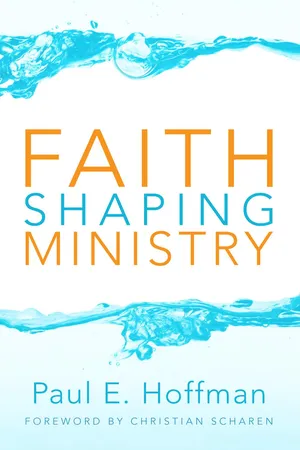
Faith Shaping Ministry
About this book
What happens after a congregation welcomes new Christians into its ministry? Building on the work of the first volume in this series, Faith Forming Faith, Paul Hoffman interprets how a congregation that intentionally practices baptism and its renewal is itself re-formed. Pastors, teachers, lay leaders, students of ministry, and people in the pew: all will find the compelling story of the ministry of Phinney Ridge Lutheran Church in Seattle, Washington--one of our nation's most secular cities--to be an inspiring and practical primer for renewal. Who would have thought? Bringing others to the waters of baptism transforms those already at home in the congregation. In fact, this intentional spiritual practice completely transforms the parish and the lives of God's people. There are new discoveries to be made in the ancient treasures of the Church as these gifts are shared with those hungering and thirsting for a place at God's table.
Information
Topic
Theology & ReligionSubtopic
Christian Ministry1
And a Little Child Shall Lead Them
Just a few weeks ago, Brigid’s mom and stepdad came to me after the second service and asked if we could say a prayer together. Brigid was flying from Seattle all the way to Chicago to spend two months of summer vacation with her father. It was the first time that she and her mom had been apart for so long, and even though her stepdad asked me to say a prayer for Brigid, I was pretty sure that the prayer was for them as well.
Brigid was being her usual kindergarten self, bouncing around the narthex of the church from adult to adult and from kid to kid. This was her new family of faith, those to whom she had endeared herself in the past nine months since moving with her mom and stepdad to Seattle.
Following the parents’ request, I got on my knees, called her over, and told her: “Mom and Michael think it would be a good idea for us to say a prayer together before you fly to Chicago tomorrow for the summer. What do you think about that?”
And then the most amazing thing happened: Brigid took me by the hand, motioned to her mom and stepdad to follow, and led the three of us into the sanctuary to the baptismal font.
She dipped her hand into the water, made the sign of the cross and then looked up at the three of us as if to say, “Okay. Let’s get this prayer underway.”
Brigid knew to go to the font because of what she had heard. In Romans 10, St. Paul reminds us that faith comes from what is heard, and what is heard comes through the word of Christ. What Brigid heard had come to her in a lifetime of caring faith formation from her parents, fulfilling the promises made for her in holy baptism. What Brigid heard came to her in the Bible stories that were read and told to her. What Brigid heard had been reinforced through the last several months’ worth of faith formation that she had received in children’s choir.
I’ve just come from the fountain,
I’ve just come from the fountain, Lord,
I’ve just come from the fountain,
his name’s so sweet.1
What she had heard had been dramatically revealed to her a few months earlier in the powerful liturgy of the Easter Vigil. The transformative, saving action of moving from death to new life in Christ that stands at the heart of the Christian gospel had been spoken and demonstrated to her in a weekly confessional rite. There she saw water poured into the font, then ritually sprinkled as the words of forgiveness were announced in the name of Jesus.
While all of us in parish ministry may not yet fully know or appreciate it, we have congregations full of Brigids: women, children, and men who have heard the faith proclaimed and who have the potential to live in such a way that all roads lead to the living, transforming Christ in the baptismal waters. We have congregations filled with Brigids: men and women, children and youth who are eager to live out a faith that is born in baptism’s waters. From those waters we draw the life of Christ, crucified and risen from the dead, to propel us into the world to serve. What our Brigids need is a style of leadership that takes this promise and conviction seriously and puts it into practice in ways that permeate all of parish life.
That pattern of dying and rising is the pattern of life given to us by Christ himself. It is a pattern given us by the very first Christians as witnessed by Paul’s strong and beautiful embrace of that pattern throughout Romans 6. It is a pattern that lived on in the church’s early history as witnessed by Cyril, bishop of Jerusalem, in the fourth century: The waters of baptism were at once your grave and your Mother.2 These interwoven images of death and new life are inextricably united. Here is the clear pattern for Christian life that is truly transformative: dying to the old life of sin and rising out of the waters into a new life as disciples of Jesus formed for service in the world.
It is all grounded in the font, and it is all in the font because the Word is grounded in the font. And the Word is grounded in the font because Christ is in the font.
Do you not know that all of us who have been baptized into Christ Jesus were baptized into his death? Therefore we have been buried with him by baptism into death, so that, just as Christ was raised from the dead by the glory of the Father, so we too might walk in newness of life. For if we have been united with him in a death like his, we shall certainly be united with him in a resurrection like his. (Rom 6:3–5)
In this bold new vision of living in the ancient Christians’ pattern of faith formation, we must see our life in church as fully immersed in the wonder of baptism. I propose that we rethink parish life in such a way that all we do is shaped by a reappropriation of our most basic and formative paradigm—the death and resurrection of Jesus, to which each of us is joined in our baptism. This is not to make baptism a new god. Neither is it to abandon any of the classic categories of theological conversation that we all love and cherish—law and gospel, sin and grace, repentance and forgiveness. It is instead to richly embrace them and to be absolutely certain, to the best of our abilities, that these classic categories are doing nothing less than serving the saving gospel, for the sake of the transformation of the world.
In her latest work, Christianity after Religion, Diana Butler Bass wisely and convincingly makes the case that we have entered a post-Christian era in North American life. When someone or something has died, a rebirth is in order.3 So perhaps the key to our new life in the present and exciting era of Christian faith is to become like a little child. To become like Brigid: taking one another’s hands, skipping to the source of life, undeterred and unafraid of the death that lurks at the edges of the font—our grave and our mother—because, after all, what is left to fear in death? Perhaps we could be like Brigids in our shared and important walk into a new way of doing ministry. Taking one another’s hands, could we be unabashedly unafraid, for the sake of the gospel, to dip into the saving waters and let those waters drip, trickle, run, and perhaps even gush over us and into a needy world?
On the pages that follow, the story of one congregation’s ministry in a very secular city is chronicled. Our story is offered so that you, too, might find renewal and new life in the very core activities of parish life: confirmation, pre-marital preparation, worship planning, preaching, administration, Sunday school, and so many more. In each of these areas of ministry it is hoped that you can imagine your parish skipping to the waters of the font, finding there a renewal of faith and life, and then joyously going into the world to serve with renewed energy, conviction, and hope.
1. “I’ve Just Come from the Fountain,” arr. by James Capers, in With One Voice, #696.
2. Cat. 20.4. Cited by Kreider, Change of Conversion and the Origin of Christendom, 45.
3. Bass, Christianity after Religion, 28.
2
A Word about The WAY
Before unfolding the story of how offering new Christians the gift of holy baptism has changed our congregational life, it will be important to give a brief overview of the process itself. We call this year of intentional faith formation The WAY.
For two decades, visitors, friends, potential members, unbaptized Christians, and people seeking a deeper spiritual life have gathered together on Sunday evenings for a meal and Bible study. From October through Pentecost, all people who are “inquiring” about faith and life in our parish are directed toward this process. For some it is their very first encounter with Christians and Christianity. For others, perhaps active Lutherans all their lives, it is an opportunity for a “faith sabbatical.” Most people fall somewhere in the middle of these two descriptions—people for whom baptism took place long ago and far away. For reasons as varied as the people themselves, their baptismal life never went much beyond the day that the sacrament was administered.
Our parish’s commitment to the first group, the unbaptized, grew out of the realization that our parish was no longer growing or even self-sustaining. The thousands of members in 1960 who were worshiping weekly had diminished to less than three hundred in the early 1990s. We were no longer repopulating the parish in the usual Lutheran ways—through birth and through immigration from northern European nations. Combine that with ministering in the city of Seattle, where the vast majority of the population when asked will list “None” as their religious preference,4 and you have a rich mission field for forming faith and bringing people to the waters of baptism. In what has turned out to be a tremendous gift of the Holy Spirit’s leadership among us, we chose to do this in a thorough and intentional way following the pattern of the faithful that stretches all the way back to the fourth century. Grace, wisdom, and care prevailed in our decision-making, and the congregation and its leaders resisted the option of “baptism on demand.” Clearly, offering the sacrament with little or no prior formation in the current religious environment was neither pastoral nor effective in shaping the lives of new Christians.
As our new process of faith formation began in the early nineties, there simply weren’t people lining up at our door to be baptized. So in an effort to have a viable, sustainable group with which to work, even those who would ordinarily have simply “transferred in” were given the opportunity to participate in the yearlong process of The WAY, and strongly encouraged to do so. In the early days of our practice, the men and women who would ordinarily have spent an hour or two in Pastor’s Class were gifted with an entire year of Bible study, fellowship, and ritual welcome instead. Where they may have received a tour of the church and a box of offering envelopes, they received a renewing and life-giving year of welcome grounded in the Scriptures.
The great majority of people to whom we minister in The WAY are people who had been baptized as children, or perhaps as a result of a spiritual awakening in college or early adulthood, but had wandered away and lost interest in discipleship in Christ for one reason or another. Some were coming to us requesting baptism for their own children. Some came at a time of personal crisis—a death in the family, the loss of a job, a life-threatening illness. Some came looking for a place to have a wedding and received instead a year of formation in faith and a congregation in which to ground their marriage.
But the heart of the matter is that those who gathered and were invited to this substantial process of faith formation reflected the complexion of our neighborhood itself. They were men and women of a variety of backgrounds, with a variety of faith experiences, triumphs, challenges, and disappointments. They were bold or timid, well grounded in faith or hanging on by a thread, marrie...
Table of contents
- Title Page
- Foreword
- Acknowledgments
- Preface
- Chapter 1: And a Little Child Shall Lead Them
- Chapter 2: A Word about The WAY
- Chapter 3: The Faith Formation of Jane
- Chapter 4: A New Model for Sunday School
- Chapter 5: Confirmation Ministry
- Chapter 6: Pre-Marital Counseling
- Chapter 7: Hospitality and Welcome
- Chapter 8: Parish Meetings
- Chapter 9: The Text at the Center
- Chapter 10: Worship Preparation and Planning
- Chapter 11: Formational Preaching
- Chapter 12: God’s Work in the World
- Chapter 13: Stewardship
- Chapter 14: The Shape of Our Prayers
- Chapter 15: Faith Shaping Ministry
- Appendix 1
- Appendix 2
- Appendix 3
- Bibliography
Trusted by 375,005 students
Access to over 1.5 million titles for a fair monthly price.
Study more efficiently using our study tools.
Frequently asked questions
Yes, you can cancel anytime from the Subscription tab in your account settings on the Perlego website. Your subscription will stay active until the end of your current billing period. Learn how to cancel your subscription
No, books cannot be downloaded as external files, such as PDFs, for use outside of Perlego. However, you can download books within the Perlego app for offline reading on mobile or tablet. Learn how to download books offline
Perlego offers two plans: Essential and Complete
- Essential is ideal for learners and professionals who enjoy exploring a wide range of subjects. Access the Essential Library with 800,000+ trusted titles and best-sellers across business, personal growth, and the humanities. Includes unlimited reading time and Standard Read Aloud voice.
- Complete: Perfect for advanced learners and researchers needing full, unrestricted access. Unlock 1.5M+ books across hundreds of subjects, including academic and specialized titles. The Complete Plan also includes advanced features like Premium Read Aloud and Research Assistant.
We are an online textbook subscription service, where you can get access to an entire online library for less than the price of a single book per month. With over 1.5 million books across 990+ topics, we’ve got you covered! Learn about our mission
Look out for the read-aloud symbol on your next book to see if you can listen to it. The read-aloud tool reads text aloud for you, highlighting the text as it is being read. You can pause it, speed it up and slow it down. Learn more about Read Aloud
Yes! You can use the Perlego app on both iOS and Android devices to read anytime, anywhere — even offline. Perfect for commutes or when you’re on the go.
Please note we cannot support devices running on iOS 13 and Android 7 or earlier. Learn more about using the app
Please note we cannot support devices running on iOS 13 and Android 7 or earlier. Learn more about using the app
Yes, you can access Faith Shaping Ministry by Paul E. Hoffman in PDF and/or ePUB format, as well as other popular books in Theology & Religion & Christian Ministry. We have over 1.5 million books available in our catalogue for you to explore.